iGCSE Physics (0625) 2.1.1 States of matter-Exam Style Questions- New Syllabus
Question
▶️ Answer/Explanation
Detailed solution:
The first change occurs when the liquid is heated and turns into a gas; this process is called vaporisation (boiling or evaporation).
Upon cooling, the gas returns to a liquid state, a process defined as condensation.
Further cooling causes the liquid to turn into a solid, which is known as freezing or solidification.
The complete sequence described in the prompt follows the path: liquid→gas→liquid→solid.
Matching these physical transformations to the correct terminology results in the sequence: vaporisation → condensation → freezing.
This corresponds exactly to the order provided in Option C.
Question

▶️ Answer/Explanation
Detailed solution:
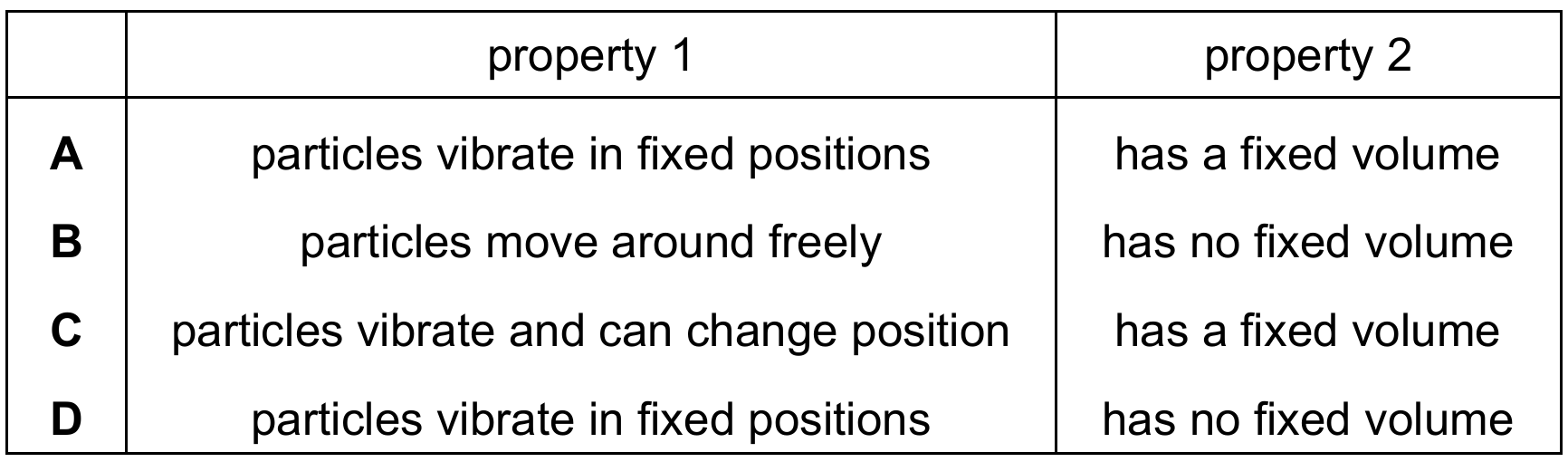
In a solid, particles are packed closely together in a regular lattice arrangement held by strong intermolecular forces.
Because of this rigid structure, the particles cannot move from place to place; they only vibrate in fixed positions.
This lack of particle mobility ensures that a solid maintains a fixed volume and a definite shape under constant conditions.
Option B describes a gas, while Option C describes a liquid where particles can slide past one another.
Option D is contradictory because a fixed particle arrangement prevents a substance from having “no fixed volume”.
Therefore, Row A accurately identifies both the microscopic and macroscopic properties of a solid.
Question
▶️ Answer/Explanation
Detailed solution:
Both liquids and gases are classified as fluids because their particles can move past one another, giving them the ability to flow.
When a liquid turns into a gas, the particles move much further apart, causing the volume to increase significantly.
Gases are highly compressible due to the large spaces between particles, whereas liquids are virtually incompressible.
While both take the shape of their container, a gas expands to fill the entire available space unlike a liquid.
Therefore, the only property that remains fundamentally the same for both states in this context is their ability to flow.
