
▶️ Answer/Explanation
Detailed solution:
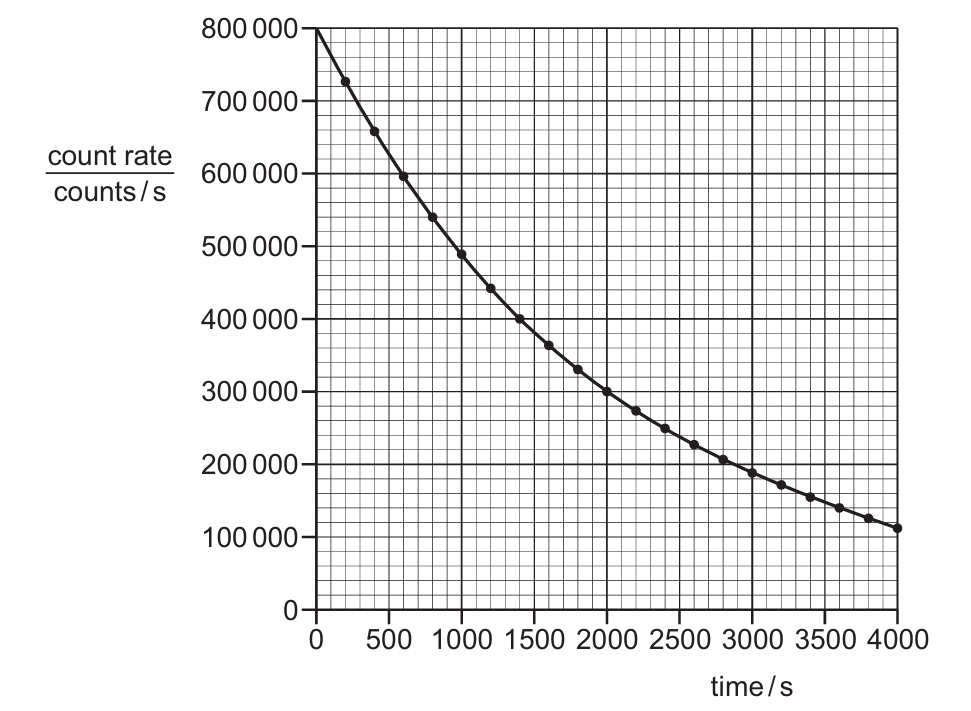
The half-life is the time taken for the activity (count rate) of a radioactive sample to decrease to half of its initial value. From the graph, the initial count rate at $t = 0$ s is $800~000$ counts/s. Half of this initial value is $\frac{800~000}{2} = 400~000$ counts/s. By locating $400~000$ counts/s on the y-axis and moving horizontally to the curve, we drop down to the x-axis to find the corresponding time. The intersection occurs at approximately $1400$ s. Therefore, the approximate half-life is $1400$ s.
▶️ Answer/Explanation
Detailed solution:
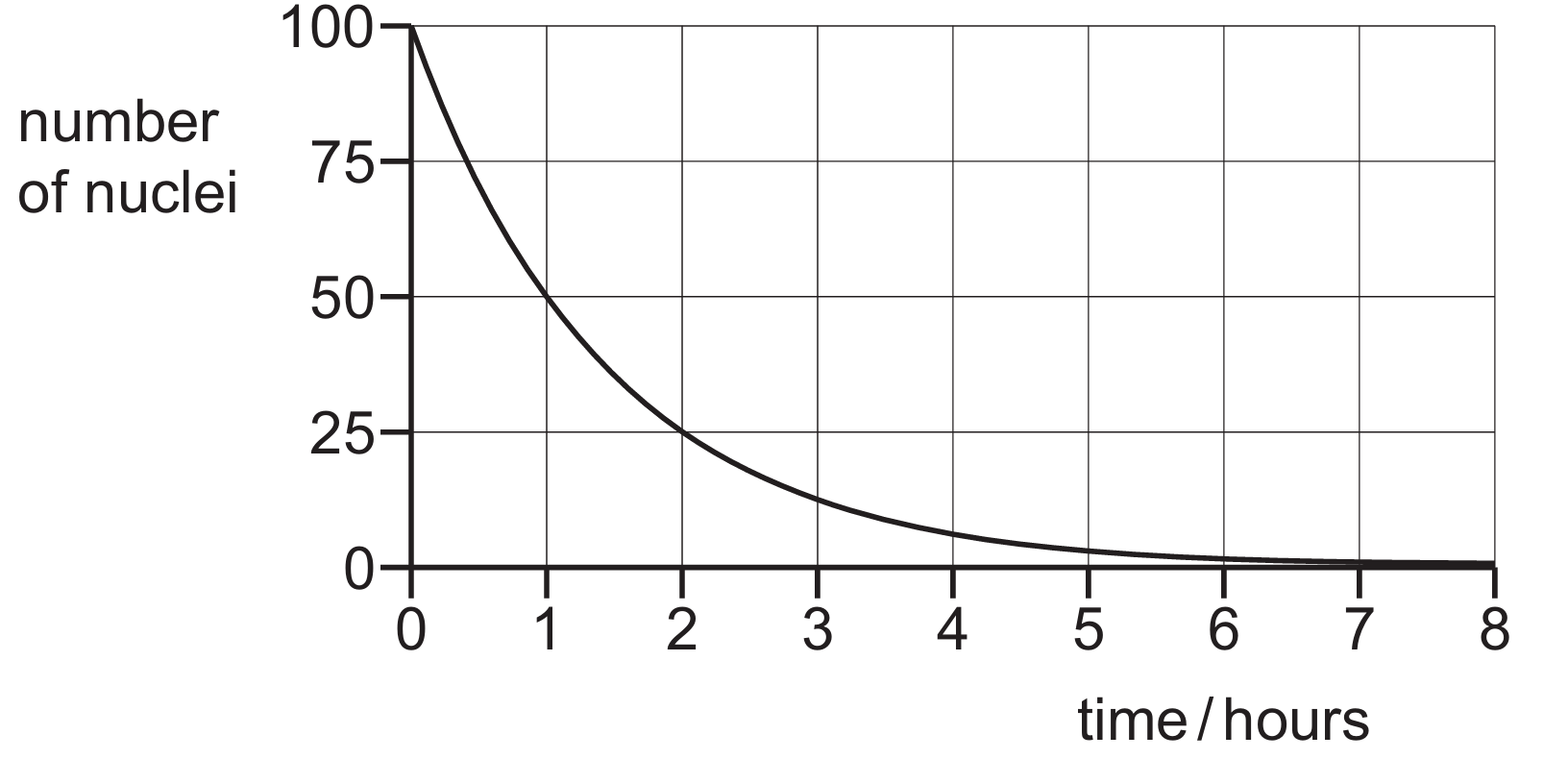
The half-life is defined as the time taken for half the nuclei in a sample to decay. Starting with $100$ nuclei at $t = 0$, half of the initial amount is $\frac{100}{2} = 50$ nuclei. By locating $50$ on the vertical axis (number of nuclei) and moving horizontally to the curve, we drop down to the horizontal axis to find the corresponding time. The graph shows that the sample reaches $50$ nuclei at $t = 1$ hour. Similarly, it takes another hour to halve again to $25$ nuclei at $t = 2$ hours, confirming the half-life is $1$ hour.