
iGCSE Physics (0625) 1.7.1 Energy -Exam Style Questions Paper 1- New Syllabus
Question
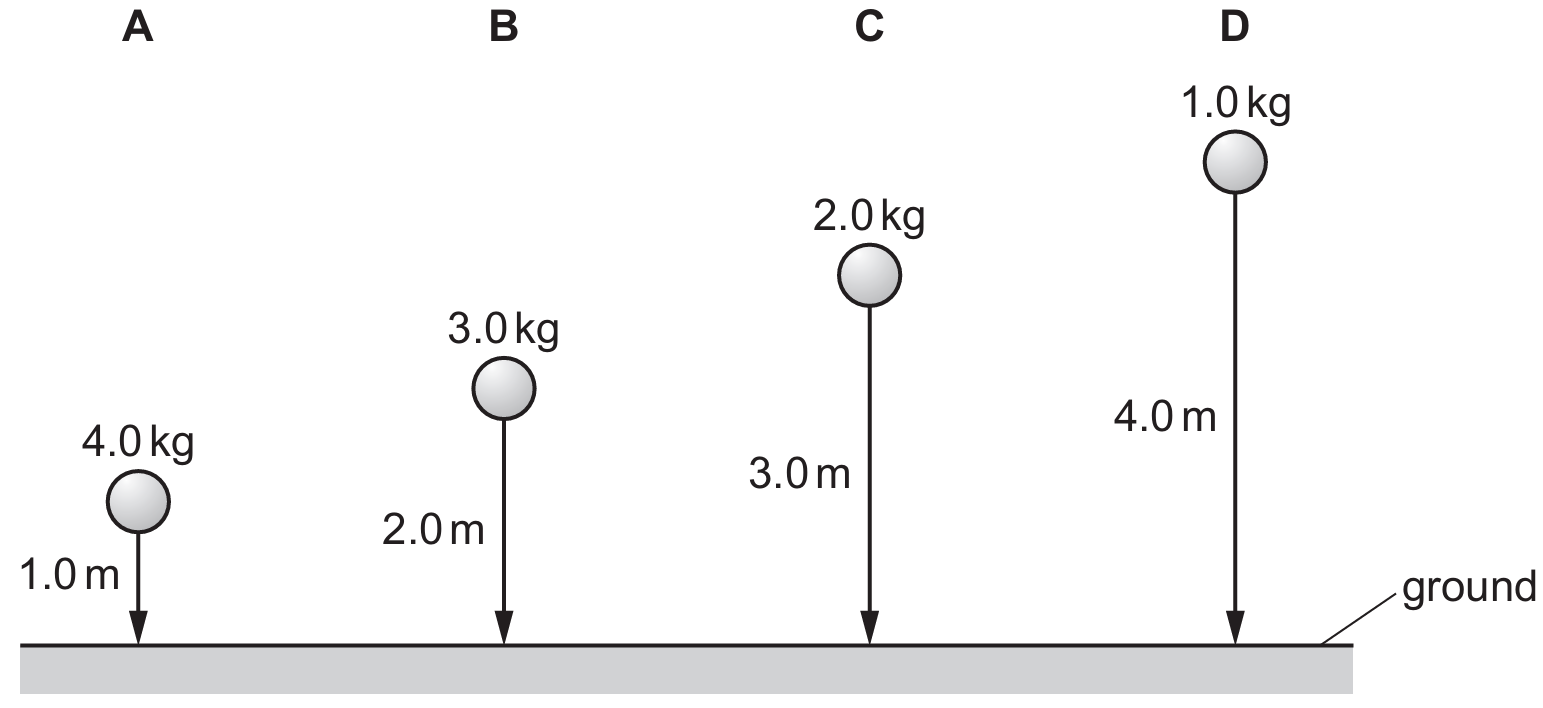
Four balls with different masses are dropped from the heights shown.
Air resistance can be ignored.
Which ball has the greatest average speed?
▶️ Answer/Explanation
Correct Answer: \( \boxed{\mathrm{D}} \)
When air resistance is ignored, all objects fall with the same acceleration due to gravity:
\( g \approx 9.8\,\mathrm{m\,s^{-2}} \)
The final speed of an object dropped from rest is:
\( v = \sqrt{2gh} \)
Therefore, the greater the height \(h\), the greater the final speed reached before hitting the ground.
For motion with constant acceleration from rest, the average speed is:
\( v_{\mathrm{avg}} = \frac{u+v}{2} = \frac{v}{2} \)
Since \(v\) increases with height, the average speed also increases with height.
Ball D is dropped from the greatest height, \(4.0\,\mathrm{m}\), so it has the greatest average speed.
The masses of the balls do not affect their speeds because all objects accelerate at the same rate in free fall.
Hence, the correct answer is (D).
Question
A stone has a gravitational energy store equal to \(46\,\mathrm{J}\).
When the stone falls in air, it does \(21\,\mathrm{J}\) of work against air resistance.
What is the gain in kinetic energy stored in the stone during this fall?
(B) \(25\,\mathrm{J}\)
(C) \(46\,\mathrm{J}\)
(D) \(67\,\mathrm{J}\)
▶️ Answer/Explanation
Correct Answer: \( \boxed{\mathrm{B}} \)
According to the principle of conservation of energy, the total energy of the system remains constant.
As the stone falls, its gravitational potential energy is converted into kinetic energy and thermal energy due to air resistance.
The energy relationship is:
\( \Delta E_{\mathrm{p}} = \Delta E_{\mathrm{k}} + W \)
where \( \Delta E_{\mathrm{p}} = 46\,\mathrm{J} \) and \( W = 21\,\mathrm{J} \) is the work done against air resistance.
Substituting the values:
\( 46 = \Delta E_{\mathrm{k}} + 21 \)
\( \Delta E_{\mathrm{k}} = 46 – 21 \)
\( \Delta E_{\mathrm{k}} = 25\,\mathrm{J} \)
Therefore, \(21\,\mathrm{J}\) of energy is dissipated to the surroundings, and the remaining \(25\,\mathrm{J}\) becomes kinetic energy.
Hence, the gain in kinetic energy is \(25\,\mathrm{J}\).
Therefore, the correct answer is (B).
Question
When an object falls freely due to gravity, energy that was stored as gravitational potential energy is transferred to the kinetic energy store.
How is the energy transferred in this process?
(B) by electromagnetic waves
(C) by heating
(D) by mechanical work
▶️ Answer/Explanation
Correct Answer: \( \boxed{\mathrm{D}} \)
As an object falls, the gravitational force acts on it and causes it to move through a distance.
When a force causes an object to move, energy is transferred by mechanical work.
The work done by gravity is given by:
\( W = Fd \)
During the fall, the gravitational potential energy decreases:
\( \Delta E_{\mathrm{p}} = mg\Delta h \)
This energy is transferred to the kinetic energy store:
\( E_{\mathrm{k}} = \frac{1}{2}mv^{2} \)
No electrical work, heating, or electromagnetic radiation is responsible for this energy transfer in free fall.
Therefore, the energy is transferred by mechanical work done by gravity.
Hence, the correct answer is (D).