
iGCSE Physics (0625) 1.8 Pressure -Exam Style Questions Paper 1- New Syllabus
Question
A skier is standing still on a flat area of snow.
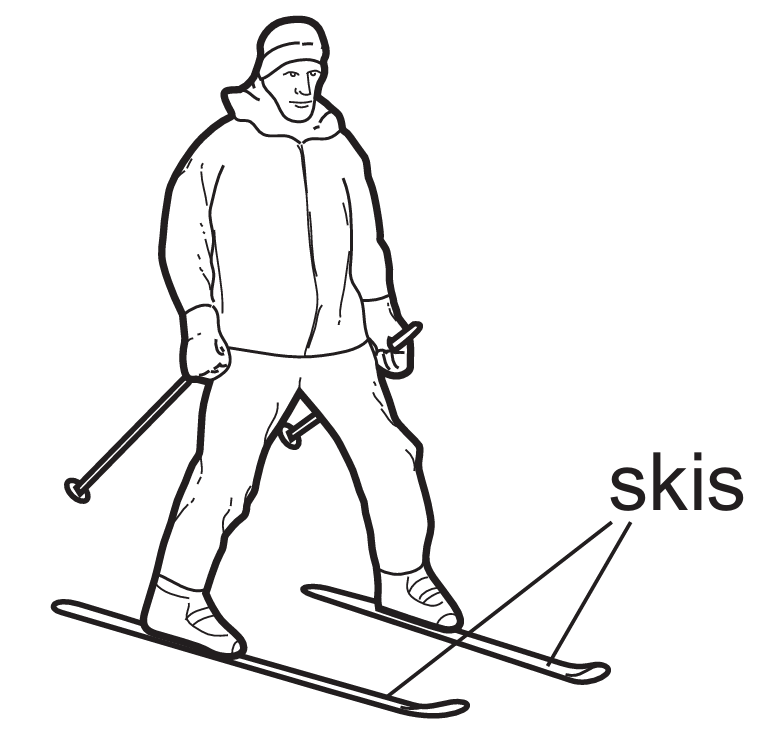
The total weight of the skier is \(550\,\mathrm{N}\). The total area of his skis in contact with the ground is \(0.015\,\mathrm{m^{2}}\).
What is the pressure exerted on the ground by the skier?
(B) \(8.3\,\mathrm{N/m^{2}}\)
(C) \(3700\,\mathrm{N/m^{2}}\)
(D) \(37000\,\mathrm{N/m^{2}}\)
▶️ Answer/Explanation
Correct Answer: \( \boxed{\mathrm{D}} \)
Pressure is defined as force per unit area:
\( p = \frac{F}{A} \)
where \(p\) is the pressure, \(F\) is the force applied, and \(A\) is the area over which the force acts.
For the skier:
\( F = 550\,\mathrm{N} \)
\( A = 0.015\,\mathrm{m^{2}} \)
Substituting into the formula:
\( p = \frac{550}{0.015} \)
\( p = 36666.7\,\mathrm{N/m^{2}} \)
To two significant figures:
\( p \approx 37000\,\mathrm{N/m^{2}} \)
This large area provided by the skis reduces the pressure on the snow, helping to prevent the skier from sinking.
Therefore, the pressure exerted on the ground is \(37000\,\mathrm{N/m^{2}}\).
Hence, the correct answer is (D).
Question
A steel knife needs a cutting edge with a small surface area.
What is the reason for this?
(B) A small surface area increases the density of the steel.
(C) A small surface area prevents the cutting edge from rusting.
(D) A small surface area prevents the knife from becoming magnetised.
▶️ Answer/Explanation
Correct Answer: \( \boxed{\mathrm{A}} \)
Pressure is defined as force acting per unit area:
\( p = \frac{F}{A} \)
where \(p\) is pressure, \(F\) is the applied force, and \(A\) is the area over which the force acts.
For a given force, pressure is inversely proportional to area. This means that reducing the surface area increases the pressure exerted.
A sharp knife has a very small contact area at its cutting edge, producing a large pressure even when only a moderate force is applied.
The increased pressure makes it easier for the knife to cut through materials.
The surface area of the edge does not affect the density of the steel, prevent rusting, or stop the knife from becoming magnetised.
Therefore, a knife is sharpened to a small surface area so that it produces a greater pressure.
Hence, the correct answer is (A).
Question
Which unit is a unit of pressure?
(B) \( \mathrm{kg/m^{3}} \)
(C) \( \mathrm{Nm} \)
(D) \( \mathrm{N/m^{2}} \)
▶️ Answer/Explanation
Correct Answer: \( \boxed{\mathrm{D}} \)
Pressure is defined as force acting per unit area:
\( p = \frac{F}{A} \)
where \(p\) is pressure, \(F\) is force, and \(A\) is area.
The SI unit of force is the newton \((\mathrm{N})\), and the SI unit of area is the square metre \((\mathrm{m^{2}})\).
Therefore, the SI unit of pressure is:
\( \mathrm{\frac{N}{m^{2}}} \)
This unit is also called the pascal:
\( 1\,\mathrm{Pa} = 1\,\mathrm{N/m^{2}} \)
Option \( \mathrm{kg/m^{3}} \) is the unit of density, while \( \mathrm{Nm} \) is the unit of moment (torque) or work done.
Therefore, the correct unit of pressure is \( \mathrm{N/m^{2}} \).
Hence, the correct answer is (D).