
▶️ Answer/Explanation
Detailed solution:
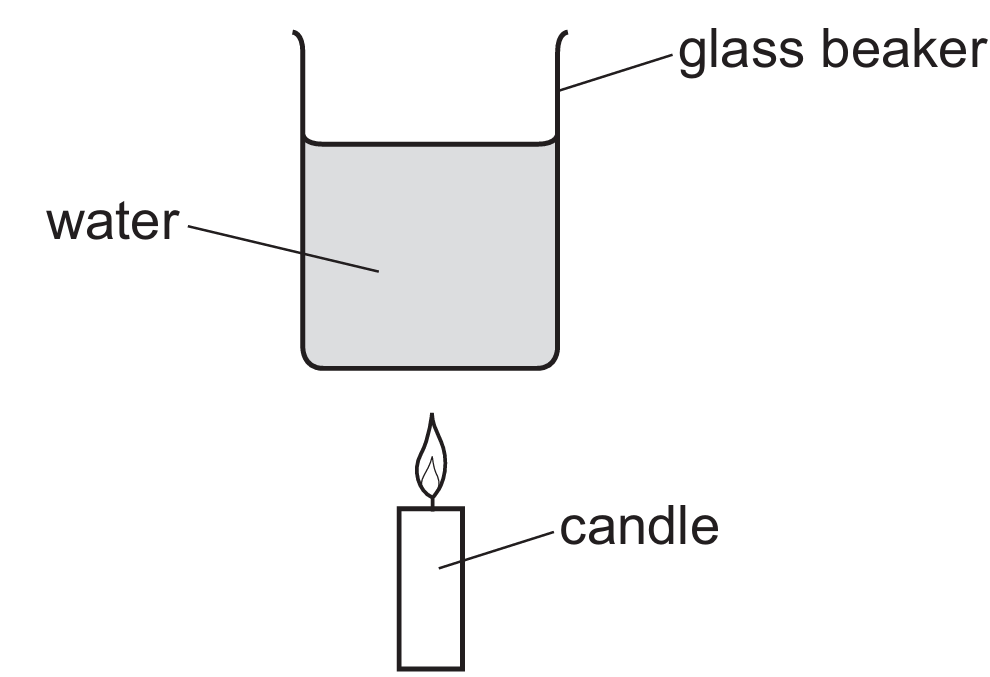
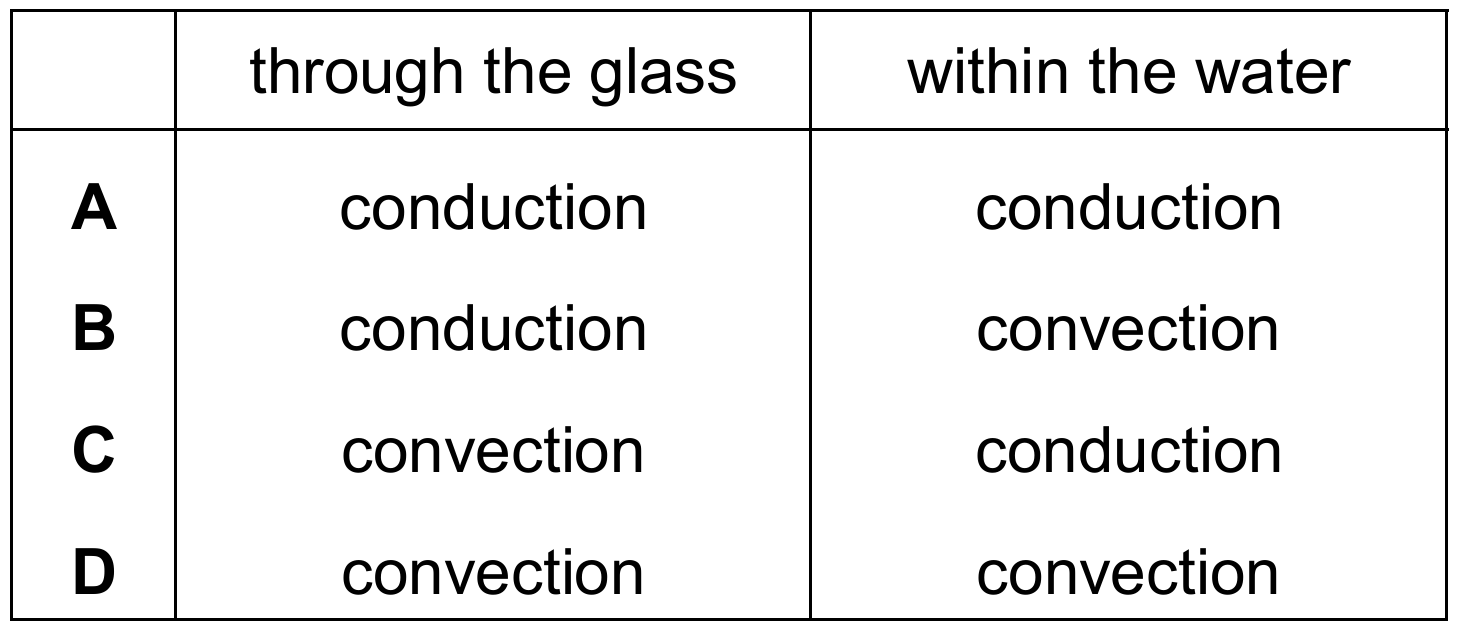
Heat transfer through the solid glass occurs via conduction, where thermal energy is passed through atomic vibrations. In the liquid water, the main method is convection; as water at the bottom heats up, its density decreases, causing it to rise and create a circulation current. While radiation exists, it is not the primary mechanism for these specific media. Consequently, the heat moves through the solid beaker by conduction and circulates within the fluid water by convection. This identifies Row B as the correct description of the primary thermal processes involved.
▶️ Answer/Explanation
Detailed solution:
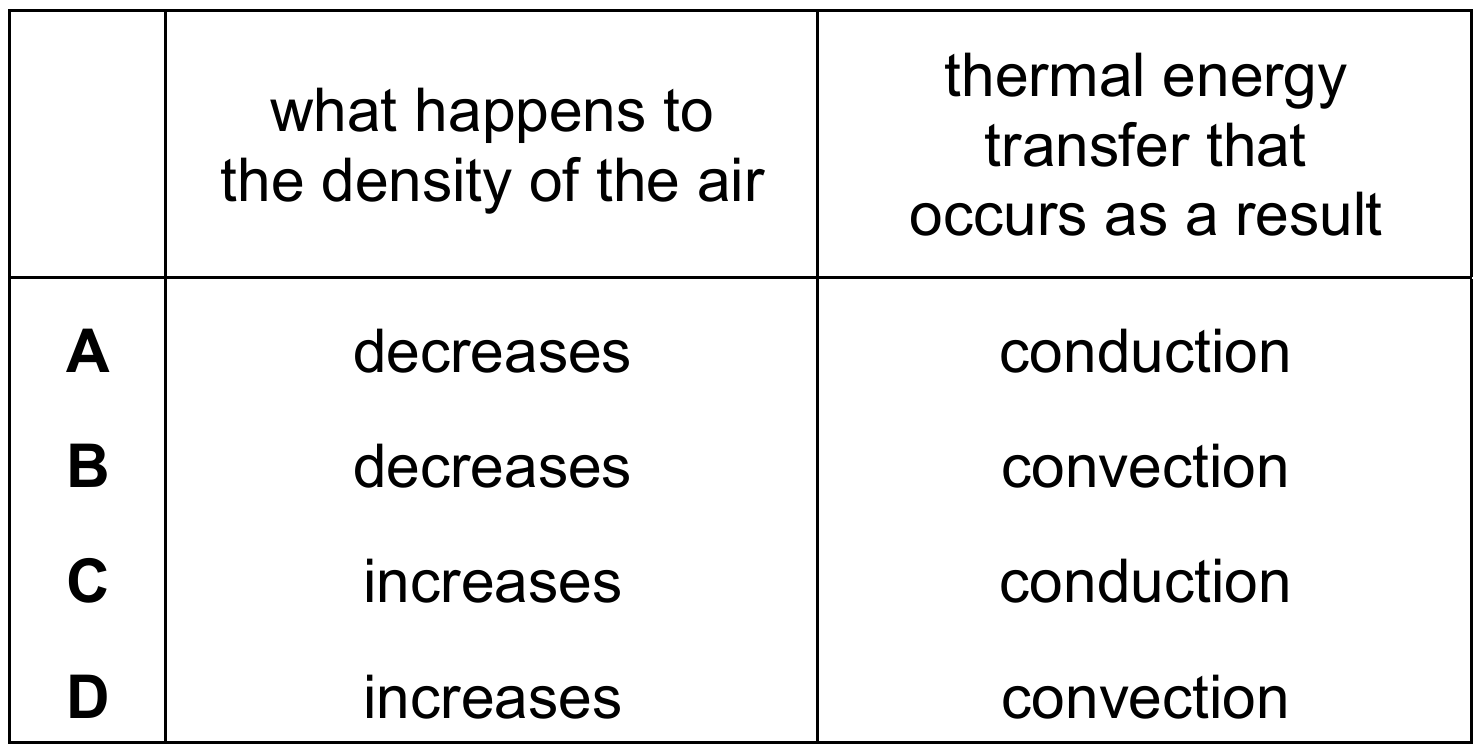
When air is heated, the particles gain kinetic energy and move further apart, causing the air to expand. Since the same mass now occupies a larger volume $V$, the density $\rho$ decreases according to $\rho = \frac{m}{V}$. This less dense, warmer air rises while cooler, denser air sinks to take its place. This bulk movement of fluid caused by density differences is the primary mechanism of thermal energy transfer in gases known as convection. Therefore, the density decreases and the resulting transfer is convection, as shown in Row B.