
iGCSE Physics (0625) 3.2.1 Reflection of light-Exam Style Questions Paper 1 - New Syllabus
Question
A ray of light is incident on a plane mirror. A student measures the angle of incidence \(i\) and the angle of reflection \(r\).
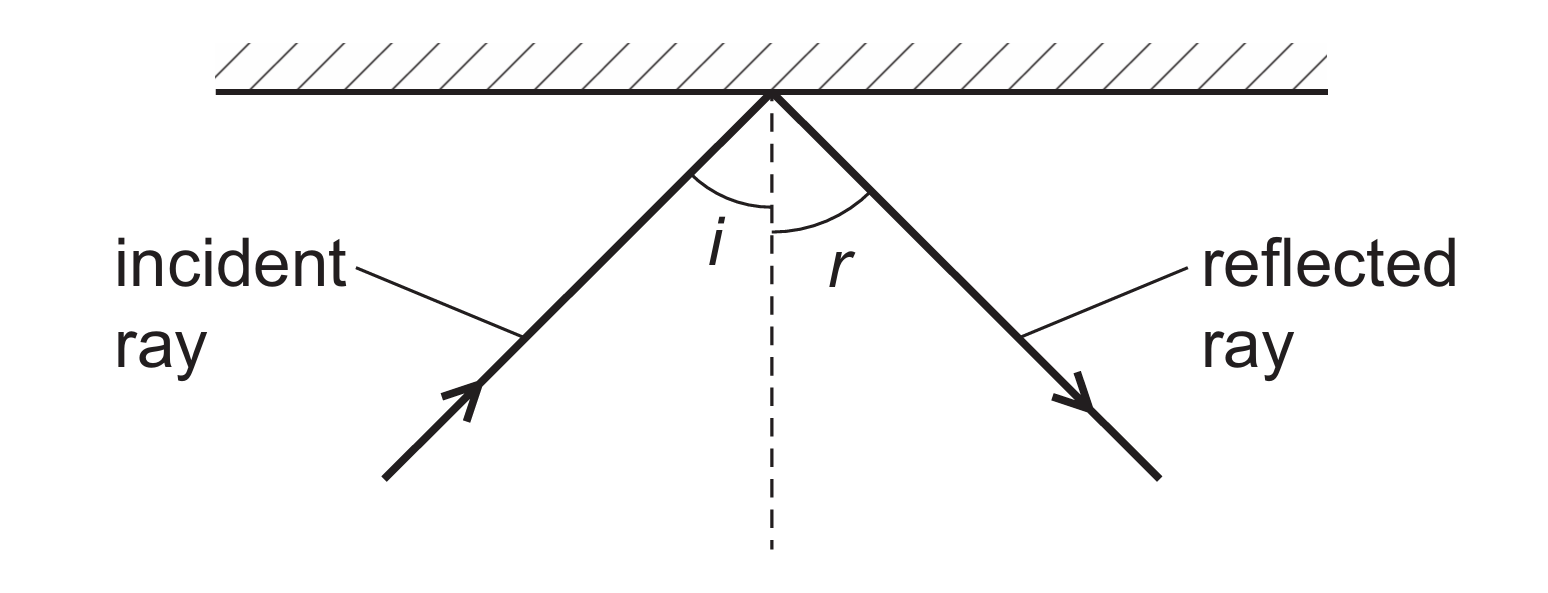
The student varies the angle of incidence and then plots a graph of \(r\) against \(i\).
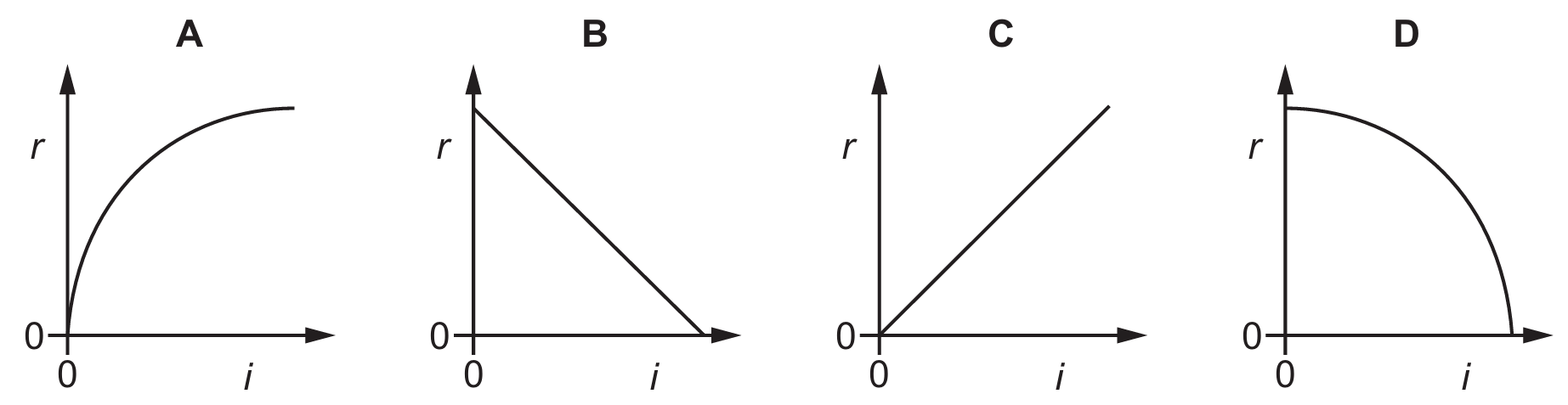
What does the graph look like?
▶️ Answer/Explanation
Correct Answer: \( \boxed{\mathrm{C}} \)
According to the law of reflection,
\(r=i\)
This means that for every value of the angle of incidence \(i\), the angle of reflection \(r\) has exactly the same value.
Therefore, \(r\) is directly proportional to \(i\).
A graph of \(r\) against \(i\) is a straight line passing through the origin with gradient \(1\).
For example:
If \(i=20^\circ\), then \(r=20^\circ\).
If \(i=50^\circ\), then \(r=50^\circ\).
Among the four graphs shown, only graph C represents this relationship.
Hence, the correct answer is (C).
Question
The diagram shows a ray of light incident on the surface of a glass block.
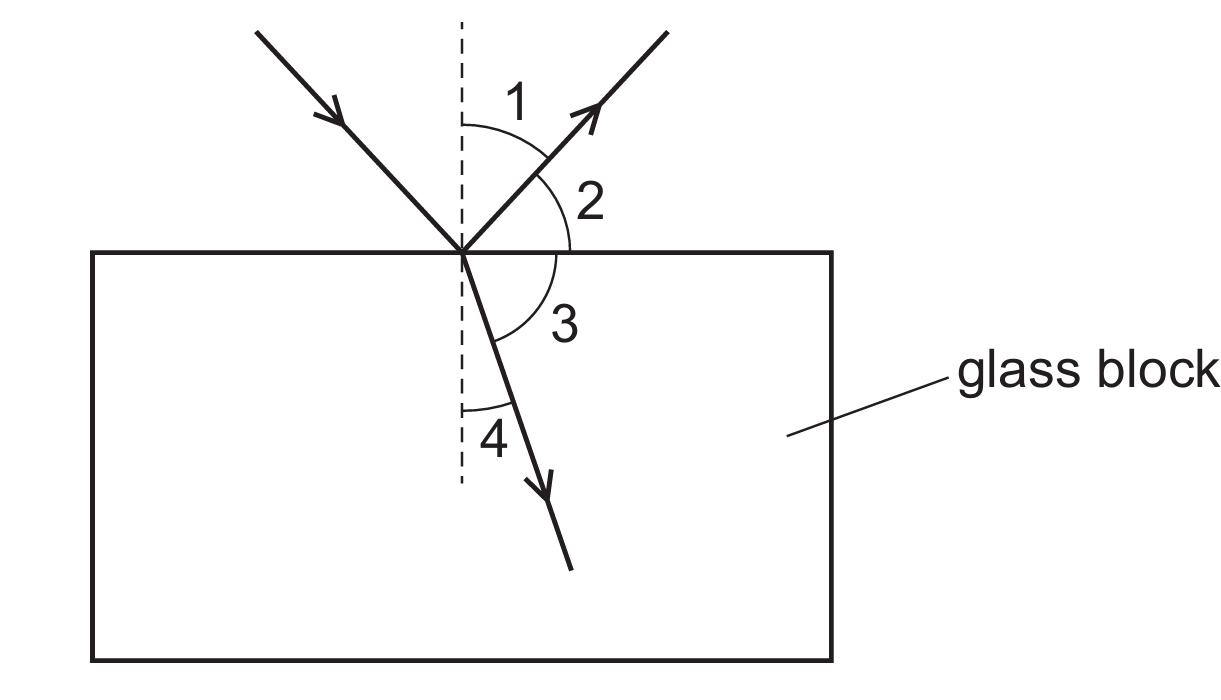
The ray of light is partially reflected back into the air and partially refracted into the glass block.
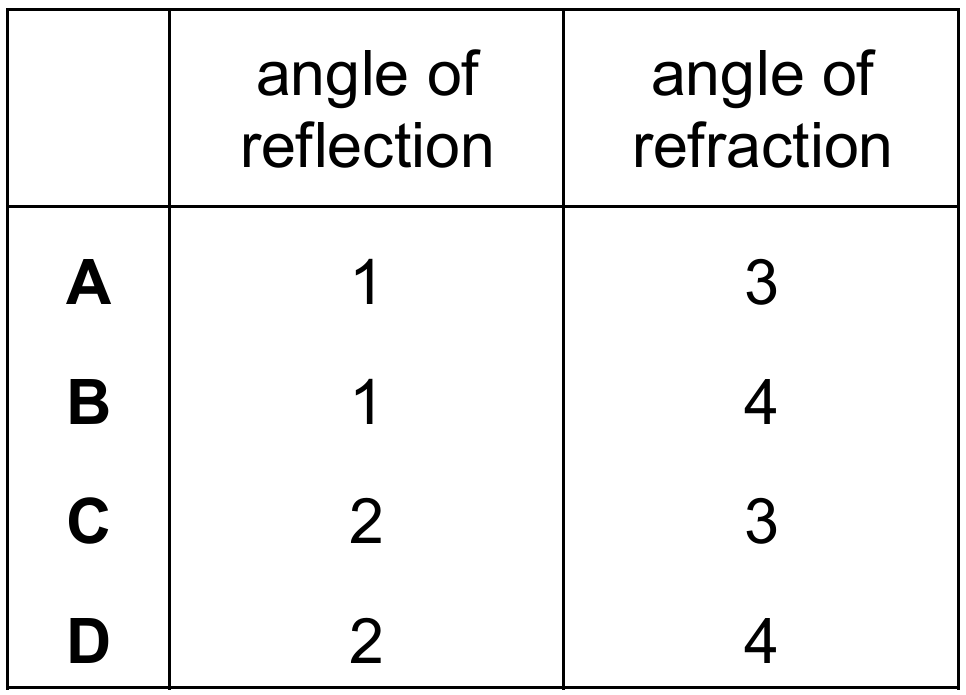
Which row correctly identifies the angle of reflection and the angle of refraction?
▶️ Answer/Explanation
Correct Answer: \( \boxed{\mathrm{B}} \)
In optics, angles are always measured between a ray and the normal to the surface.
The dashed vertical line represents the normal at the point where the light ray strikes the glass surface.
The angle of reflection is the angle between the reflected ray and the normal in the air. This is labelled as angle \(1\).
The angle of refraction is the angle between the refracted ray and the normal inside the glass block. This is labelled as angle \(4\).
Angles \(2\) and \(3\) are measured relative to the surface rather than the normal, so they are not the required angles.
Therefore:
Angle of reflection \(= 1\)
Angle of refraction \(= 4\)
Hence, the correct answer is (B).
Question
Topic: 7.4 Mirrors and Images
A person stands \(1.0\text{ m}\) in front of a plane mirror. The mirror is moved away from the person at a speed of \(1.0\text{ m/s}\). Which statement is correct?
(B) The image moves away from the person at a speed of \(2.0\text{ m/s}\).
(C) The image moves towards the person at a speed of \(1.0\text{ m/s}\).
(D) The image moves towards the person at a speed of \(2.0\text{ m/s}\).
▶️ Answer/Explanation
Correct Answer: \( \boxed{\mathrm{B}} \)
For a plane mirror, the image is always formed the same distance behind the mirror as the object is in front of it.
Initially, the person is \(1.0\text{ m}\) from the mirror, so the image is \(1.0\text{ m}\) behind the mirror.
Therefore, the image is initially \(2.0\text{ m}\) from the person.
After \(1.0\text{ s}\), the mirror has moved \(1.0\text{ m}\) farther away, making the person-mirror distance \(2.0\text{ m}\).
The image must then be \(2.0\text{ m}\) behind the mirror, so the image is now \(4.0\text{ m}\) from the person.
Thus, in \(1.0\text{ s}\), the image moves from \(2.0\text{ m}\) to \(4.0\text{ m}\) away from the person.
Speed of image relative to the person:
\(v=\dfrac{4.0-2.0}{1.0}=2.0\text{ m/s}\)
Therefore, the image moves away from the person at \(2.0\text{ m/s}\).
Hence, the correct answer is (B).