
iGCSE Physics (0625) 3.2.2 Refraction of light-Exam Style Questions Paper 1 - New Syllabus
Question
A ray of light passes from air into a rectangular transparent block.
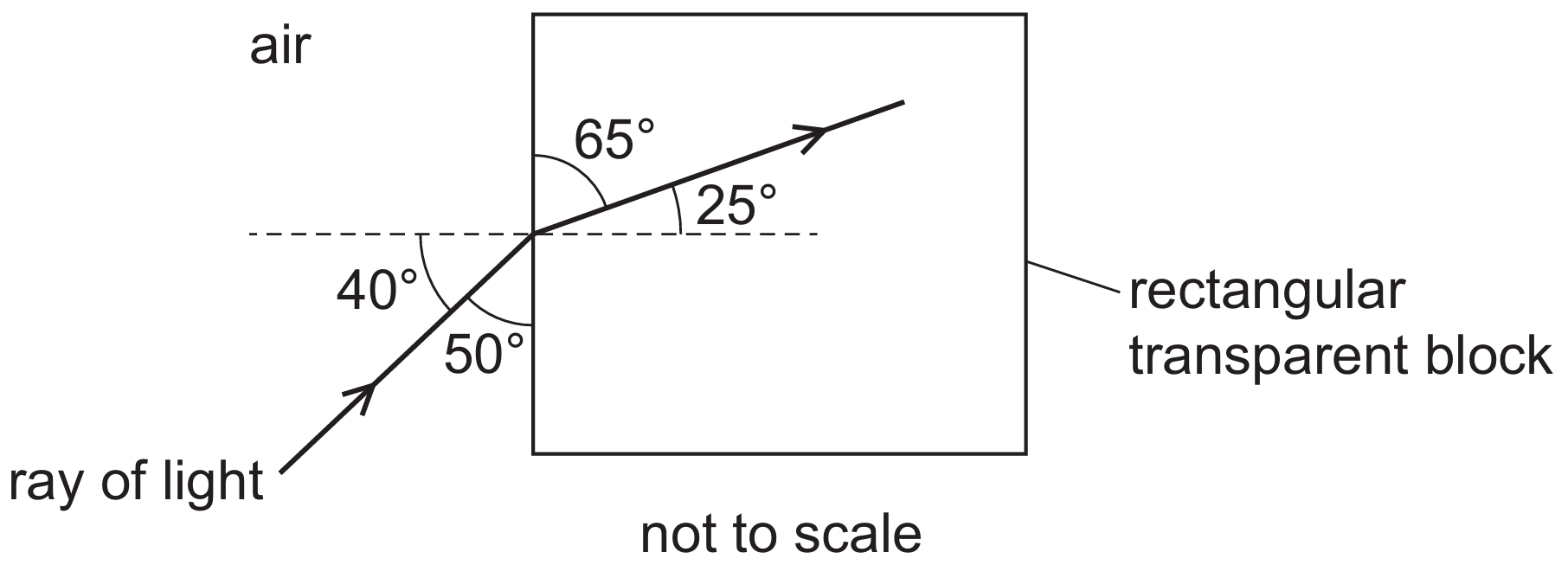
What is the angle of refraction?
(B) \(40^\circ\)
(C) \(50^\circ\)
(D) \(65^\circ\)
▶️ Answer/Explanation
Correct Answer: \( \boxed{\mathrm{A}} \)
The angle of refraction is defined as the angle between the refracted ray and the normal at the boundary.
In the diagram, the dashed horizontal line represents the normal to the vertical face of the transparent block.
The angle between the refracted ray and this normal is labelled \(25^\circ\).
The angle \(65^\circ\) is measured between the refracted ray and the surface of the block, not the normal.
Therefore,
\( r = 25^\circ \)
Hence, the correct answer is (A).
Question
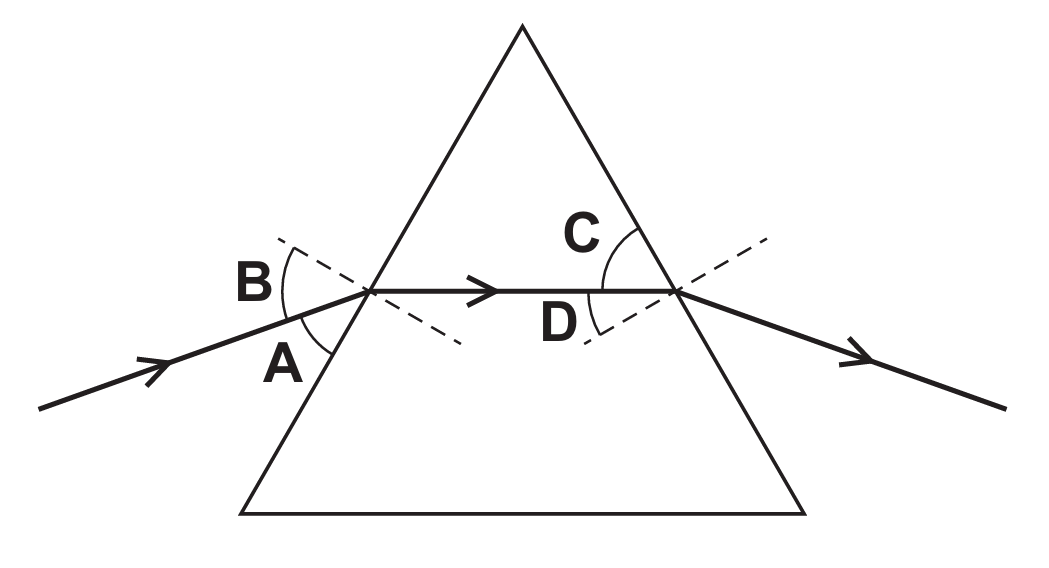
The diagram shows a ray of red light travelling through a transparent prism.
Normals to the prism surfaces are marked at the points where the ray meets the prism surfaces.
The direction of the incident ray is changed until total internal reflection just occurs at one of the surfaces.
Which angle must now be equal to the critical angle?
▶️ Answer/Explanation
Correct Answer: \( \boxed{\mathrm{D}} \)
Total internal reflection occurs only when light travels from a more optically dense medium to a less optically dense medium and the angle of incidence exceeds the critical angle.
The critical angle is defined as the angle of incidence in the denser medium for which the angle of refraction is exactly \(90^\circ\).
In the prism, light enters through the first surface and then reaches the second surface where it attempts to leave the glass and enter the air.
At the instant when total internal reflection just occurs, the angle of incidence at the glass–air boundary must be equal to the critical angle.
Angle \(D\) is the angle between the ray inside the prism and the normal at the second surface. Therefore, \(D\) represents the angle of incidence at the boundary where total internal reflection can occur.
Hence,
\(D = c\)
where \(c\) is the critical angle.
Angles \(A\) and \(B\) are associated with the first surface where light enters the prism from air, so total internal reflection cannot occur there.
Therefore, the angle that must be equal to the critical angle is \(D\).
Question
A ray of light passes from air into a block of glass. The critical angle is \(42^\circ\).
Which statement is correct?
(B) The angle of incidence is always bigger than \(42^\circ\).
(C) The angle of refraction cannot be less than \(42^\circ\).
(D) The angle of refraction is smaller than the angle of incidence.
▶️ Answer/Explanation
Correct Answer: \( \boxed{\mathrm{D}} \)
When light travels from a less optically dense medium (air) into a more optically dense medium (glass), it slows down and bends towards the normal.
Therefore, the angle of refraction \(r\) is smaller than the angle of incidence \(i\):
\(r < i\)
Option A is incorrect because the angle of incidence is measured between the incident ray and the normal, not the surface.
Option B is incorrect because the angle of incidence can take any value between \(0^\circ\) and \(90^\circ\).
Option C is incorrect because the critical angle of \(42^\circ\) applies to light travelling from glass to air. When light enters glass from air, the refracted angle can be much less than \(42^\circ\).
Using Snell’s law,
\(n_{1}\sin i = n_{2}\sin r\)
and since \(n_{\mathrm{glass}} > n_{\mathrm{air}}\), it follows that \(r < i\).
Therefore, the correct statement is that the angle of refraction is smaller than the angle of incidence.
Hence, the correct answer is (D).