
▶️ Answer/Explanation
Detailed solution:
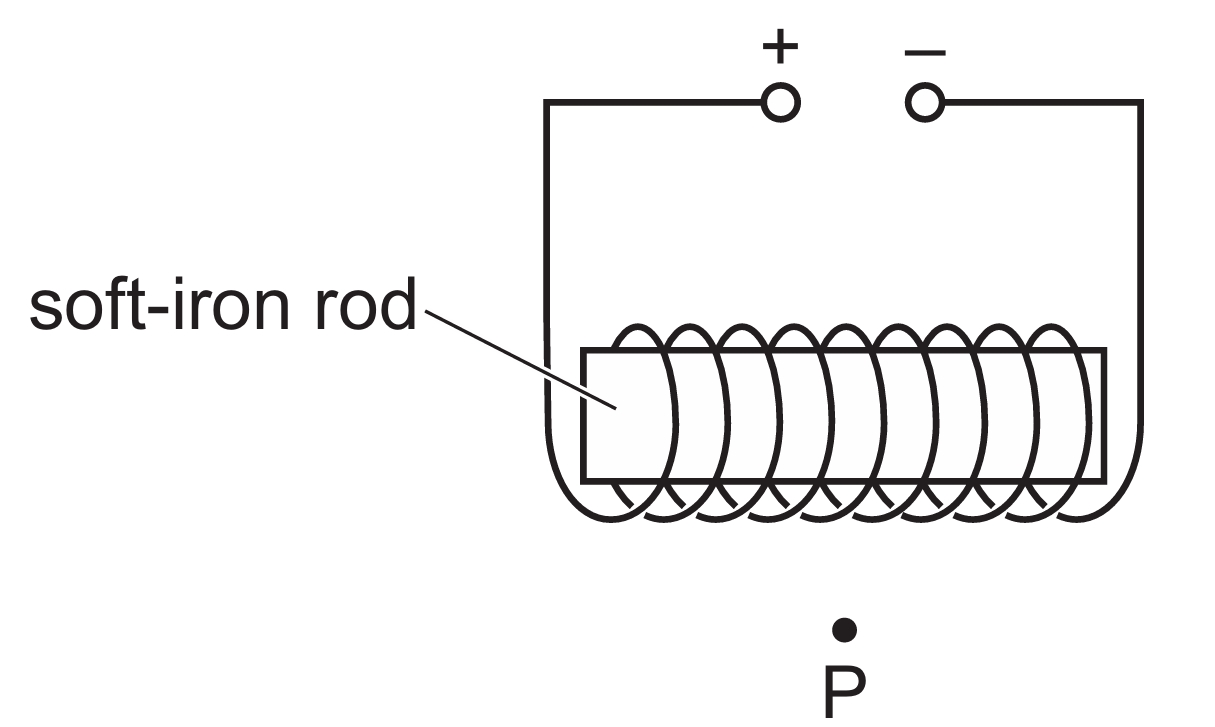
Using the right-hand grip rule, current flows from the positive $(+)$ to negative $(-)$ terminal, moving upward across the front of the soft-iron rod. Wrapping your fingers in the direction of the current, your thumb points left, identifying the left end as the North $(N)$ pole and the right end as the South $(S)$ pole. Magnetic field lines emerge from the $N$ pole and return to the $S$ pole outside the solenoid. At point $P$ (located below the solenoid), the field lines travel from left to right as they return to the $S$ pole. Since a compass $N$ pole points in the direction of the local magnetic field, it will point towards the right of the page.
▶️ Answer/Explanation
Detailed solution:
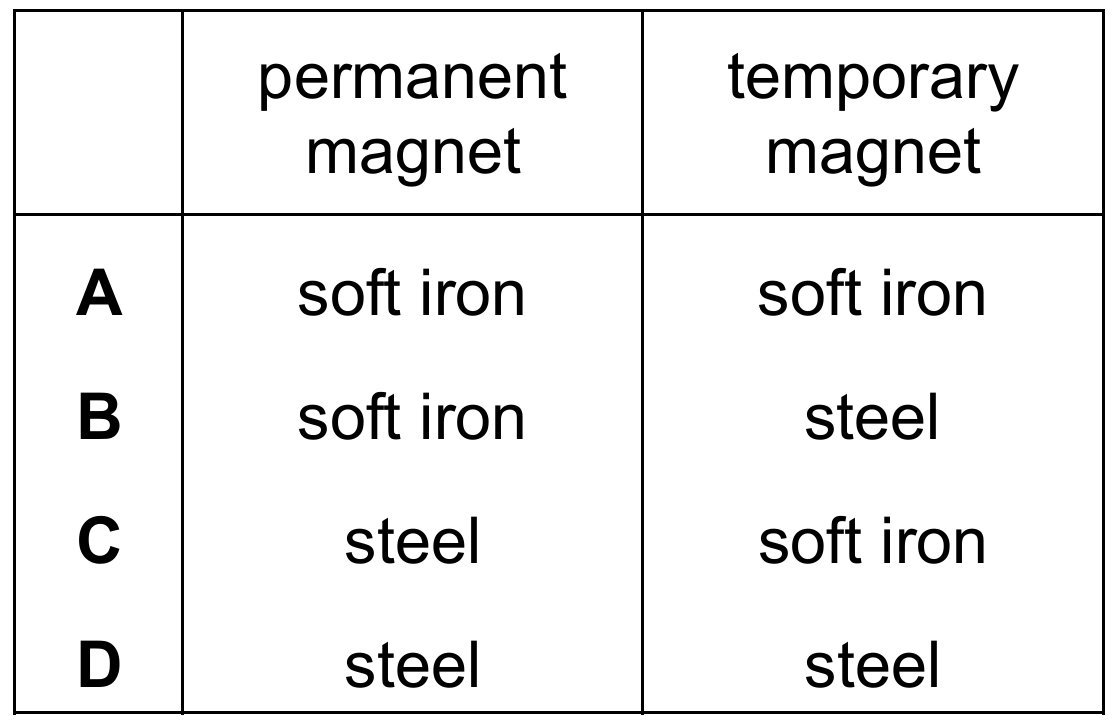
Magnetic materials are classified by how easily they can be magnetized and demagnetized. Steel is a “hard” magnetic material; it is difficult to magnetize but retains its magnetism well, making it ideal for permanent magnets. Soft iron is a “soft” magnetic material; it magnetizes easily but loses its magnetism almost immediately when the external magnetic field is removed. This property makes soft iron the standard choice for temporary magnets, such as the cores of electromagnets. Therefore, Row $C$ correctly identifies that permanent magnets are made of steel and temporary magnets are made of soft iron.