iGCSE Physics (0625) 4.3.2 Series and parallel circuits-Exam Style Questions- New Syllabus
Question

▶️ Answer/Explanation
Detailed solution:
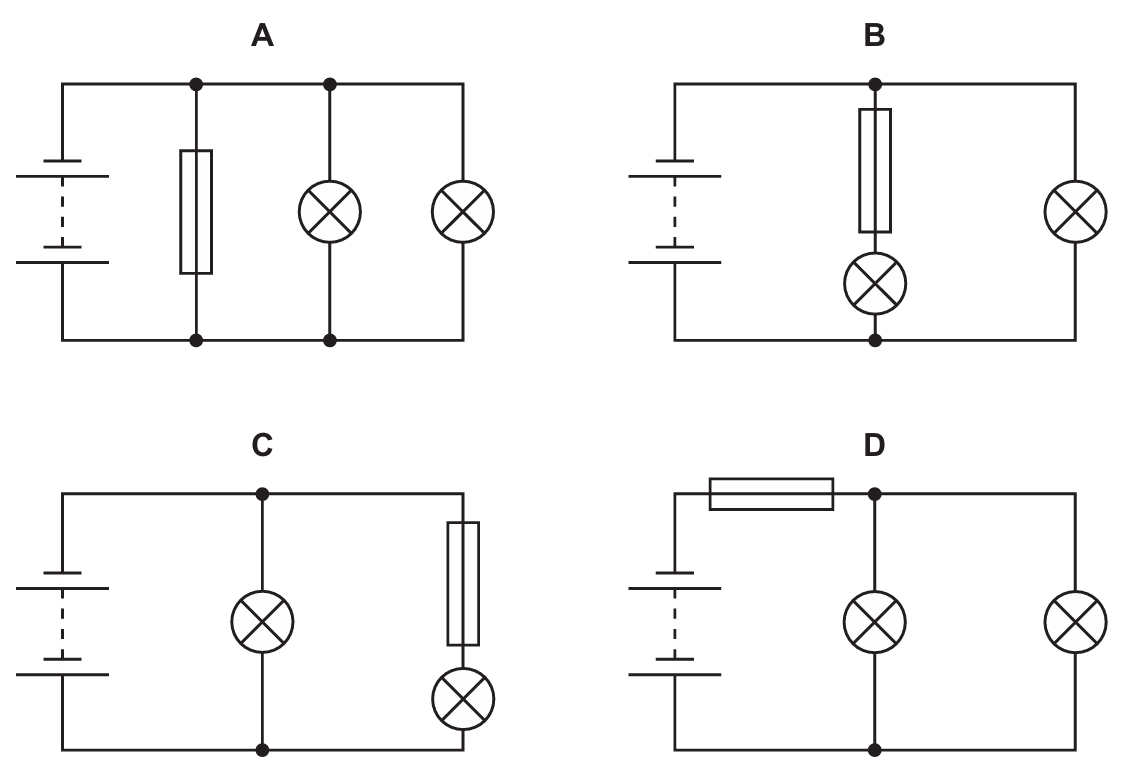
A fuse is a safety device designed to break the circuit by melting when the current exceeds a specific limit. For a fuse to cause all components in a circuit to turn off, it must be placed in the main branch where the total current $I_{total}$ flows. In circuits A, B, and C, the fuse is placed in parallel branches; if it blows, current can still flow through the other available paths to the remaining lamps. In circuit D, the fuse is connected in series with the battery before the parallel junction. If this fuse blows, it creates an open circuit, meaning $I = 0~A$ throughout the entire system, causing both lamps to go out immediately.
Question
▶️ Answer/Explanation
Detailed solution:
In a series circuit, the current I is the same at every point; therefore, both the 5.0 Ω and 10 Ω resistors have identical current flowing through them.
According to Ohm’s Law, the potential difference is calculated as V=IR.
Since I is constant for both resistors, the potential difference V is directly proportional to the resistance R.
For the first resistor, V 1 =I×5.0, and for the second, V 2 =I×10.
Because 10~\Omega > 5.0~\Omega, the potential difference V 2 must be greater than V 1 .
Thus, statement D is correct as the p.d. is greater across the higher resistance.
Question
▶️ Answer/Explanation
Detailed solution:
For two resistors connected in parallel, the combined resistance R total is calculated using the formula R total 1 = R 1 1 + R 2 1 .
Substituting the given values R 1 =3.0Ω and R 2 =6.0Ω, we get R total 1 = 3.0 1 + 6.0 1 .
Finding a common denominator, R total 1 = 6.0 2 + 6.0 1 = 6.0 3 .
Taking the reciprocal to find the total resistance, R total = 3 6.0 =2.0Ω.
Alternatively, using the product-over-sum rule: R total = R 1 +R 2 R 1 ×R 2 = 3.0+6.0 3.0×6.0 = 9 18 =2.0Ω.
This confirms that the combined resistance is always less than the smallest individual resistor in a parallel circuit.
