IIT JEE Main Maths -Unit 10- Pair of Straight Line- Study Notes-New Syllabus
IIT JEE Main Maths -Unit 10- Pair of Straight Line – New syllabus
IIT JEE Main Maths -Unit 10- Pair of Straight Line -IIT JEE Main Maths – per latest Syllabus.
Key Concepts:
- Family of Lines
Family of Lines
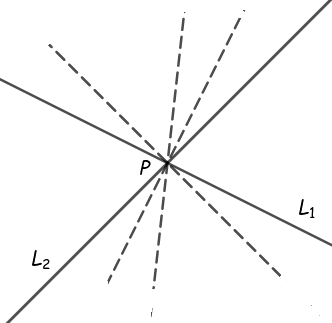
A family of lines is a group of infinitely many straight lines that satisfy a common condition. In coordinate geometry, families of lines help in finding equations of lines that pass through specific sets of points or satisfy geometric conditions.
![]()
Family of Lines Passing Through the Intersection of Two Lines
If two lines are:
\( L_1 \equiv a_1x + b_1y + c_1 = 0 \)
\( L_2 \equiv a_2x + b_2y + c_2 = 0 \)
Then every line passing through their intersection is given by:
\( L_1 + \lambda L_2 = 0 \)
This is the most important formula in JEE.
Expanding:
\( (a_1 + \lambda a_2)x + (b_1 + \lambda b_2)y + (c_1 + \lambda c_2) = 0 \)
Family of Lines Through a Given Point \( (x_1, y_1) \)
The general form is:
\( (y – y_1) = m(x – x_1) \)
where parameter \( m \) varies over all real numbers.
This represents the family of all lines passing through a fixed point.
Family of Lines Parallel to a Given Line
If line has slope \( m \), then every line parallel to it is of the form:
\( y = mx + c \)
where \( c \) is any constant.
Thus parallel family depends on the constant \( c \).
Family of Lines Perpendicular to a Given Line
If slope of given line = \( m \), then every line perpendicular has slope:
\( -\dfrac{1}{m} \)
Thus general perpendicular family:
\( y = -\dfrac{1}{m}x + c \)
Combined Family (Most Useful in JEE)
If you want a line that:
- passes through intersection of two given lines
- and satisfies some additional condition
Then use
\( L_1 + \lambda L_2 = 0 \)
and find \( \lambda \) using the condition.
Special Results
- If the required line must pass through a specific point → substitute the point and solve for \( \lambda \).
- If the required line must be perpendicular to another line → use slope condition to find \( \lambda \).
- If the required line must be at a fixed distance from origin → use distance formula.
- If the required line must form a given angle → use angle-of-lines formula.
Example
Find the family of lines passing through the intersection of \( x + y – 2 = 0 \) and \( 2x – y + 3 = 0 \).
▶️ Answer / Explanation
General family:
\( (x + y – 2) + \lambda(2x – y + 3) = 0 \)
Expand:
\( x + y – 2 + \lambda(2x – y + 3) = 0 \)
This is the required family.
Example
Find the equation of the line passing through the intersection of \( 3x + y – 5 = 0 \) and \( x – 2y + 4 = 0 \), and also passing through the point \( (1, 2) \).
▶️ Answer / Explanation
Family: \( (3x + y – 5) + \lambda(x – 2y + 4) = 0 \)
Substitute point \( (1, 2) \):
\( 3(1) + 2 – 5 + \lambda(1 – 4 + 4) = 0 \)
\( 0 + \lambda(1) = 0 \Rightarrow \lambda = 0 \)
Thus required line:
\( 3x + y – 5 = 0 \)
Example
Find the line passing through the intersection of \( x – y + 1 = 0 \) and \( 2x + 3y – 5 = 0 \), and perpendicular to the line \( 3x – y + 7 = 0 \).
▶️ Answer / Explanation
Step 1: Form the family
\( (x – y + 1) + \lambda(2x + 3y – 5) = 0 \)
Equation becomes:
\( (1 + 2\lambda)x + (-1 + 3\lambda)y + (1 – 5\lambda) = 0 \)
Step 2: Use perpendicularity condition
Line perpendicular to \( 3x – y + 7 = 0 \) has slope = negative reciprocal.
Slope of given line = \( m = \dfrac{3}{1} = 3 \)
Required slope = \( -\dfrac{1}{3} \)
Slope of family line:
\( m_f = -\dfrac{1 + 2\lambda}{-1 + 3\lambda} \)
Set equal:
\( -\dfrac{1 + 2\lambda}{-1 + 3\lambda} = -\dfrac{1}{3} \)
Cross multiply:
\( 3(1 + 2\lambda) = 1(-1 + 3\lambda) \)
\( 3 + 6\lambda = -1 + 3\lambda \)
\( 3\lambda = -4 \Rightarrow \lambda = -\dfrac{4}{3} \)
Step 3: Substitute back
\( 1 + 2\lambda = 1 – \dfrac{8}{3} = -\dfrac{5}{3} \)
\( -1 + 3\lambda = -1 – 4 = -5 \)
\( 1 – 5\lambda = 1 + \dfrac{20}{3} = \dfrac{23}{3} \)
Line equation:
\( -\dfrac{5}{3}x – 5y + \dfrac{23}{3} = 0 \)
Multiply by 3:
\( -5x – 15y + 23 = 0 \)
Pair of Straight Lines
In coordinate geometry, a second-degree equation can represent:
- a pair of straight lines
- a point
- a parabola, ellipse, hyperbola
The special case where the quadratic equation represents two straight lines is very important for JEE.
1. General Second-Degree Equation
\( ax^2 + 2hxy + by^2 + 2gx + 2fy + c = 0 \)
This represents a pair of straight lines iff:
\( abc + 2fgh – af^2 – bg^2 – ch^2 = 0 \)
This determinant-based condition is extremely important.
2. Combined Equation of Pair of Lines Through Origin
If the pair of lines passes through the origin:
\( ax^2 + 2hxy + by^2 = 0 \)
This splits into two lines:
\( (lx + my)(l’x + m’y) = 0 \)
3. Splitting the Combined Equation
If
\( ax^2 + 2hxy + by^2 = 0 \)
Divide both sides by \( x^2 \):
\( a + 2h\dfrac{y}{x} + b\dfrac{y^2}{x^2} = 0 \)
Let \( m = \dfrac{y}{x} \). Then
\( bm^2 + 2hm + a = 0 \)
Solutions \( m_1, m_2 \) give slopes of individual lines:
\( y = m_1x \), \( y = m_2x \)
4. Condition for Lines to be Real, Coincident, or Imaginary
For equation \( ax^2 + 2hxy + by^2 = 0 \):
- Real & distinct lines if \( h^2 > ab \)
- Coincident lines if \( h^2 = ab \)
- Imaginary lines if \( h^2 < ab \)
5. Pair of Lines Not Through Origin
If the equation includes linear terms:
\( ax^2 + 2hxy + by^2 + 2gx + 2fy + c = 0 \)
Then it will represent a pair of straight lines (not necessarily through origin) only if:
\( abc + 2fgh – af^2 – bg^2 – ch^2 = 0 \)
6. Angle Between the Pair of Lines
If combined equation is
\( ax^2 + 2hxy + by^2 = 0 \)
Angle between the two lines \( \theta \) is given by:
\( \tan\theta = \dfrac{2\sqrt{h^2 – ab}}{a + b} \)
(Valid when lines are real: \( h^2 > ab \))
7. Combined Equation of Two Known Lines
If two lines are
\( L_1: a_1x + b_1y + c_1 = 0 \)
\( L_2: a_2x + b_2y + c_2 = 0 \)
Their combined equation is:
\( (a_1x + b_1y + c_1)(a_2x + b_2y + c_2) = 0 \)
Example
Show that the equation \( x^2 – 5xy + 6y^2 = 0 \) represents a pair of straight lines.
▶️ Answer / Explanation
Here:
\( a = 1,\ h = -\dfrac{5}{2},\ b = 6 \)
Check condition for pair of lines: \( h^2 \ge ab \)
\( \left(-\dfrac{5}{2}\right)^2 = \dfrac{25}{4} \)
\( ab = 6 \)
\( \dfrac{25}{4} > 6 \) → real pair of lines.
Thus it represents a pair of straight lines.
Example
Find the slopes of the lines represented by \( 6x^2 – xy – y^2 = 0 \).
▶️ Answer / Explanation
Let \( m = \dfrac{y}{x} \).
\( -m^2 – m + 6 = 0 \)
Multiply by -1:
\( m^2 + m – 6 = 0 \)
Solve:
\( m = \dfrac{-1 \pm \sqrt{1 + 24}}{2} = \dfrac{-1 \pm 5}{2} \)
\( m_1 = 2,\quad m_2 = -3 \)
Slopes are 2 and -3.
Example
Find the angle between the lines represented by \( 3x^2 – 7xy – 6y^2 = 0 \).
▶️ Answer / Explanation
Given:
\( a = 3,\ h = -\dfrac{7}{2},\ b = -6 \)
Formula:
\( \tan\theta = \dfrac{2\sqrt{h^2 – ab}}{a + b} \)
Compute:
\( h^2 = \dfrac{49}{4} \)
\( ab = -18 \)
\( h^2 – ab = \dfrac{49}{4} + 18 = \dfrac{49 + 72}{4} = \dfrac{121}{4} \)
\( \sqrt{h^2 – ab} = \dfrac{11}{2} \)
\( a + b = 3 – 6 = -3 \)
\( \tan\theta = \dfrac{2 \cdot \dfrac{11}{2}}{-3} = -\dfrac{11}{3} \)
Angle between lines is acute angle = \( \theta = \tan^{-1}\left(\dfrac{11}{3}\right) \)
Answer: \( \theta = \tan^{-1}\left(\dfrac{11}{3}\right) \)
Homogeneous Second Degree Equation
A homogeneous second-degree equation in two variables \( x \) and \( y \) is an equation where all terms are of total degree 2 and no linear or constant term is present.
General form:
\( ax^2 + 2hxy + by^2 = 0 \)
This is the most important special case of a conic, and in JEE this equation always represents a pair of straight lines through the origin.
1. Why Does It Represent a Pair of Lines?
Because the equation is homogeneous and degree 2, substituting \( y = mx \) reduces it to a quadratic in \( m \). Thus it splits into two lines:
\( y = m_1x \) and \( y = m_2x \)
These lines always pass through the origin \((0,0)\).
2. Condition for Nature of Lines
For equation: \( ax^2 + 2hxy + by^2 = 0 \)
- Real and distinct lines if \( h^2 > ab \)
- Coincident lines if \( h^2 = ab \)
- Imaginary lines if \( h^2 < ab \)
3. Splitting into Two Lines Using Slopes
Divide equation by \( x^2 \):
\( a + 2hm + bm^2 = 0 \)
or
\( bm^2 + 2hm + a = 0 \)
Slope of lines = roots:
\( m_1, m_2 = \dfrac{-2h \pm \sqrt{4h^2 – 4ab}}{2b} = \dfrac{-h \pm \sqrt{h^2 – ab}}{b} \)
Therefore lines are:
\( y = m_1 x,\quad y = m_2 x \)
4. Angle Between the Pair of Lines
For equation:
\( ax^2 + 2hxy + by^2 = 0 \)
The angle \( \theta \) between the two lines is:
\( \tan\theta = \dfrac{2\sqrt{h^2 – ab}}{a + b} \)
This is valid only when \( h^2 > ab \) (i.e., real lines).
5. Condition for Perpendicular Lines
The pair represents perpendicular lines if:
\( a + b = 0 \)
Proof comes from the formula of \( \tan\theta \).
6. Combined Form of Two Known Lines Through Origin
If two lines passing through origin are:
\( y = m_1x \) and \( y = m_2x \)
The combined homogeneous equation is:
\( (y – m_1x)(y – m_2x) = 0 \)
Expand to get the homogeneous quadratic form.
Example
Show that \( x^2 – 5xy + 6y^2 = 0 \) represents a pair of straight lines.
▶️ Answer / Explanation
For general form: \( a = 1,\ h = -\dfrac{5}{2},\ b = 6 \)
Check condition \( h^2 > ab \).
\( h^2 = \dfrac{25}{4},\quad ab = 6 \)
\( \dfrac{25}{4} > 6 \) → real pair of lines.
Thus it represents a pair of lines through origin.
Example
Find the two lines represented by \( 6x^2 + 5xy – 6y^2 = 0 \).
▶️ Answer / Explanation
Let \( m = \dfrac{y}{x} \).
\( 6 + 5m – 6m^2 = 0 \)
Rewrite:
\( -6m^2 + 5m + 6 = 0 \)
Multiply by -1:
\( 6m^2 – 5m – 6 = 0 \)
Use quadratic formula:
\( m = \dfrac{5 \pm \sqrt{25 + 144}}{12} = \dfrac{5 \pm 13}{12} \)
\( m_1 = \dfrac{18}{12} = \dfrac{3}{2},\quad m_2 = \dfrac{-8}{12} = -\dfrac{2}{3} \)
Thus lines are:
\( y = \dfrac{3}{2}x,\quad y = -\dfrac{2}{3}x \)
Example
Find the angle between the lines represented by \( 4x^2 + 7xy – 2y^2 = 0 \).
▶️ Answer / Explanation
Here: \( a = 4,\ h = \dfrac{7}{2},\ b = -2 \)
Formula:
\( \tan\theta = \dfrac{2\sqrt{h^2 – ab}}{a + b} \)
\( h^2 = \dfrac{49}{4},\quad ab = -8 \)
\( h^2 – ab = \dfrac{49}{4} + 8 = \dfrac{49 + 32}{4} = \dfrac{81}{4} \)
\( \sqrt{h^2 – ab} = \dfrac{9}{2} \)
\( a + b = 4 – 2 = 2 \)
\( \tan\theta = \dfrac{2 \cdot \dfrac{9}{2}}{2} = \dfrac{9}{2} \)
\( \theta = \tan^{-1}\left(\dfrac{9}{2}\right) \)
Answer: \( \theta = \tan^{-1}\left(\dfrac{9}{2}\right) \)
Notes and Study Materials
- Concepts of Pair of Straight Line
- Pair of Straight Line Master File
- Pair of Straight Line Revision Notes
- Pair of Straight Line Formulae
- Pair of Straight Line Reference Book
- Pair of Straight Line Past Many Years Questions and Answer
Examples and Exercise
IIT JEE (Main) Mathematics ,”Pair of Straight Line” Notes ,Test Papers, Sample Papers, Past Years Papers , NCERT , S. L. Loney and Hall & Knight Solutions and Help from Ex- IITian
About this unit
Equations of internal and external bisectors of angles between two lines, coordinates of centroid, orthocentr, and circumcentre of a triangle, equation of family of lines passing through the point of intersection of two lines.
IITian Academy Notes for IIT JEE (Main) Mathematics – Pair of Straight Line
The success mantra of the JEE is practice and hard work. Gone are the days when students used to spend hours in attempting one question. Now it is an era of multiple choice questions. The JEE Mathematics questions test a student’s acquired knowledge as well as his aptitude. We have excellent notes prepared by Ex-IITian to best match the requirement of the exam.Focus is given on problem solving skills and small tips and tricks to do it faster and easier. We , Ex-IITian at https://www.iitianacademy.com. will make sure you understand the concept well.
IIT JEE (Main) Mathematics, Pair of Straight Line Solved Examples and Practice Papers.
Get excellent practice papers and Solved examples to grasp the concept and check for speed and make you ready for big day. These Question Papers are prepared by Ex-IITIan for IIT JEE (Main) Mathematics , Pair of Straight Line.
S. L. Loney IIT JEE (Main) Mathematics
This book is the one of the most beautifully written book by the author. Trigonometry is considered to be one of the easiest topics in mathematics by the aspirants of IIT JEE, AIEEE and other state level engineering examination preparation. It would not be untrue to say that most of the sources have taken inspiration from this book as it is the most reliable source. The best part of this book is its coverage in Heights and Distances and Inverse Trigonometric Functions. The book gives a very good learning experience and the exercises which follow are not only comprehensive but they have both basic and standard questions.. I will help you online for any doubt / clarification.
Hall & Knight IIT JEE (Main) Mathematics
Algebra by Hall and Knight is one of the best books for JEE preparation. Students preparing for IIT JEE and other engineering entrance exams as well as students appearing for board exams should read this everyday, especially to master Algebra and Probability. Hall and Knight have explained the concepts logically in their book.
IIT JEE (Main) Mathematics Assignments
Chapter wise assignments are being given by teachers to students to make them understand the chapter concepts. Its extremely critical for all CBSE students to practice all assignments which will help them in gaining better marks in examinations. All assignments available for free download on the website are developed by the best teachers having many years of teaching experience in CBSE schools all over the country. Students, teachers and parents are advised to contact me online incase of any doubt / clarification.
Past Many Years (40 Years) Questions IIT JEE (Main) Mathematics Solutions Pair of Straight Line
Past 40 Years Question Papers Solutions for IIT JEE (Main) Mathematics Pair of Straight Line are provided here with simple step-by-step explanations. These solutions for Pair of Straight Line are extremely popular among IIT JEE (Main) students for Chemistry . Pair of Straight Line Solutions come handy for quickly completing your homework and preparing for exams. All questions and answers from the Past Many Years Question Papers Book of IIT JEE (Main) Mathematics Chapter Pair of Straight Line are provided here for . I will help you online for any doubt / clarification.
