
Quadratic Equations in Real and Complex Systems
A quadratic equation is an equation of the form: 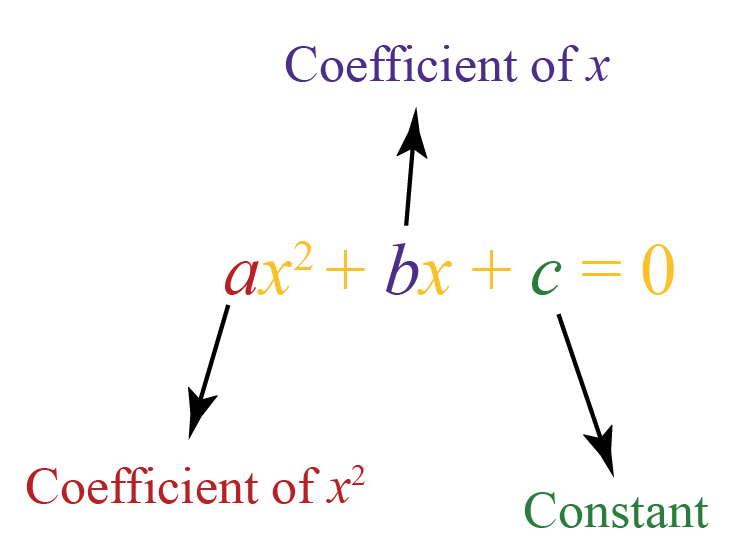
\( ax^2 + bx + c = 0 \), where \( a, b, c \in \mathbb{R} \) (or \( \mathbb{C} \)), and \( a \ne 0 \).
The solutions (or roots) of the equation are the values of \( x \) that satisfy it.
1. Roots of a Quadratic Equation
The roots are given by the quadratic formula:
\( x = \dfrac{-b \pm \sqrt{b^2 – 4ac}}{2a} \)
Here, the expression \( D = b^2 – 4ac \) is called the discriminant.
2. Nature of Roots (Real System)
| Discriminant \(D\) | Nature of Roots | Remarks |
|---|---|---|
| \( D > 0 \) | Real and distinct | Two different real roots |
| \( D = 0 \) | Real and equal | Both roots are the same |
| \( D < 0 \) | Complex conjugate | Non-real roots |
3. Roots in Complex System
When \( D < 0 \), roots are complex. Let \( D = -k \) where \( k > 0 \).
\( x = \dfrac{-b \pm i\sqrt{k}}{2a} \)
The roots are conjugate pairs of the form \( p + iq \) and \( p – iq \).
4. Relationship Between Coefficients and Roots
If \( \alpha \) and \( \beta \) are the roots of \( ax^2 + bx + c = 0 \), then:
- Sum of roots: \( \alpha + \beta = -\dfrac{b}{a} \)
- Product of roots: \( \alpha \beta = \dfrac{c}{a} \)
Example
Find the roots of \( 2x^2 – 3x + 1 = 0 \).
▶️ Answer / Explanation
Step 1: Identify coefficients \( a = 2, b = -3, c = 1 \).
Step 2: \( D = (-3)^2 – 4(2)(1) = 9 – 8 = 1 \)
Step 3: \( x = \dfrac{3 \pm \sqrt{1}}{4} \)
\( \Rightarrow x = 1 \) or \( x = \dfrac{1}{2} \)
Answer: Roots are \( 1 \) and \( \dfrac{1}{2} \).
Example
Find the roots of \( x^2 + 4x + 8 = 0 \).
▶️ Answer / Explanation
Step 1: \( a = 1, b = 4, c = 8 \)
Step 2: \( D = 4^2 – 4(1)(8) = 16 – 32 = -16 \)
Step 3: \( x = \dfrac{-4 \pm i\sqrt{16}}{2} = \dfrac{-4 \pm 4i}{2} \)
\( \Rightarrow x = -2 + 2i, \; x = -2 – 2i \)
Answer: Complex conjugate roots are \( -2 \pm 2i \).
Example
Find the roots of \( 3x^2 + 2x + 5 = 0 \) and express in the form \( p \pm iq \).
▶️ Answer / Explanation
Step 1: \( a = 3, b = 2, c = 5 \)
Step 2: \( D = b^2 – 4ac = 4 – 60 = -56 \)
Step 3: \( x = \dfrac{-2 \pm i\sqrt{56}}{6} = \dfrac{-2 \pm i2\sqrt{14}}{6} \)
\( \Rightarrow x = \dfrac{-1}{3} \pm i\dfrac{\sqrt{14}}{3} \)
Answer: \( x_1 = -\dfrac{1}{3} + i\dfrac{\sqrt{14}}{3} \), \( x_2 = -\dfrac{1}{3} – i\dfrac{\sqrt{14}}{3} \).
Solving Quadratic Equations by Different Methods
A quadratic equation in one variable is of the form: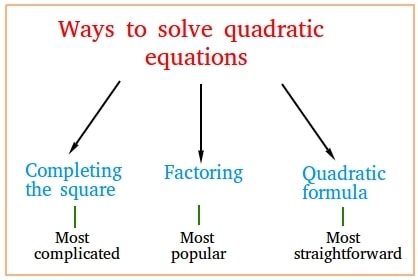
$ ax^2 + bx + c = 0, \quad a \ne 0 $
Its roots (solutions) are the values of \( x \) that satisfy this equation.
General Formula (Most Common Method)
$ x = \dfrac{-b \pm \sqrt{b^2 – 4ac}}{2a} $
where \( D = b^2 – 4ac \) is called the discriminant.
- If \( D > 0 \) → Two distinct real roots
- If \( D = 0 \) → Equal (repeated) real roots
- If \( D < 0 \) → Complex conjugate roots
Method 1 — Factorization (Splitting the Middle Term)
This is the fastest and most JEE-friendly method when coefficients are rational.
Steps:
- Multiply \( a \times c \).
- Find two numbers whose product = \( a \times c \) and sum = \( b \).
- Split the middle term accordingly and factorize.
Example
Solve \( 2x^2 + 5x + 3 = 0 \).
▶️ Answer / Explanation
Here, \( a \times c = 6 \) and \( b = 5 \).
Split \( 5x \) as \( 2x + 3x \): \( 2x^2 + 2x + 3x + 3 = 0 \).
\( 2x(x + 1) + 3(x + 1) = 0 \Rightarrow (2x + 3)(x + 1) = 0. \)
Roots: \( x = -\dfrac{3}{2}, -1. \)
Method 2 — Completing the Square
Useful when the equation is not easily factorable.
Steps:
- Divide through by \( a \) to make the coefficient of \( x^2 \) unity.
- Rearrange to get \( x^2 + \dfrac{b}{a}x = -\dfrac{c}{a} \).
- Add and subtract \( \left(\dfrac{b}{2a}\right)^2 \) to complete the square.
- Take square roots and simplify.
Example
Solve \( x^2 + 6x – 16 = 0 \).
▶️ Answer / Explanation
Move constant: \( x^2 + 6x = 16 \).
Add \( (6/2)^2 = 9 \): \( x^2 + 6x + 9 = 25. \)
\( (x + 3)^2 = 25 \Rightarrow x + 3 = \pm 5. \)
Roots: \( x = 2, -8. \)
Method 3 — Using Vieta’s Relations (Sum and Product of Roots)
For \( ax^2 + bx + c = 0 \):
$ \alpha + \beta = -\dfrac{b}{a}, \quad \alpha\beta = \dfrac{c}{a} $
This trick helps to quickly form or find equations when roots are known or related.
Example
If one root is twice the other, and the equation is \( x^2 – 5x + 6 = 0 \), verify the condition.
▶️ Answer / Explanation
Let roots be \( \alpha \) and \( 2\alpha \).
Then, \( \alpha + 2\alpha = 3\alpha = 5 \Rightarrow \alpha = \dfrac{5}{3}. \)
Product: \( 2\alpha^2 = 6 \Rightarrow \alpha^2 = 3 \Rightarrow \alpha = \sqrt{3}. \)
Contradiction — means roots are not in 1:2 ratio. This trick helps check quickly without solving.
Method 4 — Graphical Method (Fast Intuition)
The quadratic \( y = ax^2 + bx + c \) represents a parabola:
- If \( a > 0 \): opens upward.
- If \( a < 0 \): opens downward.
The roots are the x-intercepts (where \( y = 0 \)).
Trick: If \( D = b^2 – 4ac \) is negative → No x-intercept (complex roots).
Method 5 — Shortcut Using Sum and Product
If you know \( \alpha + \beta = S \) and \( \alpha\beta = P \), then roots are given directly by:
$ x = \dfrac{S \pm \sqrt{S^2 – 4P}}{2} $
This is faster than using \( a,b,c \) when only the relations are known.
Method 6 — Trick for Quadratics of Form \( (x + \dfrac{1}{x}) \)
Many JEE problems involve transformations like:
$ x^2 + \dfrac{1}{x^2}, \quad x + \dfrac{1}{x} $
Trick: If \( t = x + \dfrac{1}{x} \), then
$ x^2 + \dfrac{1}{x^2} = t^2 – 2, \quad x^3 + \dfrac{1}{x^3} = t^3 – 3t $
Example
Solve \( x^2 + \dfrac{1}{x^2} = 3 \).
▶️ Answer / Explanation
Let \( t = x + \dfrac{1}{x} \Rightarrow x^2 + \dfrac{1}{x^2} = t^2 – 2. \)
So \( t^2 – 2 = 3 \Rightarrow t^2 = 5 \Rightarrow t = \pm\sqrt{5}. \)
Now \( x + \dfrac{1}{x} = \sqrt{5} \Rightarrow x^2 – \sqrt{5}x + 1 = 0. \)
Roots: \( x = \dfrac{\sqrt{5} \pm 1}{2}. \)
Method 7 — Substitution Trick (JEE Shortcut)
For equations like \( ax^4 + bx^2 + c = 0 \): Let \( x^2 = t \Rightarrow \) becomes a quadratic in \( t \).
Example
Solve \( x^4 – 5x^2 + 4 = 0. \)
▶️ Answer / Explanation
Let \( x^2 = t \Rightarrow t^2 – 5t + 4 = 0. \)
\( (t – 4)(t – 1) = 0 \Rightarrow t = 4, 1. \)
\( \Rightarrow x = \pm2, \pm1. \)
Roots: \( -2, -1, 1, 2. \)
Method 8 — Observation & Coefficient Trick (JEE Shortcut)
When \( a + b + c = 0 \) → one root is \( x = 1 \). When \( a – b + c = 0 \) → one root is \( x = -1 \).
Example
Solve \( 3x^2 – 8x + 5 = 0. \)
▶️ Answer / Explanation
Check: \( a + b + c = 3 – 8 + 5 = 0 \Rightarrow x = 1 \) is a root.
Divide by \( (x – 1) \): \( 3x^2 – 8x + 5 = (x – 1)(3x – 5). \)
Roots: \( x = 1, \dfrac{5}{3}. \)
Newton’s Formula (Newton’s Identities / Newton’s Sums)
Newton’s Formula provides a way to express the sum of powers of roots of a polynomial in terms of its coefficients.
It is especially useful for evaluating expressions like \( \alpha^2 + \beta^2 \), \( \alpha^3 + \beta^3 \), etc., without solving for the roots individually.
General Polynomial Form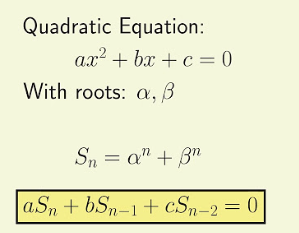
Let
$ a_0x^n + a_1x^{n-1} + a_2x^{n-2} + \dots + a_{n-1}x + a_n = 0 $
with roots \( \alpha_1, \alpha_2, \dots, \alpha_n \).
Define the sum of k-th powers of roots as:
$ S_k = \alpha_1^k + \alpha_2^k + \dots + \alpha_n^k $
Newton’s General Formula
For all \( r \ge 1 \):
$ a_0S_r + a_1S_{r-1} + a_2S_{r-2} + \dots + a_{r-1}S_1 + r\,a_r = 0 $
This relation allows us to find \( S_r \) recursively using previous sums \( S_1, S_2, \dots, S_{r-1} \).
For Quadratic Equation
For \( ax^2 + bx + c = 0 \) with roots \( \alpha, \beta \):
- \( \alpha + \beta = -\dfrac{b}{a} \)
- \( \alpha\beta = \dfrac{c}{a} \)
Using Newton’s Sums:
- \( S_1 = \alpha + \beta = -\dfrac{b}{a} \)
- \( S_2 = \alpha^2 + \beta^2 = S_1^2 – 2\dfrac{c}{a} \)
- \( S_3 = \alpha^3 + \beta^3 = S_1S_2 – S_1\dfrac{c}{a} \)
For Cubic Equation
For \( ax^3 + bx^2 + cx + d = 0 \) with roots \( \alpha, \beta, \gamma \):
- \( \alpha + \beta + \gamma = -\dfrac{b}{a} \)
- \( \alpha\beta + \beta\gamma + \gamma\alpha = \dfrac{c}{a} \)
- \( \alpha\beta\gamma = -\dfrac{d}{a} \)
Newton’s Sums:
- \( S_1 = -\dfrac{b}{a} \)
- \( S_2 = \dfrac{b^2 – 2ac}{a^2} \)
- \( S_3 = -\dfrac{b^3 – 3abc + 3a^2d}{a^3} \)
General Recursive Pattern
Newton’s relation for the first few terms:
| r | Newton’s Identity |
|---|---|
| 1 | \( a_0S_1 + a_1 = 0 \) |
| 2 | \( a_0S_2 + a_1S_1 + 2a_2 = 0 \) |
| 3 | \( a_0S_3 + a_1S_2 + a_2S_1 + 3a_3 = 0 \) |
| 4 | \( a_0S_4 + a_1S_3 + a_2S_2 + a_3S_1 + 4a_4 = 0 \) |
Shortcut Relations for Quadratics (JEE Tricks)
- \( \alpha^2 + \beta^2 = (\alpha + \beta)^2 – 2\alpha\beta \)
- \( \alpha^3 + \beta^3 = (\alpha + \beta)^3 – 3\alpha\beta(\alpha + \beta) \)
- \( \alpha^4 + \beta^4 = (\alpha^2 + \beta^2)^2 – 2(\alpha\beta)^2 \)
These can be directly derived from Newton’s identities and are faster for JEE-style questions.
Example
For \( x^2 – 5x + 6 = 0 \), find \( \alpha^2 + \beta^2 \).
▶️ Answer / Explanation
\( \alpha + \beta = 5, \alpha\beta = 6. \)
\( \alpha^2 + \beta^2 = (\alpha + \beta)^2 – 2\alpha\beta = 25 – 12 = 13. \)
Answer: \( 13. \)
Example
For \( x^3 – 6x^2 + 11x – 6 = 0 \), find \( \alpha^3 + \beta^3 + \gamma^3 \).
▶️ Answer / Explanation
\( a_0 = 1, a_1 = -6, a_2 = 11, a_3 = -6. \)
\( S_1 = -\dfrac{a_1}{a_0} = 6, \quad S_2 = \dfrac{a_1^2 – 2a_0a_2}{a_0^2} = 36 – 22 = 14. \)
Now use Newton’s formula for \( S_3 \): \( a_0S_3 + a_1S_2 + a_2S_1 + 3a_3 = 0. \)
\( 1(S_3) – 6(14) + 11(6) – 18 = 0 \Rightarrow S_3 = 36. \)
Answer: \( \alpha^3 + \beta^3 + \gamma^3 = 36. \)
Example
For \( x^3 + 3x^2 + 3x + 1 = 0 \), find \( \alpha^5 + \beta^5 + \gamma^5 \).
▶️ Answer / Explanation
Given: \( a_0 = 1, a_1 = 3, a_2 = 3, a_3 = 1. \)
\( S_1 = -3, \quad S_2 = (-3)^2 – 2(3) = 3, \quad S_3 = -3(3) – 3(-3) – 3(1) = -3. \)
Now \( a_0S_4 + a_1S_3 + a_2S_2 + a_3S_1 + 4a_4 = 0. \)
Since degree = 3, \( a_4 = 0 \). So \( S_4 + 3(-3) + 3(3) + 1(-3) = 0 \Rightarrow S_4 – 3 = 0 \Rightarrow S_4 = 3. \)
Similarly, \( S_5 + 3S_4 + 3S_3 + S_2 = 0 \Rightarrow S_5 + 9 – 9 + 3 = 0 \Rightarrow S_5 = -3. \)
Answer: \( \alpha^5 + \beta^5 + \gamma^5 = -3. \)
Example
Let \( \alpha \) and \( \beta \) be the roots of the equation \( x^2 – 6x – 2 = 0 \). If \( a_n = \alpha^n – \beta^n \), for \( n \ge 1 \), then find the value of
$ \dfrac{a_{10} – 2a_8}{2a_9}. $
▶️ Answer / Explanation
Step 1: Given quadratic equation:
$ x^2 – 6x – 2 = 0. $
Hence, \( \alpha + \beta = 6 \) and \( \alpha\beta = -2. \)
$ a_n = \alpha^n – \beta^n. $
Take common \( \alpha^8 \) in numerator.
$ a_{10} – 2a_8 = (\alpha^{10} – \beta^{10}) – 2(\alpha^8 – \beta^8) = \alpha^8(\alpha^2 – 2) – \beta^8(\beta^2 – 2). $
From the quadratic equation, \( \alpha^2 = 6\alpha + 2 \) and \( \beta^2 = 6\beta + 2. \)
Therefore,
$ \alpha^2 – 2 = 6\alpha, \quad \beta^2 – 2 = 6\beta. $
Substitute these in the numerator:
$ a_{10} – 2a_8 = \alpha^8(6\alpha) – \beta^8(6\beta) = 6(\alpha^9 – \beta^9) = 6a_9. $
$ \dfrac{a_{10} – 2a_8}{2a_9} = \dfrac{6a_9}{2a_9} = 3. $