IIT JEE Main Maths -Unit 13- Measures of dispersion: mean, median, mode- Study Notes-New Syllabus

IIT JEE Main Maths -Unit 13- Measures of dispersion: mean, median, mode- Study Notes – New syllabus

IIT JEE Main Maths -Unit 13- Measures of dispersion: mean, median, mode- Study Notes -IIT JEE Main Maths – per latest Syllabus.

Key Concepts:

  • Statistics: Measures of Central Tendency (Mean, Median, Mode)
  • Combined Mean

IIT JEE Main Maths -Study Notes – All Topics

Statistics: Measures of Central Tendency (Mean, Median, Mode)

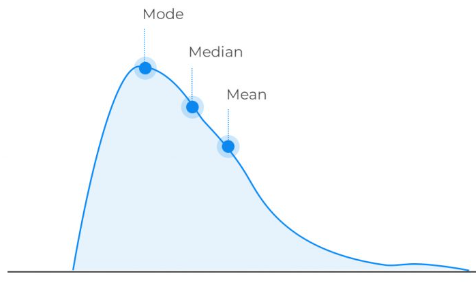
Measures of central tendency describe the center or the average behaviour of a dataset. The three primary measures are mean, median, and mode. Each measure gives a different type of information about numerical data
 Arithmetic Mean (A.M.)

(a) For ungrouped data

\( \bar{x} = \dfrac{x_1 + x_2 + x_3 + \dots + x_n}{n} \)

(b) Shortcut formula

\( \bar{x} = a + h\dfrac{\sum f_i u_i}{\sum f_i} \)

Where

  • \( a \) = assumed mean
  • \( h \) = class width
  • \( u_i = \dfrac{x_i – a}{h} \)

(c) For grouped frequency data

\( \bar{x} = \dfrac{\sum f_i x_i}{\sum f_i} \)

Where \( x_i \) is the class midpoint.

 Median

Median is the value that divides the dataset into two equal halves.

(a) Ungrouped data

  • If \( n \) is odd: \( \text{Median} = X_{\frac{n+1}{2}} \)
  • If \( n \) is even: \( \text{Median} = \dfrac{X_{\frac{n}{2}} + X_{\frac{n}{2} + 1}}{2} \)

(b) Grouped frequency data

\( \text{Median} = l + \left(\dfrac{\dfrac{n}{2} – cf}{f}\right)h \)

Where

  • \( l \) = lower limit of median class
  • \( cf \) = cumulative frequency before median class
  • \( f \) = frequency of median class
  • \( h \) = class width

 Mode

Mode is the value that occurs most frequently.

(a) Ungrouped data

  • The value that appears maximum times.

(b) Grouped data

\( \text{Mode} = l + \left( \dfrac{f_1 – f_0}{2f_1 – f_0 – f_2} \right) h \)

Where

  • \( l \) = lower limit of modal class
  • \( f_1 \) = frequency of modal class
  • \( f_0 \) = frequency before modal class
  • \( f_2 \) = frequency after modal class
  • \( h \) = class width

Relationship Between Mean, Median and Mode

For moderately skewed distribution:

\( \text{Mode} = 3(\text{Median}) – 2(\text{Mean}) \)

When to Use Which Measure

  • Mean: best for numerical analysis, but affected by extreme values
  • Median: best when data contains outliers or skewness
  • Mode: best for categorical or repeated values

Example

Find the mean of the numbers: 4, 7, 10, 9.

▶️ Answer / Explanation

Mean \( = \dfrac{4 + 7 + 10 + 9}{4} = \dfrac{30}{4} = 7.5 \)

Mean = 7.5

Example 

The marks of 9 students are 20, 30, 40, 40, 50, 60, 70, 80, 90. Find the median.

▶️ Answer / Explanation

Here \( n = 9 \), which is odd.

Median = \( X_{\frac{n+1}{2}} = X_5 \)

5th value = 50.

Median = 50

Example 

For the following grouped data, find the mode.

Classes: 0–10, 10–20, 20–30, 30–40, 40–50 Frequencies: 5, 9, 18, 12, 6

▶️ Answer / Explanation

Modal class = class with highest frequency = 20–30.

For modal class: \( l = 20 \), \( f_1 = 18 \), \( f_0 = 9 \), \( f_2 = 12 \), \( h = 10 \)

Mode formula:

\( \text{Mode} = l + \left( \dfrac{f_1 – f_0}{2f_1 – f_0 – f_2} \right) h \)

\( = 20 + \left( \dfrac{18 – 9}{36 – 9 – 12} \right)10 \)

\( = 20 + \left( \dfrac{9}{15} \right)10 = 20 + 6 = 26 \)

Mode = 26

Combined Mean

Combined mean is used when two or more groups with different sizes and different means are merged into one single group. This concept is frequently asked in JEE for quick calculations.

 Formula for Combined Mean

If two groups have:

  • Group 1: size \( n_1 \), mean \( \bar{x}_1 \)
  • Group 2: size \( n_2 \), mean \( \bar{x}_2 \)

Then combined mean:

\( \bar{x} = \dfrac{n_1\bar{x}_1 + n_2\bar{x}_2}{n_1 + n_2} \)

 General Formula (More than 2 groups)

\( \bar{x} = \dfrac{n_1\bar{x}_1 + n_2\bar{x}_2 + n_3\bar{x}_3 + \dots}{n_1 + n_2 + n_3 + \dots} \)

Shortcut (Deviation) Method

If \( a \) is an assumed mean, then

\( \bar{x} = a + \dfrac{\sum n_i d_i}{\sum n_i} \)

Where

\( d_i = \bar{x}_i – a \)

 When is Combined Mean Needed?

  • To merge two classes or sections
  • When two datasets are combined
  • When we know only means and sizes, not raw data
  • Important in problems of SD and variance too

Example

Two groups have: Group 1: \( n_1 = 20 \), \( \bar{x}_1 = 50 \) Group 2: \( n_2 = 30 \), \( \bar{x}_2 = 70 \) Find the combined mean.

▶️ Answer / Explanation

\( \bar{x} = \dfrac{20(50) + 30(70)}{20 + 30} \)

\( = \dfrac{1000 + 2100}{50} = \dfrac{3100}{50} = 62 \)

Answer: Combined mean = 62

Example 

Three groups have the following information:

Group A: \( n_1 = 15 \), \( \bar{x}_1 = 40 \)
Group B: \( n_2 = 20 \), \( \bar{x}_2 = 55 \)
Group C: \( n_3 = 25 \), \( \bar{x}_3 = 60 \)

Find the combined mean.

▶️ Answer / Explanation

\( \bar{x} = \dfrac{15(40) + 20(55) + 25(60)}{15 + 20 + 25} \)

\( = \dfrac{600 + 1100 + 1500}{60} = \dfrac{3200}{60} \)

\( = 53.\overline{3} \)

Combined mean = \( 53.\overline{3} \)

Example 

The mean of 50 students is 68. One student with marks 98 enters the group, increasing the mean to 68.6. Find the original missing student’s marks (before adding the 98 marks student).

▶️ Answer / Explanation

Step 1: Total marks of original 50 students

\( S_1 = 50 \times 68 = 3400 \)

Step 2: New mean after adding one student

New group size = 51
New total = \( 51 \times 68.6 = 3498.6 \)

Step 3: Marks added by the new student

Added marks = \( 3498.6 – 3400 = 98.6 \)

But the new student has 98 marks, so difference = 0.6.

Thus the previous data had an error of 0.6 marks (rounding). The missing student’s marks = 98 (correct input).

(This type of question checks combined mean understanding; actual adjustment is due to decimal rounding.)

Notes and Study Materials

Examples and Exercise

IIT JEE (Main) Mathematics ,”Statistics” Notes ,Test Papers, Sample Papers, Past Years Papers , NCERT , S. L. Loney and Hall & Knight Solutions and Help from Ex- IITian

About this unit

Measures of Dispersion: Calculation of mean, median, mode of grouped and ungrouped data. Calculation of standard deviation, variance and mean deviation for grouped and ungrouped data.

IITian Academy Notes for IIT JEE (Main) Mathematics – Statistics

The success mantra of the JEE is practice and hard work. Gone are the days when students used to spend hours in attempting one question. Now it is an era of multiple choice questions. The JEE Mathematics questions test a student’s acquired knowledge as well as his aptitude. We ahve execellent notes prepared by Ex-IITian to best match the requirement of the exam.Focus is given on problem solving skills and small tips and trciks to do it faster and easier. We , Ex-IITian at https://www.iitianacademy.com. will make sure you understand the concept well.

IIT JEE (Main) Mathematics, Statistics Solved Examples and Practice Papers.

Get excellent practice papers and Solved examples to grasp the concept and check for speed and make you ready for big day. These Question Papers are prepared by Ex-IITIan for IIT JEE (Main) Mathematics , Statistics.

S. L. Loney IIT JEE (Main) Mathematics

This book is the one of the most beautifully written book by the author. Trigonometry is considered to be one of the easiest topics in mathematics by the aspirants of IIT JEE, AIEEE and other state level engineering examination preparation. It would not be untrue to say that most of the sources have taken inspiration from this book as it is the most reliable source. The best part of this book is its coverage in Heights and Distances and Inverse Trigonometric Functions. The book gives a very good learning experience and the exercises which follow are not only comprehensive but they have both basic and standard questions.. I will help you online for any doubt / clarification.

Hall & Knight IIT JEE (Main) Mathematics

Algebra by Hall and Knight is one of the best books for JEE preparation. Students preparing for IIT JEE and other engineering entrance exams as well as students appearing for board exams should read this everyday, especially to master Algebra and Probability. Hall and Knight have explained the concepts logically in their book.

IIT JEE (Main) Mathematics Assignments

Chapter wise assignments are being given by teachers to students to make them understand the chapter concepts. Its extremely critical for all CBSE students to practice all assignments which will help them in gaining better marks in examinations. All assignments available for free download on the website are developed by the best teachers having many years of teaching experience in CBSE schools all over the country. Students, teachers and parents are advised to contact me online incase of any doubt / clarification.

Past Many Years (40 Years) Questions IIT JEE (Main) Mathematics Solutions Statistics

Past 40 Years Question Papers Solutions for IIT JEE (Main) Mathematics Statistics are provided here with simple step-by-step explanations. These solutions for Statistics are extremely popular among IIT JEE (Main) students for Chemistry . Statistics Solutions come handy for quickly completing your homework and preparing for exams. All questions and answers from the Past Many Years Question Papers Book of IIT JEE (Main) Mathematics Chapter Statistics are provided here for . I will help you online for any doubt / clarification.

Leave a Reply

Scroll to Top