
De Morgan’s Laws
De Morgan’s Laws are important identities in set theory that relate the complement of unions and intersections of sets.
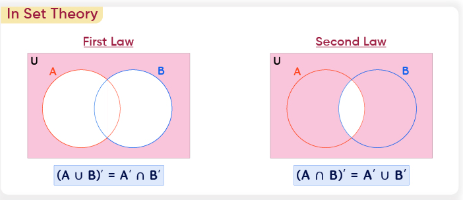
They are widely used in simplifying set expressions and solving problems involving complements.
First Law:
\( (A \cup B)’ = A’ \cap B’ \)
Meaning: The complement of the union of two sets is equal to the intersection of their complements.
Explanation: An element belongs to \( (A \cup B)’ \) if it is not in \( A \) and not in \( B \).
This is exactly the condition for being in both \( A’ \) and \( B’ \).
Second Law:
\( (A \cap B)’ = A’ \cup B’ \)
Meaning: The complement of the intersection of two sets is equal to the union of their complements.
Explanation: An element belongs to \( (A \cap B)’ \) if it is not common to both sets.
This means it lies in at least one of \( A’ \) or \( B’ \).
Important Notes:
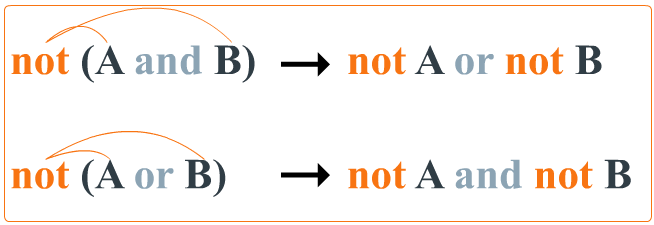
- These laws are always defined with respect to a universal set \( U \).
- They are very useful in simplifying complex set expressions.
- They can be extended to three or more sets.
Extension to Three Sets:
- \( (A \cup B \cup C)’ = A’ \cap B’ \cap C’ \)
- \( (A \cap B \cap C)’ = A’ \cup B’ \cup C’ \)
Example 1
If \( U = \{1,2,3,4,5,6\} \), \( A = \{1,2,3\} \), \( B = \{3,4,5\} \), verify that \( (A \cup B)’ = A’ \cap B’ \).
▶️ Answer / Explanation
\( A \cup B = \{1,2,3,4,5\} \)
\( (A \cup B)’ = \{6\} \)
\( A’ = \{4,5,6\}, \quad B’ = \{1,2,6\} \)
\( A’ \cap B’ = \{6\} \)
Hence, LHS = RHS
Example 2
Verify \( (A \cap B)’ = A’ \cup B’ \) for the same sets.
▶️ Answer / Explanation
\( A \cap B = \{3\} \)
\( (A \cap B)’ = \{1,2,4,5,6\} \)
\( A’ = \{4,5,6\}, \quad B’ = \{1,2,6\} \)
\( A’ \cup B’ = \{1,2,4,5,6\} \)
Hence, verified
Example 3
Simplify \( (A \cup B)’ \cap A \).
▶️ Answer / Explanation
Using De Morgan’s Law:
\( (A \cup B)’ = A’ \cap B’ \)
So expression becomes:
\( (A’ \cap B’) \cap A \)
\( = (A’ \cap A) \cap B’ \)
\( A’ \cap A = \varnothing \)
Therefore, result \( = \varnothing \)
Number of Elements in Sets
This topic deals with finding the number of elements in unions and intersections of sets. It is one of the most important and frequently asked concepts in JEE Main.
Basic Idea:
When combining two or more sets, some elements may be counted more than once. Therefore, we subtract the common elements to avoid repetition.
Formula for Two Sets:
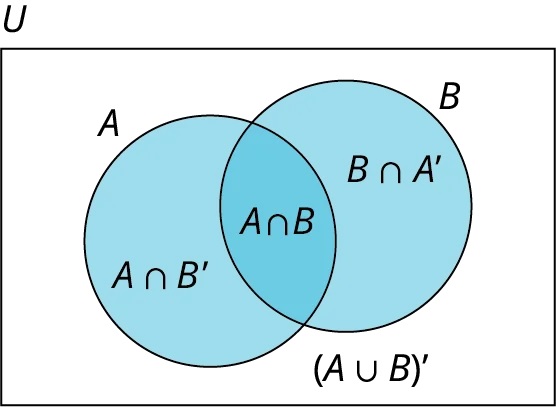
\( n(A \cup B) = n(A) + n(B) – n(A \cap B) \)
Explanation:
- Elements of \( A \) and \( B \) are added.
- Common elements \( (A \cap B) \) are counted twice, so we subtract them once.
Formula for Three Sets:
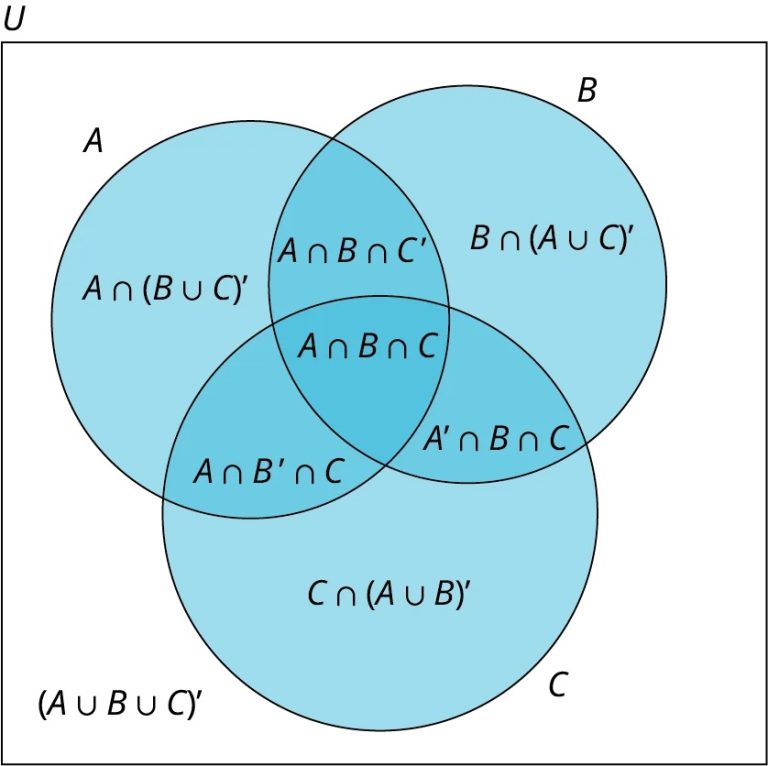
\( n(A \cup B \cup C) = n(A) + n(B) + n(C) \)
\( – n(A \cap B) – n(B \cap C) – n(C \cap A) + n(A \cap B \cap C) \)
Explanation:
- Add individual sets.
- Subtract pairwise intersections (counted twice).
- Add triple intersection (subtracted too many times).
Special Cases:
- If \( A \) and \( B \) are disjoint: \( n(A \cap B) = 0 \)
- Then \( n(A \cup B) = n(A) + n(B) \)
Important Notes:
- Always identify overlapping elements carefully.
- Use Venn diagrams for better understanding.
- This concept is based on the inclusion–exclusion principle.
Example 1
In a class of 40 students, 25 like Mathematics, 20 like Physics, and 10 like both. Find how many students like at least one subject.
▶️ Answer / Explanation
Use formula:
\( n(A \cup B) = n(A) + n(B) – n(A \cap B) \)
\( = 25 + 20 – 10 = 35 \)
So, 35 students like at least one subject.
Example 2
In a group of 100 people, 60 like tea, 50 like coffee, and 30 like both. Find how many like neither.
▶️ Answer / Explanation
\( n(A \cup B) = 60 + 50 – 30 = 80 \)
People who like neither:
\( 100 – 80 = 20 \)
Example 3
In a survey of 100 students, 50 study Maths, 60 study Physics, 40 study Chemistry, 20 study Maths & Physics, 25 study Physics & Chemistry, 15 study Maths & Chemistry, and 10 study all three. Find how many study at least one subject.
▶️ Answer / Explanation
Use three-set formula:
\( n(A \cup B \cup C) = 50 + 60 + 40 \)
\( – 20 – 25 – 15 + 10 \)
\( = 150 – 60 + 10 = 100 \)
So, all 100 students study at least one subject.