IIT JEE Main Maths -Unit 1- Power set- Study Notes-New Syllabus
IIT JEE Main Maths -Unit 1- Power set – Study Notes – New syllabus
IIT JEE Main Maths -Unit 1- Power set – Study Notes -IIT JEE Main Maths – per latest Syllabus.
Key Concepts:
- Power Set
- Important Properties of Power Set
- Subsets with Conditions
- Common Mistakes and Important Notes
Power Set
The power set of a set \( A \) is the set of all possible subsets of \( A \), including the empty set \( \varnothing \) and the set \( A \) itself.
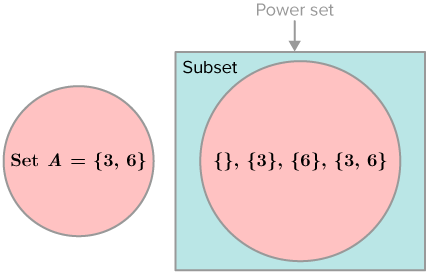
Notation: The power set of \( A \) is denoted by \( P(A) \) or \( 2^A \).
If \( A = \{a_1, a_2, a_3, \dots, a_n\} \), then
\( P(A) = \{ B \mid B \subseteq A \} \)
Number of elements in Power Set:
If \( n(A) = k \), then \( n(P(A)) = 2^k \).
This is because each element of \( A \) can either be included or not included in a subset, giving \( 2 \) choices per element.
Example
Let \( A = \{1, 2, 3\} \). Find \( P(A) \) and the total number of subsets.
▶️ Answer / Explanation
Step 1: List all possible subsets of \( A \).
\( P(A) = \{\varnothing, \{1\}, \{2\}, \{3\}, \{1,2\}, \{1,3\}, \{2,3\}, \{1,2,3\}\} \)
Step 2: Count the number of subsets.
\( n(A) = 3 \Rightarrow n(P(A)) = 2^3 = 8 \)
Step 3: Verify inclusion:
All subsets, from none to all elements, are included in \( P(A) \).
Conclusion: \( P(A) \) contains \( 8 \) subsets in total.
Example
Find the power set of \( A = \{1, 2\} \).
▶️ Answer / Explanation
Step 1: List all subsets of \( A \).
- \( \varnothing \)
- \( \{1\} \)
- \( \{2\} \)
- \( \{1,2\} \)
Step 2: Write the power set.
\( P(A) = \{\varnothing, \{1\}, \{2\}, \{1,2\}\} \)
Step 3: Count elements: \( n(A) = 2 \Rightarrow n(P(A)) = 2^2 = 4 \).
Example
If \( B = \{x, y, z\} \), find \( P(B) \) and the number of subsets that contain element \( x \).
▶️ Answer / Explanation
Step 1: Write all subsets of \( B \).
\( P(B) = \{\varnothing, \{x\}, \{y\}, \{z\}, \{x,y\}, \{x,z\}, \{y,z\}, \{x,y,z\}\} \)
Step 2: Count subsets containing \( x \).
- \( \{x\}, \{x,y\}, \{x,z\}, \{x,y,z\} \)
Number of such subsets: 4.
Step 3: Verify total subsets: \( 2^3 = 8 \).
Example
Let \( C = \{1, 2, 3, 4\} \). Find the number of subsets of \( P(C) \) that contain exactly 8 elements.
▶️ Answer / Explanation
Step 1: The number of elements in \( P(C) \) is:
\( n(P(C)) = 2^{n(C)} = 2^4 = 16 \).
Step 2: A subset of \( P(C) \) with exactly 8 elements means we choose 8 subsets out of 16.
The number of such possible subsets is given by the combination formula:
\( \text{Number of subsets} = \dbinom{16}{8} = 12870 \)
Conclusion: There are 12,870 subsets of \( P(C) \) that contain exactly 8 elements.
Important Properties of Power Set
The power set has several important properties that are frequently used in problem solving.
- If \( A = B \), then \( P(A) = P(B) \).
- If \( P(A) = P(B) \), then \( A = B \).
- If \( A \subseteq B \), then \( P(A) \subseteq P(B) \).
- Every element of \( P(A) \) is a subset of \( A \).
- The empty set is always an element of every power set.
Example
If \( A \subseteq B \), show that \( P(A) \subseteq P(B) \).
▶️ Answer / Explanation
Every element of \( P(A) \) is a subset of \( A \).
Since \( A \subseteq B \), every subset of \( A \) is also a subset of \( B \).
Hence, every element of \( P(A) \) belongs to \( P(B) \).
Conclusion: \( P(A) \subseteq P(B) \).
Power Set of Empty Set
The empty set has no elements, but its power set is not empty.
\( P(\varnothing) = \{\varnothing\} \)
\( n(P(\varnothing)) = 1 \)
Important Distinction:
- \( \varnothing \) has no elements.
- \( \{\varnothing\} \) has one element (which is the empty set).
Example
Find \( P(\varnothing) \) and its cardinal number.
▶️ Answer / Explanation
The only subset of the empty set is the empty set itself.
\( P(\varnothing) = \{\varnothing\} \)
\( n(P(\varnothing)) = 1 \)
Subsets with Conditions
Power set concepts are often used to count subsets under certain conditions.
- Subsets containing a particular element = \( 2^{n-1} \)
- Subsets NOT containing a particular element = \( 2^{n-1} \)
- Subsets containing a fixed number of elements = \( \dbinom{n}{k} \)
Explanation:
If one element is fixed, remaining \( n-1 \) elements can be chosen freely → \( 2^{n-1} \).
Example
Let \( A = \{1,2,3,4,5\} \). Find the number of subsets containing element 1.
▶️ Answer / Explanation
Fix element 1.
Remaining elements: 4
\( \text{Number of subsets} = 2^4 = 16 \)
Example
Find the number of subsets of \( A = \{1,2,3,4,5\} \) having exactly 3 elements.
▶️ Answer / Explanation
Choose 3 elements from 5.
\( \dbinom{5}{3} = 10 \)
Common Mistakes and Important Notes
- Power set always contains the empty set.
- Total number of subsets is \( 2^n \), not \( n^2 \).
- \( \varnothing \ne \{\varnothing\} \)
- Each element has only two choices: include or exclude.
- Power set size increases very rapidly.
Example
Is \( \varnothing \in P(A) \)?
▶️ Answer / Explanation
Yes, the empty set is always a subset of every set.
Hence, \( \varnothing \in P(A) \).
