
Condition for Concurrence of Lines
Three or more lines are said to be concurrent if they all pass through one common point. To check this, we use algebraic conditions based on determinants or the angle-based form of lines.
Condition for Concurrence of Three Lines (General Form)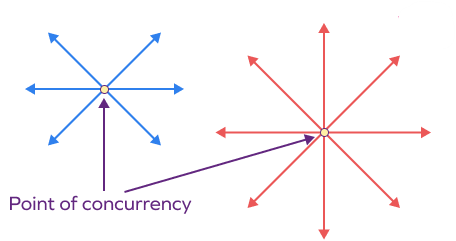
If the three lines are:
\( a_1x + b_1y + c_1 = 0 \)
\( a_2x + b_2y + c_2 = 0 \)
\( a_3x + b_3y + c_3 = 0 \)
Then the three lines are concurrent if and only if:
\( \begin{vmatrix} a_1 & b_1 & c_1 \\ a_2 & b_2 & c_2 \\ a_3 & b_3 & c_3 \end{vmatrix} = 0 \)
This is the most important JEE formula.
Reason Behind Determinant Condition
If three lines pass through a common point \( (x_0, y_0) \), then each equation must satisfy:
\( a_ix_0 + b_iy_0 + c_i = 0 \)
The determinant condition checks exactly this consistency without solving the system.
Condition for Concurrence Using Pairwise Slopes
If lines are:
\( y = m_1x + c_1 \), \( y = m_2x + c_2 \), \( y = m_3x + c_3 \)
They are concurrent if intersection of any two lines lies on the third line.
Procedure:
- Find intersection \( P \) of \( L_1 \) and \( L_2 \)
- Substitute \( P \) in equation of \( L_3 \)
- If satisfied → concurrent
This is useful when slopes are given directly.
Condition for Concurrence of Lines in Combined Form
If equation represents a pair of lines:
\( ax^2 + 2hxy + by^2 + 2gx + 2fy + c = 0 \)
and a third line \( ux + vy + w = 0 \), the three lines are concurrent if:
The third line passes through the point of intersection of the pair.
Use formula:
\( \begin{vmatrix} a & h & g \\ h & b & f \\ u & v & w \end{vmatrix} = 0 \)
Example
Check if the following lines are concurrent:
\( x + y – 2 = 0 \)
\( 2x – y + 1 = 0 \)
\( 3x + 4y – 1 = 0 \)
▶️ Answer / Explanation
Compute determinant:
\( \begin{vmatrix} 1 & 1 & -2 \\ 2 & -1 & 1 \\ 3 & 4 & -1 \end{vmatrix} \)
= \( 1((-1)(-1) – (1)(4)) – 1(2(-1) – 1(3)) + (-2)(2\cdot 4 – (-1)\cdot 3) \)
= \( 1(1 – 4) – 1(-2 – 3) -2(8 + 3) \)
= \( -3 – (-5) – 22 = -3 + 5 – 22 = -20 \)
Determinant ≠ 0
They are not concurrent.
Example
Determine if the lines are concurrent:
\( 2x – 3y + 1 = 0 \)
\( 4x + y – 7 = 0 \)
\( 6x – 2y – 5 = 0 \)
▶️ Answer / Explanation
Take determinant:
\( \begin{vmatrix} 2 & -3 & 1 \\ 4 & 1 & -7 \\ 6 & -2 & -5 \end{vmatrix} \)
= \( 2(1\cdot -5 – (-7)(-2)) – (-3)(4\cdot -5 – (-7)(6)) + 1(4(-2) – 1(6)) \)
= \( 2(-5 – 14) + 3(-20 + 42) + (-8 – 6) \)
= \( 2(-19) + 3(22) – 14 = -38 + 66 -14 = 14 \)
Determinant ≠ 0
Not concurrent.
Example
Find value of \( k \) for which the lines
\( 3x + ky – 5 = 0 \)
\( 2x – y + 3 = 0 \)
\( 4x + 2y – 1 = 0 \)
are concurrent.
▶️ Answer / Explanation
Use determinant = 0 condition:
\( \begin{vmatrix} 3 & k & -5 \\ 2 & -1 & 3 \\ 4 & 2 & -1 \end{vmatrix} = 0 \)
Expand:
\( 3((-1)(-1) – 3\cdot 2) – k(2(-1) – 3\cdot 4) -5(2\cdot 2 – (-1)\cdot 4) = 0 \)
= \( 3(1 – 6) – k(-2 – 12) -5(4 + 4) \)
= \( 3(-5) – k(-14) – 40 \)
= \( -15 + 14k – 40 = 0 \)
\( 14k – 55 = 0 \Rightarrow k = \dfrac{55}{14} \)
Answer: \( k = \dfrac{55}{14} \)