
Condition for Two Circles to Touch
Two circles can touch each other in two different ways:
- Externally tangent – circles touch at one point from outside
- Internally tangent – one circle touches the other from inside
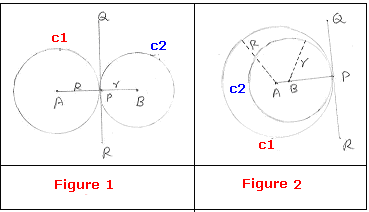
To analyze this, we use the following:
Circle 1: \( x^2 + y^2 + 2g_1x + 2f_1y + c_1 = 0 \)
Circle 2: \( x^2 + y^2 + 2g_2x + 2f_2y + c_2 = 0 \)
Centers:
\( C_1(-g_1, -f_1),\ C_2(-g_2, -f_2) \)
Radii:
\( r_1 = \sqrt{g_1^2 + f_1^2 – c_1} \)
\( r_2 = \sqrt{g_2^2 + f_2^2 – c_2} \)
Distance Between Centers
\( d = \sqrt{(g_1 – g_2)^2 + (f_1 – f_2)^2} \)
1. Condition for External Touching (Touch Externally)
Two circles touch externally if:
\( d = r_1 + r_2 \)
Geometrically → They meet at exactly 1 point from outside.
2. Condition for Internal Touching (Touch Internally)
Two circles touch internally if:
\( d = |r_1 – r_2| \)
Geometrically → One circle lies inside the other and touches at exactly 1 point.
3. Special Case (Concentric Circles)
If \( C_1 = C_2 \), i.e., same center:
- Externally touching: impossible
- Internally touching: only if \( r_1 = r_2 \) (i.e., same circle)
4. JEE Shortcut
If equations are in the form:
\( x^2 + y^2 + 2gx + 2fy + c = 0 \)
Then radius squared is simply:
\( r^2 = g^2 + f^2 – c \)
This saves time in MCQs.
Example
Find whether the circles \( x^2 + y^2 = 9 \) and \( x^2 + y^2 = 25 \) touch internally, externally, or not at all.
▶️ Answer / Explanation
Centers: both at (0,0)
Radii:
\( r_1 = 3,\quad r_2 = 5 \)
Distance between centers \( d = 0 \)
Check internal touching:
\( |r_1 – r_2| = 2 \neq d = 0 \)
Not touching.
Answer: They do NOT touch (concentric, separate).
Example
Do the circles \( x^2 + y^2 – 4x – 6y + 9 = 0 \) and \( x^2 + y^2 – 10x – 6y + 25 = 0 \) touch externally?
▶️ Answer / Explanation
Centers:
\( C_1(2,3),\ C_2(5,3) \)
Distance between centers:
\( d = |5 – 2| = 3 \)
Radii:
\( r_1 = \sqrt{2^2 + 3^2 – 9} = \sqrt{4 + 9 – 9} = \sqrt{4} = 2 \)
\( r_2 = \sqrt{5^2 + 3^2 – 25} = \sqrt{25 + 9 – 25} = \sqrt{9} = 3 \)
Check external touching:
\( r_1 + r_2 = 2 + 3 = 5 \)
\( d = 3 \neq 5 \)
They do not touch externally.
Example
Find the condition on \( k \) such that the circles \( x^2 + y^2 – 6x – 8y + 21 = 0 \) and \( x^2 + y^2 – 2kx – 8y + 9 = 0 \) touch externally.
▶️ Answer / Explanation
Step 1: Centers and radii
\( C_1(3,4),\quad r_1 = \sqrt{3^2 + 4^2 – 21} = \sqrt{25 – 21} = 2 \)
\( C_2(k,4),\quad r_2 = \sqrt{k^2 + 4^2 – 9} = \sqrt{k^2 + 7} \)
Step 2: Distance between centers
\( d = |k – 3| \)
Step 3: External touching condition
\( d = r_1 + r_2 \)
\( |k – 3| = 2 + \sqrt{k^2 + 7} \)
Square both sides:
\( (k – 3)^2 = 4 + k^2 + 7 + 4\sqrt{k^2 + 7} \)
\( k^2 – 6k + 9 = k^2 + 11 + 4\sqrt{k^2 + 7} \)
Simplify:
\( -6k – 2 = 4\sqrt{k^2 + 7} \)
Square again:
\( (6k + 2)^2 = 16(k^2 + 7) \)
\( 36k^2 + 24k + 4 = 16k^2 + 112 \)
\( 20k^2 + 24k – 108 = 0 \)
\( 5k^2 + 6k – 27 = 0 \)
Final condition:
\( 5k^2 + 6k – 27 = 0 \)
Intersection of a Circle and a Line
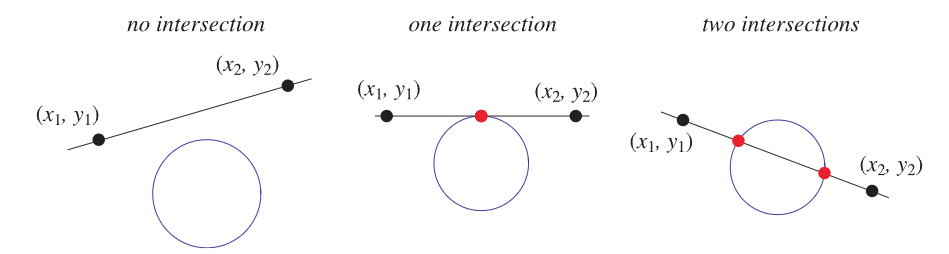
To find the intersection points of a circle and a line, we substitute the line’s expression into the circle’s equation. This produces a quadratic equation. The nature of intersection depends on the discriminant.
1. Circle + Line → Quadratic Equation
Let circle be:
\( x^2 + y^2 + 2gx + 2fy + c = 0 \)
Let line be:
\( y = mx + k \) or \( lx + my + n = 0 \)
Substitute the line in the circle → a quadratic in \( x \) or \( y \).
The number of intersection points = number of real roots.
2. Discriminant Method (Most Important for JEE)
If substitution gives a quadratic:
\( Ax^2 + Bx + C = 0 \)
Then:
- Two intersection points if \( B^2 – 4AC > 0 \)
- Tangent (one point) if \( B^2 – 4AC = 0 \)
- No intersection if \( B^2 – 4AC < 0 \)
This discriminant technique is extremely useful for MCQs.
3. Finding Intersection Points
Steps:
- Substitute \( y = mx + k \) (or express one variable in terms of the other)
- Obtain quadratic in \( x \)
- Solve for real roots \( x_1, x_2 \)
- Compute corresponding \( y_1, y_2 \)
4. Parametric Method (Optional but fast)
For circle \( x^2 + y^2 = r^2 \), if line is:
\( y = mx + k \)
Intersection points occur where:
\( x^2 + (mx + k)^2 = r^2 \)
Use discriminant to check nature.
5. Special Case: Vertical Line
If the line is \( x = a \):
Substitute \( x = a \) into circle:
\( a^2 + y^2 + 2ga + 2fy + c = 0 \)
Quadratic in \( y \).
Example
Find intersection points of circle \( x^2 + y^2 = 25 \) and line \( y = 3 \).
▶️ Answer / Explanation
Substitute \( y = 3 \):
\( x^2 + 9 = 25 \Rightarrow x^2 = 16 \Rightarrow x = \pm 4 \)
Points:
\( (4,3),\ (-4,3) \)
Answer: \( (4,3) \) and \( (-4,3) \)
Example
Find intersection of line \( y = x – 1 \) with circle \( x^2 + y^2 – 4x – 2y – 11 = 0 \).
▶️ Answer / Explanation
Substitute \( y = x – 1 \):
\( x^2 + (x – 1)^2 – 4x – 2(x – 1) – 11 = 0 \)
Expand:
\( x^2 + x^2 – 2x + 1 – 4x – 2x + 2 – 11 = 0 \)
\( 2x^2 – 8x – 8 = 0 \)
Divide by 2: \( x^2 – 4x – 4 = 0 \)
Solve for x:
\( x = \dfrac{4 \pm \sqrt{16 + 16}}{2} = 2 \pm 2\sqrt{2} \)
Corresponding y:
\( y = x – 1 = 1 \pm 2\sqrt{2} \)
Points:
\( (2 + 2\sqrt{2},\ 1 + 2\sqrt{2}) \)
\( (2 – 2\sqrt{2},\ 1 – 2\sqrt{2}) \)
Example
A line \( x + y = k \) intersects the circle \( x^2 + y^2 – 6x – 4y + 9 = 0 \). Find the range of values of \( k \) for which the line intersects the circle in real points.
▶️ Answer / Explanation
Rewrite circle as:
\( (x – 3)^2 + (y – 2)^2 = 4 \)
Line is: \( y = k – x \)
Substitute:
\( (x – 3)^2 + (k – x – 2)^2 = 4 \)
Expand:
\( x^2 – 6x + 9 + (k – x – 2)^2 = 4 \)
\( x^2 – 6x + 9 + (k – 2 – x)^2 = 4 \)
\( x^2 – 6x + 9 + (x – (k – 2))^2 = 4 \)
Expand square:
\( x^2 – 6x + 9 + x^2 – 2x(k-2) + (k-2)^2 = 4 \)
\( 2x^2 – x(6 + 2k – 4) + (9 + (k-2)^2 – 4) = 0 \)
\( 2x^2 – x(2k + 2) + (k^2 – 4k + 5) = 0 \)
For real intersection:
Discriminant ≥ 0
\( (2k + 2)^2 – 8(k^2 – 4k + 5) \ge 0 \)
\( 4k^2 + 8k + 4 – 8k^2 + 32k – 40 \ge 0 \)
\( -4k^2 + 40k – 36 \ge 0 \)
Divide by -4 (reverse inequality):
\( k^2 – 10k + 9 \le 0 \)
Factorize:
\( (k – 1)(k – 9) \le 0 \)
Range:
\( 1 \le k \le 9 \)
Radical Axis and Radical Center
The concept of radical axis and radical center is extremely important in coordinate geometry involving two or three circles.
1. Radical Axis of Two Circles 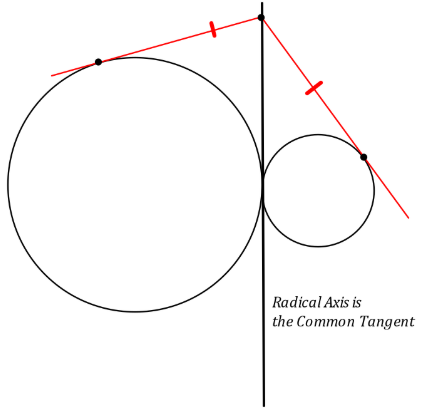
Consider two circles:
\( S_1 \equiv x^2 + y^2 + 2g_1x + 2f_1y + c_1 = 0 \)
\( S_2 \equiv x^2 + y^2 + 2g_2x + 2f_2y + c_2 = 0 \)
Definition:
The radical axis is the locus of a point P such that power of P w.r.t both circles is the same.
\( S_1 = S_2 \)
This eliminates \( x^2 + y^2 \), leaving a straight line.
2. Equation of Radical Axis
Subtract the two circle equations:
\( (S_1 – S_2) = 0 \)
So radical axis is:
\( 2(g_1 – g_2)x + 2(f_1 – f_2)y + (c_1 – c_2) = 0 \)
This is always a straight line.
3. Properties of Radical Axis
- It is a straight line perpendicular to the line joining the centers.
- Every point on radical axis has equal power w.r.t both circles.
- If two circles intersect, their radical axis is the common chord.
- If circles are disjoint, radical axis is a line outside both circles.
4. Radical Axis in Standard Form
If circles are:
\( x^2 + y^2 = r_1^2 \) \( x^2 + y^2 = r_2^2 \)
Then radical axis is:
\( r_1^2 – r_2^2 = 0 \)
If centered at different points, subtract equations normally.
5. Radical Center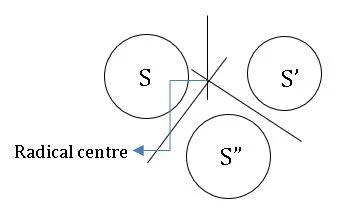
If you have three non-concentric circles:
\( S_1 = 0,\ S_2 = 0,\ S_3 = 0 \)
- Each pair gives a radical axis: \( R_{12}, R_{23}, R_{31} \)
- The three radical axes intersect at a common point
- This common point is called the Radical Center
Note: If the three centers are collinear → radical axes coincide → no unique radical center.
Example
Find the radical axis of the circles \( x^2 + y^2 = 16 \) and \( x^2 + y^2 – 6x + 8y – 20 = 0 \).
▶️ Answer / Explanation
Write both equations:
\( S_1: x^2 + y^2 – 16 = 0 \)
\( S_2: x^2 + y^2 – 6x + 8y – 20 = 0 \)
Subtract \( S_1 – S_2 \):
\( (x^2 + y^2 – 16) – (x^2 + y^2 – 6x + 8y – 20) = 0 \)
\( 6x – 8y + 4 = 0 \)
Answer: \( 3x – 4y + 2 = 0 \)
Example
Find the radical axis of the circles:
\( x^2 + y^2 – 4x – 2y – 11 = 0 \) \( x^2 + y^2 + 2x – 6y + 5 = 0 \)
▶️ Answer / Explanation
Subtract:
\( (x^2 + y^2 – 4x – 2y – 11) – (x^2 + y^2 + 2x – 6y + 5) = 0 \)
\( -6x + 4y – 16 = 0 \)
Divide by -2:
\( 3x – 2y + 8 = 0 \)
Example
Find the radical center of the circles:
\( S_1: x^2 + y^2 = 25 \)
\( S_2: x^2 + y^2 – 6x – 8y + 9 = 0 \)
\( S_3: x^2 + y^2 – 10x + 6y + 1 = 0 \)
▶️ Answer / Explanation
Step 1: Radical axis of \( S_1 \) & \( S_2 \)
Subtract:
\( (x^2 + y^2) – (x^2 + y^2 – 6x – 8y + 9) = 0 \)
\( 6x + 8y – 9 = 0 \) Call this \( R_{12} \)
Step 2: Radical axis of \( S_1 \) & \( S_3 \)
\( (x^2 + y^2) – (x^2 + y^2 – 10x + 6y + 1) = 0 \)
\( 10x – 6y – 1 = 0 \) Call this \( R_{13} \)
Step 3: Solve \( R_{12} \) and \( R_{13} \)
\( 6x + 8y – 9 = 0 \) \( 10x – 6y – 1 = 0 \)
Solve:
Multiply first equation by 3:
\( 18x + 24y – 27 = 0 \)
Multiply second by 4:
\( 40x – 24y – 4 = 0 \)
Add both:
\( 58x – 31 = 0 \Rightarrow x = \dfrac{31}{58} = \dfrac{1}{2} \)
Substitute into \( 6x + 8y – 9 = 0 \):
\( 3 + 8y – 9 = 0 \Rightarrow 8y = 6 \Rightarrow y = \dfrac{3}{4} \)
Radical center = \( \left( \dfrac{1}{2},\ \dfrac{3}{4} \right) \)
Power of a Point
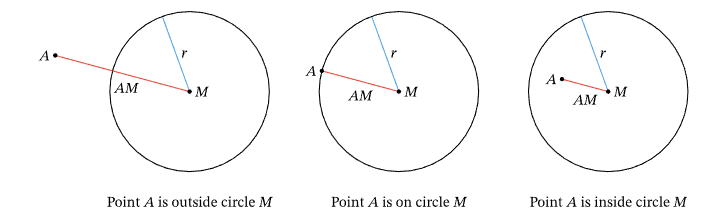
The power of a point with respect to a circle measures how far the point is from the circle in algebraic form. It plays a major role in tangent lengths, radical axis, and geometry of circles.
1. Definition
For a circle:
\( S \equiv x^2 + y^2 + 2gx + 2fy + c = 0 \)
Power of point \( P(x_1, y_1) \) with respect to the circle is:
\( S_1 = x_1^2 + y_1^2 + 2gx_1 + 2fy_1 + c \)
2. Geometrical Meaning
(i) If \( S_1 > 0 \)
Point lies outside the circle and two tangents can be drawn.
(ii) If \( S_1 = 0 \)
Point lies exactly on the circle and one tangent exists.
(iii) If \( S_1 < 0 \)
Point lies inside the circle and no tangent can be drawn.
3. Length of Tangent From a Point
If point \( P(x_1, y_1) \) lies outside the circle, length of tangent from P is:
\( PT = \sqrt{S_1} \)
This is directly derived from power of point.
4. Chord Cut by a Line
If a line through a point P intersects circle at A and B, then:
\( PA \cdot PB = S_1 \)
This is used often in geometry-based problems.
5. Relation With Radical Axis
For two circles \( S_1 = 0 \) and \( S_2 = 0 \):
Point P lies on radical axis ⟺ Power of P is equal for both circles (i.e., \( S_1(P) = S_2(P) \))
Thus radical axis is locus of equal power points.
6. Shortcut (Very Useful in JEE)
For circle centered at \( (a,b) \) with radius \( r \), power of point \( P(x_1,y_1) \) is:
\( PO^2 – r^2 \)
Where O is center of circle.
This avoids expanding general form.
Example
Find the power of the point \( (4,3) \) with respect to circle \( x^2 + y^2 = 16 \).
▶️ Answer / Explanation
Circle: center (0,0), radius 4.
Compute:
\( PO^2 = 4^2 + 3^2 = 25 \)
Power = \( 25 – 16 = 9 \)
Answer: 9
Example
Find the length of tangent from point \( (5,2) \) to the circle \( x^2 + y^2 – 6x – 8y + 9 = 0 \).
▶️ Answer / Explanation
Compute \( S_1 \):
\( 5^2 + 2^2 – 6(5) – 8(2) + 9 \)
= \( 25 + 4 – 30 – 16 + 9 = -8 \)
Since \( S_1 < 0 \), point lies inside the circle.
No tangent can be drawn.
Example
A line through point \( P(1,2) \) cuts the circle \( x^2 + y^2 – 4x + 6y – 12 = 0 \) at A and B. Find the value of \( PA \cdot PB \).
▶️ Answer / Explanation
Power of point P w.r.t the circle:
\( S_1 = 1^2 + 2^2 – 4(1) + 6(2) – 12 \)
= \( 1 + 4 – 4 + 12 – 12 = 1 \)
Using formula:
\( PA \cdot PB = S_1 = 1 \)
Answer: 1