
Ellipse: Equation of Tangent
For the standard ellipse:
\( \dfrac{x^2}{a^2} + \dfrac{y^2}{b^2} = 1 \)
There are three important forms of tangent: point form, parametric form, and slope form.
1. Tangent at a Point on Ellipse (Point Form)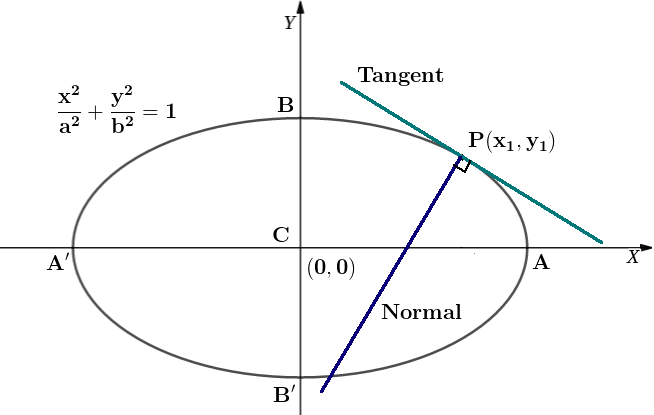
If \( (x_1, y_1) \) lies on the ellipse, then equation of tangent is:
\( \dfrac{xx_1}{a^2} + \dfrac{yy_1}{b^2} = 1 \)
This is obtained by replacing:
- \( x^2 \to xx_1 \)
- \( y^2 \to yy_1 \)
This is the most used formula for JEE.
2. Tangent in Parametric Form
The parametric point on ellipse is:
\( (x_1, y_1) = (a\cos\theta,\ b\sin\theta) \)
Substituting in point form gives tangent:
\( \dfrac{x\cos\theta}{a} + \dfrac{y\sin\theta}{b} = 1 \)
This form is very useful in advanced JEE locus/geometry questions.
3. Tangent in Slope Form
If tangent has slope \( m \), then its equation is:
\( y = mx \pm \sqrt{a^2 m^2 + b^2} \)
Condition: All real values of slope \( m \) give a valid tangent because ellipse is a closed shape.
4. Condition of Tangency (General Line)
If line is:
\( y = mx + c \)
It is tangent to ellipse iff:
\( c^2 = a^2 m^2 + b^2 \)
This is extremely important for JEE MCQs.
5. Tangent to Vertical Ellipse
For ellipse:
\( \dfrac{x^2}{b^2} + \dfrac{y^2}{a^2} = 1 \)
Tangent at \( (x_1, y_1) \):
\( \dfrac{xx_1}{b^2} + \dfrac{yy_1}{a^2} = 1 \)
6. Special Tangents
- At Vertex (±a,0): equation is \( x = ±a \)
- At Co-vertex (0,±b): equation is \( y = ±b \)
- At parametric θ: \( \dfrac{x\cos\theta}{a} + \dfrac{y\sin\theta}{b} =1 \)
Example
Find tangent to ellipse \( \dfrac{x^2}{16} + \dfrac{y^2}{9} = 1 \) at point \( (4,\dfrac{3\sqrt{3}}{2}) \).
▶️ Answer / Explanation
Using point form:
\( \dfrac{xx_1}{a^2} + \dfrac{yy_1}{b^2} = 1 \)
Here \( a^2 = 16,\ b^2 = 9 \)
\( \dfrac{x\cdot 4}{16} + \dfrac{y(\frac{3\sqrt{3}}{2})}{9} = 1 \)
Simplify:
\( \dfrac{x}{4} + \dfrac{y\sqrt{3}}{6} = 1 \)
Answer: \( \dfrac{x}{4} + \dfrac{y\sqrt{3}}{6} = 1 \)
Example
Find the tangent to ellipse \( \dfrac{x^2}{25} + \dfrac{y^2}{9} = 1 \) in parametric form for \( \theta = \dfrac{\pi}{3} \).
▶️ Answer / Explanation
Tangent in parametric form:
\( \dfrac{x\cos\theta}{a} + \dfrac{y\sin\theta}{b} = 1 \)
Here \( a = 5,\ b = 3 \).
Substitute \( \theta = \pi/3 \):
\( \cos\theta = \dfrac{1}{2},\ \sin\theta = \dfrac{\sqrt{3}}{2} \)
\( \dfrac{x\cdot \frac{1}{2}}{5} + \dfrac{y\cdot \frac{\sqrt{3}}{2}}{3} = 1 \)
Simplify:
\( \dfrac{x}{10} + \dfrac{y\sqrt{3}}{6} = 1 \)
Answer: \( \dfrac{x}{10} + \dfrac{y\sqrt{3}}{6} = 1 \)
Example
Find the equation of tangent to ellipse \( \dfrac{x^2}{9} + \dfrac{y^2}{4} = 1 \) having slope \( m = 2 \).
▶️ Answer / Explanation
Slope form of tangent:
\( y = mx \pm \sqrt{a^2 m^2 + b^2} \)
Here \( a = 3,\ b = 2,\ m = 2 \)
\( \sqrt{a^2 m^2 + b^2} = \sqrt{9\cdot 4 + 4} = \sqrt{40} = 2\sqrt{10} \)
Thus tangents:
\( y = 2x \pm 2\sqrt{10} \)
Answer: \( y = 2x + 2\sqrt{10} \) and \( y = 2x – 2\sqrt{10} \)
Ellipse: Equation of Normal
For the standard ellipse:
\( \dfrac{x^2}{a^2}+\dfrac{y^2}{b^2}=1 \)
The normal at a point on the ellipse is the line perpendicular to the tangent at that point.
1. Normal at a Point on Ellipse (Point Form)
If point \( (x_1,y_1) \) lies on ellipse, then slope of tangent is:
\( m_t = -\dfrac{b^2 x_1}{a^2 y_1} \)
So slope of normal is the negative reciprocal:
\( m_n = \dfrac{a^2 y_1}{b^2 x_1} \)
Normal equation:
\( y – y_1 = \dfrac{a^2 y_1}{b^2 x_1}(x – x_1) \)
2. Normal in Parametric Form (Most Important for JEE)
Parametric point on ellipse:
\( (x_1,y_1)=(a\cos\theta,\ b\sin\theta) \)
Normal at this point is:
\( a x \sec\theta – b y \csc\theta = a^2 – b^2 \)
This is the most powerful and frequently used normal equation for ellipse.
3. Normal in Slope Form
If normal has slope \( m \), then the point of contact satisfies:
\( \tan\theta = -\dfrac{b^2}{a^2 m} \)
Using parametric substitution, the normal equation becomes:
\( y = mx \pm \sqrt{a^2 + b^2 m^2} \)
Used mainly in locus questions.
4. Number of Normals from a Point (Important Theory)
- From an external point, three normals can be drawn to an ellipse.
- From a point on the director circle, exactly two normals exist.
- From a point on the ellipse, exactly one normal exists.
5. Key Identities
- If the normal at parametric point \( \theta \) meets the major axis at right angle → special locus problems.
- Normals are important in reflection and optical properties of ellipses.
Example
Find equation of normal to ellipse \( \dfrac{x^2}{16}+\dfrac{y^2}{4}=1 \) at point \( (4,\sqrt{3}) \).
▶️ Answer / Explanation
Here \( a=4,\ b=2 \).
Normal slope:
\( m_n=\dfrac{a^2 y_1}{b^2 x_1} =\dfrac{16\cdot \sqrt{3}}{4\cdot 4} = \dfrac{\sqrt{3}}{1} \)
Normal equation:
\( y-\sqrt{3}= \sqrt{3}(x-4) \)
Answer: \( y = \sqrt{3}x – 3\sqrt{3} \)
Example
Find the normal in parametric form for ellipse \( \dfrac{x^2}{25}+\dfrac{y^2}{9}=1 \) at point corresponding to \( \theta = \dfrac{\pi}{6} \).
▶️ Answer / Explanation
Normal equation:
\( a x \sec\theta – b y \csc\theta = a^2 – b^2 \)
Here \( a=5,\ b=3 \).
\( \sec(\pi/6)=\dfrac{2}{\sqrt{3}},\quad \csc(\pi/6)=2 \)
Plug in values:
\( 5x\cdot\dfrac{2}{\sqrt{3}} – 3y\cdot 2 = 25 – 9 \)
\( \dfrac{10x}{\sqrt{3}} – 6y = 16 \)
Answer: \( \dfrac{10x}{\sqrt{3}} – 6y = 16 \)
Example
Find all normals drawn from point \( (10,0) \) to the ellipse \( \dfrac{x^2}{9}+\dfrac{y^2}{4}=1. \)
▶️ Answer / Explanation
Use general normal in parametric form:
\( a x \sec\theta – b y \csc\theta = a^2 – b^2 \)
Here \( a=3,\ b=2 \), and the point \( (10,0) \) must satisfy:
\( 3\cdot 10 \sec\theta – 2\cdot 0 \csc\theta = 9 – 4 \)
\( 30\sec\theta = 5 \)
\( \sec\theta = \dfrac{1}{6} \)
Impossible for real \( \theta \) (since |secθ| ≥ 1).
Therefore, no real normal exists from (10,0) to the ellipse.