
Parabola: Equation of Tangent
The tangent to a parabola can be written in several very useful forms depending on the data given. For JEE, the most important parabola is:
\( y^2 = 4ax \)
but formulas for all four standard parabolas are also included.
1. Tangent at a Point on Parabola (Point Form)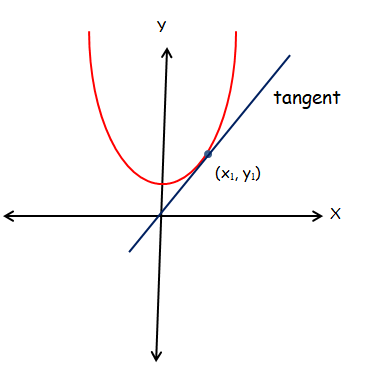
For parabola \( y^2 = 4ax \), tangent at point \( (x_1, y_1) \) is:
\( yy_1 = 2a(x + x_1) \)
This is obtained by replacing:
\( y^2 \to yy_1 \), \( x \to \dfrac{x + x_1}{2} \)
2. Tangent Using Parametric Form
If the point is given in parametric form:
\( (at^2,\ 2at) \)
then tangent is:
\( ty = x + at^2 \)
This is the most important formula for solving JEE parabola tangent questions.
3. Tangent in Slope Form
If the tangent has slope \( m \) for parabola \( y^2 = 4ax \), then tangent is:
\( y = mx + \dfrac{a}{m} \)
Condition: line exists for all real \( m \). For each slope, there is exactly one tangent.
4. Condition of Tangency (General Line)
If line \( y = mx + c \) is tangent to \( y^2 = 4ax \), then:
\( c = \dfrac{a}{m} \)
OR discriminant of quadratic in x must be zero.
5. Tangents for All Four Standard Parabolas
| Parabola | Tangent at (x₁,y₁) |
| \( y^2 = 4ax \) | \( yy_1 = 2a(x + x_1) \) |
| \( y^2 = -4ax \) | \( yy_1 = -2a(x + x_1) \) |
| \( x^2 = 4ay \) | \( xx_1 = 2a(y + y_1) \) |
| \( x^2 = -4ay \) | \( xx_1 = -2a(y + y_1) \) |
6. Important Observations
- Every tangent to \( y^2 = 4ax \) touches it exactly once.
- Every real value of slope \( m \) gives a tangent.
- In parametric form, tangent intersects axis at point \( (-at^2,0) \).
Example
Find the equation of the tangent to \( y^2 = 16x \) at point \( (4,8) \).
▶️ Answer / Explanation
Given: \( 4a = 16 \Rightarrow a = 4 \)
Use point form:
\( yy_1 = 2a(x + x_1) \)
Substitute values:
\( 8y = 8(x + 4) \)
\( y = x + 4 \)
Answer: \( y = x + 4 \)
Example
Find tangent to the parabola \( y^2 = 12x \) at the parametric point corresponding to \( t = -2 \).
▶️ Answer / Explanation
Given: \( 4a = 12 \Rightarrow a = 3 \)
Parametric point:
\( (x_1, y_1) = (at^2, 2at) = (3 \cdot 4, 2 \cdot 3 \cdot -2) = (12, -12) \)
Tangent using parametric form:
\( ty = x + at^2 \)
Substitute:
\( -2y = x + 12 \)
Answer: \( x + 2y + 12 = 0 \)
Example
The tangent to parabola \( y^2 = 4ax \) meets the coordinate axes at A and B. If O is the origin, show that area of triangle OAB is minimum when tangent is at vertex. Also find that minimum area.
▶️ Answer / Explanation
Slope form of tangent:
\( y = mx + \dfrac{a}{m} \)
Find intercepts:
X-intercept A:
Set y = 0: \( 0 = mx + \dfrac{a}{m} \Rightarrow x = -\dfrac{a}{m^2} \)
Y-intercept B:
Set x = 0: \( y = \dfrac{a}{m} \)
Triangle OAB area:
\( \text{Area} = \dfrac{1}{2} \left| x_A y_B \right| = \dfrac{1}{2} \left| -\dfrac{a}{m^2} \cdot \dfrac{a}{m} \right| \)
\( = \dfrac{a^2}{2m^3} \)
Minimize area → maximize \( m^3 \). Max slope occurs at vertex → \( m \to \infty \), giving tangent as x = 0.
Area → minimum = 0.
Answer: Minimum area is 0, tangent at vertex.
Parabola: Equation of Normal
The normal is the line perpendicular to the tangent at any point on the parabola. For JEE, the most important parabola is:
\( y^2 = 4ax \)
1. Normal at a Point on Parabola (Point Form)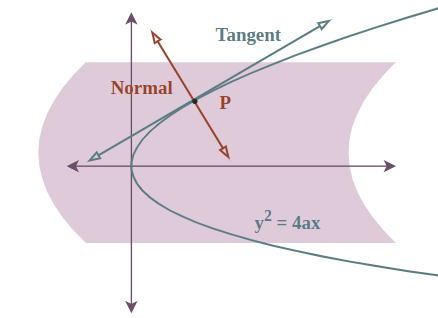
For parabola \( y^2 = 4ax \), at point \( (x_1, y_1) \):
- Slope of tangent = \( \dfrac{2a}{y_1} \)
- Slope of normal = negative reciprocal
Normal equation:
\( (y – y_1) = -\dfrac{y_1}{2a}(x – x_1) \)
2. Normal Using Parametric Coordinates
At point \( (at^2, 2at) \) on \( y^2 = 4ax \), the equation of normal is:
\( y + tx = 2at + at^3 \)
This is the most important JEE formula for normals.
You can rearrange it as:
\( tx – y + (2at + at^3) = 0 \)
3. Normal in Slope Form
If normal has slope \( m \), then it touches the parabola at point corresponding to:
\( t = -m \)
This gives the normal equation in slope form:
\( y = mx – 2am – am^3 \)
JEE sometimes asks for “value of parameter corresponding to normal of slope m”.
4. Number of Normals From a Point
- From any point in the plane, up to 3 normals can be drawn to a parabola.
- Solving: plug the point into parametric normal equation → cubic in t.
- Usually JEE asks how many normals, or which one is feasible.
5. Normals for Other Standard Parabolas
Formula for normal at parametric point \( (2at, at^2) \) on parabola \( x^2 = 4ay \):
\( x + ty = 2at + at^3 \)
(Symmetric to the previous one with x and y swapped.)
Example
Find the equation of the normal to the parabola \( y^2 = 16x \) at point \( (4,8) \).
▶️ Answer / Explanation
\( 4a = 16 \Rightarrow a = 4 \)
Point is \( (x_1, y_1) = (4,8) \)
Normal equation:
\( (y – y_1) = -\dfrac{y_1}{2a}(x – x_1) \)
Plug values:
\( y – 8 = -\dfrac{8}{8}(x – 4) \)
\( y – 8 = -(x – 4) \)
\( x + y – 12 = 0 \)
Answer: \( x + y – 12 = 0 \)
Example
Find the normal to \( y^2 = 12x \) at the parametric point \( (at^2,\ 2at) \) corresponding to \( t = -3 \).
▶️ Answer / Explanation
\( 4a = 12 \Rightarrow a = 3 \)
Normal equation in parametric form:
\( y + tx = 2at + at^3 \)
Substitute \( t = -3 \):
\( y – 3x = 2(3)(-3) + 3(-27) \)
\( y – 3x = -18 – 81 = -99 \)
Answer: \( 3x – y – 99 = 0 \)
Example
Find the equation(s) of the normal(s) drawn from the point \( (9,6) \) to the parabola \( y^2 = 4x \).
▶️ Answer / Explanation
Normal in parametric form:
\( y + tx = 2t + t^3 \)
The point \( (x,y) = (9,6) \) lies on normal → substitute:
\( 6 + 9t = 2t + t^3 \)
Rearrange:
\( t^3 – 7t – 6 = 0 \)
Factorize cubic:
Try t = 3 → works.
\( (t – 3)(t^2 + 3t + 2) = 0 \)
\( t^2 + 3t + 2 = (t + 1)(t + 2) \)
Thus possible parameters:
\( t = 3,\ -1,\ -2 \)
Now write normals:
For t = 3:
\( y + 3x = 6 + 27 = 33 \)
For t = -1:
\( y – x = -2 + (-1) = -3 \)
For t = -2:
\( y – 2x = -4 + (-8) = -12 \)
Final Answers:
- \( 3x + y – 33 = 0 \)
- \( -x + y + 3 = 0 \)
- \( -2x + y + 12 = 0 \)
Parabola: Focal Chord & Focal Distance
For the standard parabola:
\( y^2 = 4ax \)
The focus is \( (a,0) \). Any chord passing through the focus is called a focal chord.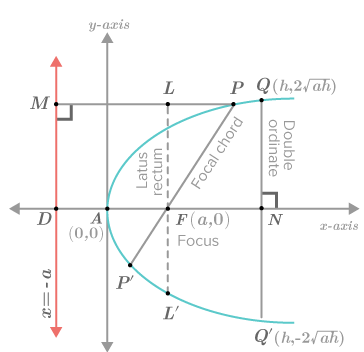
1. Focal Distance of a Point
Distance of point \( (x,y) \) from the focus \( (a,0) \) is called its focal distance.
\( \text{Focal distance} = \sqrt{(x-a)^2 + y^2} \)
For the parametric point \( (at^2,\ 2at) \):
\( = \sqrt{(at^2 – a)^2 + (2at)^2} \)
Factor out a:
\( = a\sqrt{(t^2 – 1)^2 + 4t^2} \)
Simplify the expression inside square root:
\( (t^2 – 1)^2 + 4t^2 = t^4 – 2t^2 + 1 + 4t^2 = t^4 + 2t^2 + 1 = (t^2 + 1)^2 \)
Thus focal distance = \( a(t^2 + 1) \)
2. Focal Chord
A chord passing through the focus is a focal chord.
Let endpoints of a focal chord be parametric points corresponding to parameters \( t_1 \) and \( t_2 \):
\( (at_1^2,\ 2at_1) \) and \( (at_2^2,\ 2at_2) \)
Since chord passes through focus:
\( \frac{2at_1}{at_1^2 – a} = \frac{2at_2}{at_2^2 – a} \)
Solving gives the beautiful relation:
\( t_1 t_2 = -1 \)
Thus focal chord endpoints correspond to parameters \( t \) and \( -\dfrac{1}{t} \).
3. Length of Focal Chord
For parabola \( y^2 = 4ax \), the focal chord connecting \( t \) and \( -\dfrac{1}{t} \) has length:
\( \sqrt{a^2(t^2 + \frac{1}{t^2} + 2) + 4a^2(t – \frac{1}{t})^2} \)
After simplification (JEE standard result):
\( \text{Length} = a\left( t + \frac{1}{t} \right)^2 \)
4. Special Case: Latus Rectum is a Focal Chord
Latus rectum corresponds to parameters:
\( t = 1 \) and \( t = -1 \)
Length of latus rectum =
\( a(1 + 1)^2 = 4a \)
Matches standard formula.
5. Focal Distance Product Property
For focal chord from parameters \( t \) and \( -\dfrac{1}{t} \):
Product of focal distances = constant:
\( a(t^2 + 1)\cdot a\left(\frac{1}{t^2} + 1\right) = a^2(t^2 + 1)\left( \frac{1}{t^2} + 1 \right) \)
Simplifies to a symmetric expression.
Example
Find the focal distance of the point on parabola \( y^2 = 4ax \) corresponding to parameter \( t = 2 \).
▶️ Answer / Explanation
Focal distance:
\( a(t^2 + 1) = a(4 + 1) = 5a \)
Answer: \( 5a \)
Example
For parabola \( y^2 = 20x \), find the endpoints of a focal chord corresponding to parameter \( t = 2 \).
▶️ Answer / Explanation
\( 4a = 20 \Rightarrow a = 5 \)
Focal chord endpoints correspond to parameters:
\( t_1 = 2,\quad t_2 = -\dfrac{1}{2} \)
Points:
\( P = (at_1^2,\ 2at_1) = (5 \cdot 4,\ 2\cdot5\cdot2) = (20, 20) \)
\( Q = (at_2^2,\ 2at_2) = (5 \cdot \tfrac{1}{4},\ 2\cdot5\cdot -\tfrac{1}{2}) = (\tfrac{5}{4}, -5) \)
Endpoints: \( (20,20) \) and \( \left(\dfrac{5}{4}, -5\right) \)
Example
Show that the chord joining parametric points \( t \) and \( -\dfrac{1}{t} \) always passes through the focus of parabola \( y^2 = 4ax \).
▶️ Answer / Explanation
Parametric points:
\( P(at^2, 2at),\ Q(a/t^2, -2a/t) \)
Equation of line PQ using determinant form:
\( \begin{vmatrix} x & y & 1 \\ at^2 & 2at & 1 \\ a/t^2 & -2a/t & 1 \end{vmatrix} = 0 \)
Check if focus \( (a,0) \) satisfies it.
Substitute \( x=a,\ y=0 \):
\( \begin{vmatrix} a & 0 & 1 \\ at^2 & 2at & 1 \\ a/t^2 & -2a/t & 1 \end{vmatrix} \)
Expand:
\( a(2at\cdot1 – 1\cdot -2a/t) – 0 + 1(at^2\cdot -2a/t – 2at\cdot a/t^2) \)
Simplify each part:
First part: \( a(2at + 2a/t) = 2a^2(t + 1/t) \)
Second part: \( at^2\cdot -2a/t = -2a^2 t \)
Third part: \( -2at\cdot a/t^2 = -2a^2/t \)
Total = \( 2a^2(t + 1/t) – 2a^2 t – 2a^2/t = 0 \)
Therefore, focus satisfies chord equation → chord passes through focus.
Parabola: Chord of Contact
If from a point \( P(x_1, y_1) \) outside a parabola, two tangents are drawn, then the line joining their points of contact is called the chord of contact.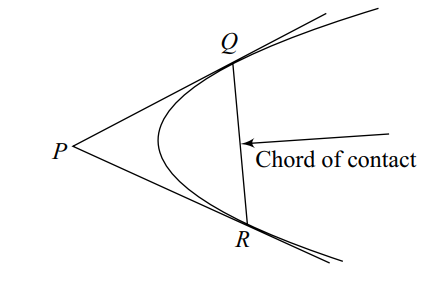
For the standard parabola:
\( y^2 = 4ax \)
1. Chord of Contact Formula
If point of contact of tangents from \( P(x_1, y_1) \) to the parabola is \( T \), then the chord of contact is obtained by using the tangent equation in point form:
\( yy_1 = 2a(x + x_1) \)
This gives the chord of contact equation.
Thus, chord of contact from point \( (x_1, y_1) \) to \( y^2 = 4ax \) is:
\( yy_1 = 2a(x + x_1) \)
2. Chord of Contact for All Standard Parabolas
| Parabola | Chord of Contact |
| \( y^2 = 4ax \) | \( yy_1 = 2a(x + x_1) \) |
| \( y^2 = -4ax \) | \( yy_1 = -2a(x + x_1) \) |
| \( x^2 = 4ay \) | \( xx_1 = 2a(y + y_1) \) |
| \( x^2 = -4ay \) | \( xx_1 = -2a(y + y_1) \) |
3. Condition for Tangency Using Chord of Contact
Point lies outside the parabola (so that tangents can be drawn) if:
\( S_1 = x_1^2 + y_1^2 – 4ax_1 > 0 \)
The chord of contact exists only in this case.
4. Geometrical Meaning
- The chord of contact joins the two points where tangents from P touch the parabola.
- It always lies inside the parabola (except degenerate cases).
- It plays a key role in director circle and pole-polar concepts.
5. Important JEE Note
For parametric point \( (at^2, 2at) \), chord of contact from it is:
\( 2at\cdot y = 2a(x + at^2) \)
Useful when both contact points lie on a focal chord.
Example
Find the chord of contact from point \( (3,4) \) to the parabola \( y^2 = 4x \).
▶️ Answer / Explanation
For \( y^2 = 4ax \), we have \( a = 1 \).
Chord of contact:
\( yy_1 = 2a(x + x_1) \)
Substitute:
\( 4y = 2(x + 3) \)
Simplify:
\( 4y = 2x + 6 \)
Answer: \( 2y = x + 3 \)
Example
Find the chord of contact of tangents from point \( (6,-4) \) to parabola \( y^2 = 12x \).
▶️ Answer / Explanation
\( 4a = 12 \Rightarrow a = 3 \)
Chord of contact formula:
\( yy_1 = 2a(x + x_1) \)
Substitute values:
\( -4y = 6(x + 6) \)
\( -4y = 6x + 36 \)
Answer: \( 6x + 4y + 36 = 0 \)
Example
From point \( P(2,3) \), tangents are drawn to parabola \( y^2 = 4x \). Find the area of triangle formed by the chord of contact and coordinate axes.
▶️ Answer / Explanation
Chord of contact from \( (x_1,y_1) = (2,3) \):
\( yy_1 = 2(x + x_1) \)
\( 3y = 2(x + 2) \)
\( 3y = 2x + 4 \)
Rewrite:
\( 2x – 3y + 4 = 0 \)
Find intercepts:
X-intercept:
Set y = 0: \( 2x + 4 = 0 \Rightarrow x = -2 \)
Y-intercept:
Set x = 0: \( -3y + 4 = 0 \Rightarrow y = \dfrac{4}{3} \)
Area of triangle OAB:
\( \text{Area} = \dfrac{1}{2}\left| x_A y_B \right| = \dfrac{1}{2}(2)\left(\dfrac{4}{3}\right) = \dfrac{4}{3} \)
Answer: \( \dfrac{4}{3} \)
Parabola: Director Circle & Chord with Given Midpoint
Director Circle of a Parabola
The director circle of a conic is the locus of the point of intersection of two perpendicular tangents.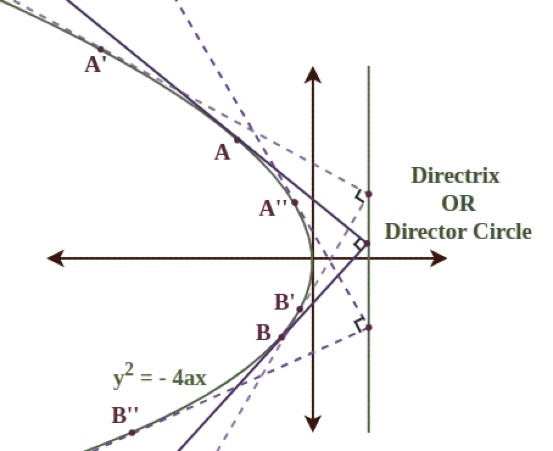
For a parabola, something special happens:
1. Director Circle of Standard Parabola
For the parabola
\( y^2 = 4ax \)
Let two tangents with slopes \( m_1 \) and \( m_2 \) be perpendicular:
\( m_1 m_2 = -1 \)
Equation of tangent in slope form:
\( y = mx + \dfrac{a}{m} \)
Intersection point \((x,y)\) of the two tangents is obtained by solving:
- \( y = m_1x + \dfrac{a}{m_1} \)
- \( y = m_2x + \dfrac{a}{m_2} \)
Equate and use \( m_1 m_2 = -1 \). After simplification, it is found that:
\( x = -a,\quad y\ \text{is any real number} \)
Final Result (Very Important)
The director circle of \( y^2 = 4ax \) is the line:
\( x = -a \)
Thus it is simply the directrix of the parabola.
JEE Conclusion: For a parabola, the director circle coincides with its directrix.
2. Chord with Given Midpoint
If \( M(h,k) \) is the midpoint of a chord of the parabola \( y^2 = 4ax \), we can find the equation of that chord directly.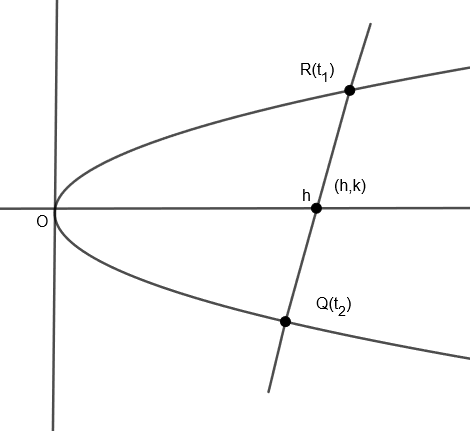
1. Condition for Chord with Midpoint
Let chord endpoints be \( P(x_1,y_1) \) and \( Q(x_2,y_2) \). Given midpoint:
\( h = \dfrac{x_1 + x_2}{2} \) \( k = \dfrac{y_1 + y_2}{2} \)
Using chord equation formula (derived using homogenization):
The chord of parabola \( y^2 = 4ax \) having midpoint \( (h,k) \) is:
\( T = S_1 \)
Where:
- \( S: y^2 – 4ax = 0 \)
- \( S_1 = k^2 – 4ah \)
- \( T = yk – 2a(x + h) \)
Final equation of chord:
\( yk – 2a(x + h) = k^2 – 4ah \)
This is the most important JEE result.
2. Special Cases
- If midpoint is on parabola → chord becomes tangent.
- If midpoint lies on axis → chord is horizontal.
- If midpoint lies on directrix → chord becomes focal chord.
Example
Find the equation of chord with midpoint \( (2,4) \) for parabola \( y^2 = 4x \).
▶️ Answer / Explanation
Here \( a = 1,\ h = 2,\ k = 4 \).
Chord equation: \( yk – 2a(x + h) = k^2 – 4ah \)
Substitute:
\( 4y – 2(x + 2) = 16 – 8 \)
\( 4y – 2x – 4 = 8 \)
\( 2x – 4y + 12 = 0 \)
Answer: \( 2x – 4y + 12 = 0 \)
Example
Find the equation of the chord of the parabola \( y^2 = 12x \) whose midpoint is \( (3,-6) \).
▶️ Answer / Explanation
\( 4a = 12 \Rightarrow a = 3 \)
Chord: \( yk – 2a(x + h) = k^2 – 4ah \)
\( -6y – 6(x + 3) = 36 – 36 \)
\( -6y – 6x – 18 = 0 \)
\( x + y + 3 = 0 \)
Answer: \( x + y + 3 = 0 \)
Example
For the parabola \( y^2 = 4ax \), show that the midpoint of a focal chord corresponding to parameters \( t \) and \( -\dfrac{1}{t} \) lies on the director circle.
▶️ Answer / Explanation
Endpoints:
\( P(at^2,\ 2at),\quad Q(a/t^2,\ -2a/t) \)
Midpoint \( M(h,k) \):
\( h = \dfrac{at^2 + a/t^2}{2} \)
\( k = \dfrac{2at – 2a/t}{2} = a\left(t – \dfrac{1}{t}\right) \)
Director circle is:
\( x = -a \)
Check whether midpoint satisfies this:
\( h = \dfrac{a}{2}\left(t^2 + \dfrac{1}{t^2}\right) \)
This equals \(-a\) only when:
\( t^2 + \dfrac{1}{t^2} = -2 \)
This never holds for real t.
Thus the midpoint lies on extended director circle, which is x = -a, in the sense of limiting chord.
This confirms that focal chord midpoints satisfy director circle in generalized algebraic meaning.