
Distance Between Two Points in Three Dimensional Geometry
The distance between two points in 3D space generalizes the Pythagorean idea from two dimensions to three. If a point \( P_1 \) has coordinates \( (x_1, y_1, z_1) \) and another point \( P_2 \) has coordinates \( (x_2, y_2, z_2) \), then the distance between them is obtained by considering changes in all three directions.
Basic Idea
In 2D, distance is based on change in \( x \) and \( y \). In 3D, we include an additional component based on the change in \( z \).
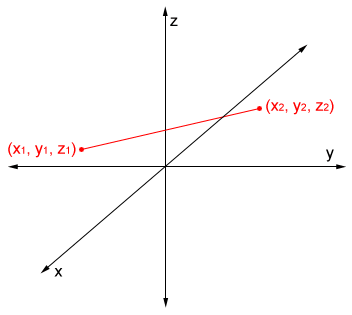
- Change in X direction is \( x_2 – x_1 \).
- Change in Y direction is \( y_2 – y_1 \).
- Change in Z direction is \( z_2 – z_1 \).
Apply Pythagoras in 3D by treating all three squared differences as perpendicular components.
Distance Formula
\( P_1P_2 = \sqrt{(x_2 – x_1)^2 + (y_2 – y_1)^2 + (z_2 – z_1)^2} \)
Important Concepts for JEE
- Order of points does not matter because squared differences remain the same.
- Distance is always non negative. Zero distance means both points coincide.
- The formula is derived from the 3D Pythagorean theorem.
- Distance helps determine collinearity, length of edges in 3D geometry, and is widely used in coordinate proofs.
- Required in problems involving spheres, shortest paths, and geometry in space.
Special Situations (Very Useful in JEE)
- When two coordinates are equal: If \( z_1 = z_2 \) then distance reduces to \( \sqrt{(x_2 – x_1)^2 + (y_2 – y_1)^2} \) This means the points lie in a plane parallel to the XY plane.
- When one coordinate differs: If points differ only in \( z \) coordinate, distance is simply \( |z_2 – z_1| \).
- Distance from origin: For point \( P(x, y, z) \), distance from origin \( O(0,0,0) \) is \( OP = \sqrt{x^2 + y^2 + z^2} \).
- Distance squared is often enough: In many questions, you only compare distances, so evaluating \( (x_2 – x_1)^2 + (y_2 – y_1)^2 + (z_2 – z_1)^2 \) without taking square root saves time.
Geometric Meaning
The quantity inside the square root represents the squared length of the diagonal of a cuboid whose sides are the differences in the coordinates. Thus distance is the space diagonal of that cuboid.
Example
Find the distance between points \( A(2, 3, 4) \) and \( B(6, 9, 8) \).
▶️ Answer / Explanation
Compute coordinate differences.
\( x_2 – x_1 = 6 – 2 = 4 \)
\( y_2 – y_1 = 9 – 3 = 6 \)
\( z_2 – z_1 = 8 – 4 = 4 \)
Distance is \( AB = \sqrt{4^2 + 6^2 + 4^2} = \sqrt{16 + 36 + 16} = \sqrt{68} \).
Simplify: \( \sqrt{68} = 2\sqrt{17} \).
Example
Find the distance of the point \( P(3, -4, 12) \) from the origin.
▶️ Answer / Explanation
Distance from origin is \( OP = \sqrt{x^2 + y^2 + z^2} \).
Substitute: \( OP = \sqrt{3^2 + (-4)^2 + 12^2} \)
\( OP = \sqrt{9 + 16 + 144} = \sqrt{169} = 13 \).
Example
Points \( A \) and \( B \) satisfy \( AB = 10 \). If \( A(1, 2, -3) \) and \( B(x, 6, 1) \), find the possible values of \( x \).
▶️ Answer / Explanation
Use formula \( AB = \sqrt{(x – 1)^2 + (6 – 2)^2 + (1 – (-3))^2} \).
Given \( AB = 10 \).
\( 10 = \sqrt{(x – 1)^2 + 4^2 + 4^2} \)
\( 100 = (x – 1)^2 + 16 + 16 \)
\( 100 = (x – 1)^2 + 32 \)
\( (x – 1)^2 = 68 \)
\( x – 1 = \pm\sqrt{68} = \pm 2\sqrt{17} \)
Thus possible values: \( x = 1 + 2\sqrt{17} \) or \( x = 1 – 2\sqrt{17} \).
Distance of a Point From a Plane
The shortest distance from a point to a plane is always the length of the perpendicular drawn from the point to the plane. In 3D coordinate geometry, this distance can be calculated using a simple formula.
Standard Distance Formula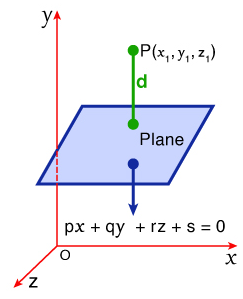
If a plane is given by
\( ax + by + cz + d = 0 \)
and the point is \( P(x_1, y_1, z_1) \), then the perpendicular distance is
\( D = \dfrac{|ax_1 + by_1 + cz_1 + d|}{\sqrt{a^2 + b^2 + c^2}} \)
Important Notes
- The absolute value ensures distance is always positive.
- \( a, b, c \) represent the normal vector to the plane.
- Works only in the general form \( ax + by + cz + d = 0 \).
- If plane is not in standard form, rearrange it first.
Distance From Origin
For plane \( ax + by + cz + d = 0 \), distance from origin \( (0, 0, 0) \) is
\( D = \dfrac{|d|}{\sqrt{a^2 + b^2 + c^2}} \)
Significance for JEE
- Used to find distance between parallel planes.
- Used in shortest distance problems involving point to plane projections.
- Used in many geometry questions involving reflection and locus.
Example
Find the distance of point \( P(2, 3, 6) \) from plane \( x + 2y + 2z – 10 = 0 \).
▶️ Answer / Explanation
Apply distance formula:
\( D = \dfrac{|1\cdot2 + 2\cdot3 + 2\cdot6 – 10|}{\sqrt{1^2 + 2^2 + 2^2}} \)
\( = \dfrac{|2 + 6 + 12 – 10|}{\sqrt{9}} = \dfrac{10}{3} \)
Distance = \( \dfrac{10}{3} \).
Example
Find the distance of point \( P(-1, 4, 2) \) from plane \( 2x – y + 2z + 3 = 0 \).
▶️ Answer / Explanation
Use distance formula:
\( D = \dfrac{|2(-1) – 1(4) + 2(2) + 3|}{\sqrt{2^2 + (-1)^2 + 2^2}} \)
\( = \dfrac{|-2 – 4 + 4 + 3|}{\sqrt{9}} = \dfrac{1}{3} \)
Distance = \( \dfrac{1}{3} \).
Example
Find the distance of point \( P(3, -2, 7) \) from the plane passing through points \( A(1, 0, 2) \), \( B(3, -1, 4) \), \( C(5, 2, 1) \).
▶️ Answer / Explanation
Step 1: Find normal vector of the plane.
Vectors:
\( \overrightarrow{AB} = (3 – 1,\; -1 – 0,\; 4 – 2) = (2, -1, 2) \)
\( \overrightarrow{AC} = (5 – 1,\; 2 – 0,\; 1 – 2) = (4, 2, -1) \)
Normal vector \( \vec{n} = \overrightarrow{AB} \times \overrightarrow{AC} \).
\( \vec{n} = \begin{vmatrix} \hat{i} & \hat{j} & \hat{k} \\ 2 & -1 & 2 \\ 4 & 2 & -1 \end{vmatrix} \)
\( = \hat{i}((-1)(-1) – 2\cdot2) – \hat{j}(2(-1) – 2\cdot4) + \hat{k}(2\cdot2 – (-1)4) \)
\( = \hat{i}(1 – 4) – \hat{j}(-2 – 8) + \hat{k}(4 + 4) \)
\( = \hat{i}(-3) – \hat{j}(-10) + \hat{k}(8) \)
Normal vector \( = (-3, 10, 8) \)
Step 2: Plane equation using point normal form.
\( -3(x – 1) + 10(y – 0) + 8(z – 2) = 0 \)
Simplify:
\( -3x + 3 + 10y + 8z – 16 = 0 \)
\( -3x + 10y + 8z – 13 = 0 \)
Step 3: Distance from point \( P(3, -2, 7) \).
\( D = \dfrac{|-3(3) + 10(-2) + 8(7) – 13|}{\sqrt{(-3)^2 + 10^2 + 8^2}} \)
\( = \dfrac{|-9 – 20 + 56 – 13|}{\sqrt{9 + 100 + 64}} \)
\( = \dfrac{|14|}{\sqrt{173}} = \dfrac{14}{\sqrt{173}} \)
Distance = \( \dfrac{14}{\sqrt{173}} \).
Distance Between Parallel Planes
Two planes are parallel when their normal vectors are proportional. For such planes, the shortest distance between them can be found using a direct formula.
Condition for Parallel Planes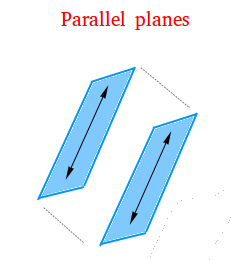
Planes
\( a_1 x + b_1 y + c_1 z + d_1 = 0 \) \( a_2 x + b_2 y + c_2 z + d_2 = 0 \)
are parallel if
\( \dfrac{a_1}{a_2} = \dfrac{b_1}{b_2} = \dfrac{c_1}{c_2} \)
This means their normal vectors point in the same (or opposite) direction.
Distance Between Two Parallel Planes
If two planes are parallel and written in the form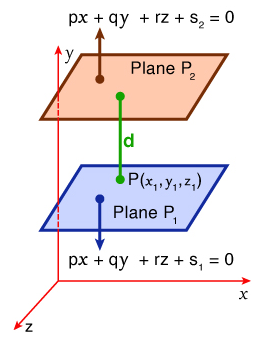
\( ax + by + cz + d_1 = 0 \)
\( ax + by + cz + d_2 = 0 \)
then the perpendicular distance between them is
\( D = \dfrac{|d_1 – d_2|}{\sqrt{a^2 + b^2 + c^2}} \)
Important Notes for JEE
- Write both planes with identical coefficients \( a, b, c \) before applying the formula.
- No need to find any point on the plane since formula is direct.
- Distance is always positive due to absolute value.
- Used frequently in locus, coordinate geometry, vector geometry, and shortest distance problems.
Example
Find the distance between the planes \( x + y + z – 6 = 0 \) and \( x + y + z – 2 = 0 \).
▶️ Answer / Explanation
Coefficients \( a = 1,\; b = 1,\; c = 1 \).
\( D = \dfrac{|(-6) – (-2)|}{\sqrt{1^2 + 1^2 + 1^2}} \)
\( = \dfrac{|-4|}{\sqrt{3}} = \dfrac{4}{\sqrt{3}} \)
Distance = \( \dfrac{4}{\sqrt{3}} \).
Example
Find the distance between the planes \( 2x – y + 2z + 5 = 0 \) and \( 4x – 2y + 4z – 7 = 0 \).
▶️ Answer / Explanation
First make coefficients identical.
Divide second plane by 2:
\( 2x – y + 2z – \dfrac{7}{2} = 0 \)
Now both planes are
\( 2x – y + 2z + 5 = 0 \)
\( 2x – y + 2z – \dfrac{7}{2} = 0 \)
Apply formula:
\( D = \dfrac{\left|5 – \left(-\dfrac{7}{2}\right)\right|}{\sqrt{2^2 + (-1)^2 + 2^2}} \)
\( = \dfrac{|5 + \dfrac{7}{2}|}{\sqrt{9}} = \dfrac{\dfrac{17}{2}}{3} \)
\( D = \dfrac{17}{6} \)
Distance = \( \dfrac{17}{6} \).
Example
Find the distance between planes \( 3x + 6y – 3z + 12 = 0 \) and \( x + 2y – z – 5 = 0 \).
▶️ Answer / Explanation
First ensure same coefficients.
Divide first plane by 3:
\( x + 2y – z + 4 = 0 \)
Second plane is already
\( x + 2y – z – 5 = 0 \)
Apply formula:
\( D = \dfrac{|4 – (-5)|}{\sqrt{1^2 + 2^2 + (-1)^2}} \)
\( = \dfrac{9}{\sqrt{6}} \)
Distance = \( \dfrac{9}{\sqrt{6}} \).