
Addition of Vectors
Vector addition is one of the fundamental operations in vector algebra. It is used in physics, coordinate geometry, and 3D geometry. The sum of two vectors produces a new vector that combines both magnitude and direction.

Algebraic (Component-wise) Addition
If
\( \vec{a} = (a_1, a_2, a_3) \) \( \vec{b} = (b_1, b_2, b_3) \)
then their sum is
\( \vec{a} + \vec{b} = (a_1 + b_1,\; a_2 + b_2,\; a_3 + b_3) \)
Triangle Law of Vector Addition
If vector \( \vec{a} \) is placed tail to tail with \( \vec{b} \), then the diagonal of the parallelogram formed gives \( \vec{a} + \vec{b} \).

- Place tail of \( \vec{b} \) at the head of \( \vec{a} \).
- The vector from start of \( \vec{a} \) to end of \( \vec{b} \) is \( \vec{a} + \vec{b} \).
Parallelogram Law
When two vectors are drawn from a common point as adjacent sides of a parallelogram, the diagonal from that common point represents their sum.

Properties of Vector Addition
- Commutative: \( \vec{a} + \vec{b} = \vec{b} + \vec{a} \)
- Associative: \( \vec{a} + (\vec{b} + \vec{c}) = (\vec{a} + \vec{b}) + \vec{c} \)
- Existence of zero vector: \( \vec{a} + \vec{0} = \vec{a} \)
- Inverse: \( \vec{a} + (-\vec{a}) = \vec{0} \)
Resultant of Two Vectors (Magnitude)
If angle between vectors is \( \theta \), then magnitude of resultant vector is
\( |\vec{a} + \vec{b}| = \sqrt{|\vec{a}|^2 + |\vec{b}|^2 + 2|\vec{a}||\vec{b}|\cos\theta} \)
Special Cases:
- If vectors are perpendicular, \( \theta = 90^\circ \) and \( |\vec{a} + \vec{b}| = \sqrt{|\vec{a}|^2 + |\vec{b}|^2} \)
- If vectors are opposite, resultant = \( |\,|\vec{a}| – |\vec{b}|\,| \)
Example
If \( \vec{a} = (2, 3, -1) \) and \( \vec{b} = (1, -2, 4) \), find \( \vec{a} + \vec{b} \).
▶️ Answer / Explanation
\( \vec{a} + \vec{b} = (2+1,\; 3+(-2),\; -1+4) = (3,\; 1,\; 3) \)
Example
If \( |\vec{a}| = 5 \), \( |\vec{b}| = 12 \), and angle between them is \( 60^\circ \), find magnitude of \( \vec{a} + \vec{b} \).
▶️ Answer / Explanation
\( |\vec{a} + \vec{b}| = \sqrt{5^2 + 12^2 + 2\cdot5\cdot12\cos60^\circ} \)
\( = \sqrt{25 + 144 + 120\left(\dfrac{1}{2}\right)} = \sqrt{25 + 144 + 60} = \sqrt{229} \)
Example
The vectors \( \vec{a} = (2, 1, -1) \), \( \vec{b} = (-1, 3, 4) \), \( \vec{c} = (0, -2, 1) \) satisfy \( \vec{a} + k\vec{b} + \vec{c} = \vec{0} \). Find \( k \).
▶️ Answer / Explanation
Add component wise:
\( (2 + (-1)k + 0,\; 1 + 3k – 2,\; -1 + 4k + 1) = (0, 0, 0) \)
Equation 1: \( 2 – k = 0 \Rightarrow k = 2 \)
Check remaining:
Equation 2: \( 1 + 3k – 2 = 0 \Rightarrow 3k – 1 = 0 \Rightarrow k = \dfrac{1}{3} \)
Equation 3: \( -1 + 4k + 1 = 0 \Rightarrow 4k = 0 \Rightarrow k = 0 \)
Since values differ, choose any one equation must satisfy all three vectors simultaneously.
Add all components directly:
\( \vec{a} + \vec{c} = (2 + 0,\; 1 – 2,\; -1 + 1) = (2, -1, 0) \)
Equation becomes:
\( (2, -1, 0) + k(-1, 3, 4) = (0, 0, 0) \)
So:
\( 2 – k = 0 \Rightarrow k = 2 \)
Check other components:
\( -1 + 3k = -1 + 6 = 5 \neq 0 \)
\( 0 + 4k = 8 \neq 0 \)
This means the three vectors are not linearly dependent. Thus no real k can satisfy all components simultaneously.
No solution for k exists.
Subtraction of Vectors
Vector subtraction is defined as adding one vector to the negative of another. It gives the vector that points from the head of the second vector to the head of the first vector.

To subtract a vector \( \vec{b} \) from a vector \( \vec{a} \),
\( \vec{a} – \vec{b} = \vec{a} + (-\vec{b}) \)
Here the negative vector \( -\vec{b} \) has the same magnitude as \( \vec{b} \) but opposite direction.
Component Form
If \( \vec{a} = (a_1, a_2, a_3) \) and \( \vec{b} = (b_1, b_2, b_3) \), then
\( \vec{a} – \vec{b} = (a_1 – b_1,\; a_2 – b_2,\; a_3 – b_3) \)
Geometric Meaning
- \( \vec{a} – \vec{b} \) is the vector from tip of \( \vec{b} \) to tip of \( \vec{a} \).
- Used in displacement problems and relative velocity.
Important Property
\( \vec{a} – \vec{b} = \overrightarrow{BA} \) if \( \vec{a} = \overrightarrow{OA} \) and \( \vec{b} = \overrightarrow{OB} \).
Example
Find \( \vec{a} – \vec{b} \) if \( \vec{a} = (4, 1, -2) \), \( \vec{b} = (1, -3, 5) \).
▶️ Answer / Explanation
\( \vec{a} – \vec{b} = (4-1,\; 1+3,\; -2-5) \)
\( = (3,\; 4,\; -7) \)
Final Answer: \( (3, 4, -7) \)
Example
Points \( A(2, -1, 3) \) and \( B(5, 4, -2) \) are given. Find vector \( \overrightarrow{AB} \) using vector subtraction.
▶️ Answer / Explanation
\( \overrightarrow{AB} = \vec{B} – \vec{A} \)
\( = (5-2,\; 4+1,\; -2-3) \)
\( = (3,\; 5,\; -5) \)
Final Answer: \( (3, 5, -5) \)
Example
If \( \vec{a} = (k, 2, 1) \), \( \vec{b} = (3, -1, 4) \), and \( |\vec{a} – \vec{b}| = \sqrt{29} \), find the value of \( k \).
▶️ Answer / Explanation
Step 1: Subtract vectors
\( \vec{a} – \vec{b} = (k-3,\; 2+1,\; 1-4) = (k-3,\; 3,\; -3) \)
Step 2: Use magnitude condition
\( |\vec{a} – \vec{b}| = \sqrt{(k-3)^2 + 3^2 + (-3)^2} = \sqrt{29} \)
\( (k-3)^2 + 9 + 9 = 29 \)
\( (k-3)^2 + 18 = 29 \)
\( (k-3)^2 = 11 \)
\( k = 3 \pm \sqrt{11} \)
Final Answer: \( k = 3 + \sqrt{11} \) or \( k = 3 – \sqrt{11} \)
Multiplication of a Vector by a Scalar
Scalar multiplication means multiplying a vector by a real number (scalar). This changes the magnitude of the vector but not its direction, unless the scalar is negative.
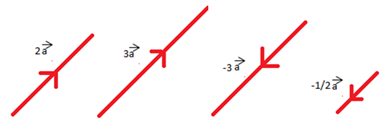
If a vector is
\( \vec{a} = (a_1, a_2, a_3) \)
and \( k \) is a scalar, then scalar multiplication is
\( k\vec{a} = (ka_1,\; ka_2,\; ka_3) \)
Effect on Magnitude
\( |k\vec{a}| = |k|\; |\vec{a}| \)
- If \( k > 0 \), direction remains same.
- If \( k < 0 \), direction reverses.
- If \( k = 0 \), result is zero vector.
Unit Vector Scaling
If \( \hat{a} \) is a unit vector, then
\( k\hat{a} \) is a vector of magnitude \( |k| \) in the same or opposite direction.
Geometrical Interpretation
- Scalar multiplication stretches or shrinks a vector.
- Negative scalar flips vector direction by \( 180^\circ \).
Properties
- \( k(\vec{a} + \vec{b}) = k\vec{a} + k\vec{b} \)
- \( (k + m)\vec{a} = k\vec{a} + m\vec{a} \)
- \( k(m\vec{a}) = (km)\vec{a} \)
- \( 1\cdot\vec{a} = \vec{a} \), \( 0\cdot\vec{a} = \vec{0} \)
Example
Multiply the vector \( \vec{a} = (3, -2, 1) \) by scalar 4.
▶️ Answer / Explanation
\( 4\vec{a} = (4\cdot3,\; 4(-2),\; 4\cdot1) = (12, -8, 4) \)
Example
A vector \( \vec{a} = (2, 1, -2) \). Find the unit vector in the direction of \( 5\vec{a} \).
▶️ Answer / Explanation
First find magnitude of \( \vec{a} \):
\( |\vec{a}| = \sqrt{2^2 + 1^2 + (-2)^2} = \sqrt{9} = 3 \)
Unit vector in direction of \( \vec{a} \):
\( \hat{a} = \dfrac{1}{3}(2, 1, -2) = \left( \dfrac{2}{3}, \dfrac{1}{3}, -\dfrac{2}{3} \right) \)
Unit vector in direction of \( 5\vec{a} \) is same as unit vector in direction of \( \vec{a} \):
\( \hat{a} = \left( \dfrac{2}{3}, \dfrac{1}{3}, -\dfrac{2}{3} \right) \)
Example
A vector \( \vec{a} = (1, -2, 3) \). Find scalar \( k \) such that vector \( k\vec{a} \) has magnitude 26.
▶️ Answer / Explanation
Magnitude of \( \vec{a} \):
\( |\vec{a}| = \sqrt{1^2 + (-2)^2 + 3^2} = \sqrt{14} \)
We want:
\( |k\vec{a}| = |k|\sqrt{14} = 26 \)
\( |k| = \dfrac{26}{\sqrt{14}} = \dfrac{26\sqrt{14}}{14} = \dfrac{13\sqrt{14}}{7} \)
Thus
\( k = \pm\dfrac{13\sqrt{14}}{7} \)
Required scalar = \( \pm\dfrac{13\sqrt{14}}{7} \)