
Scalar Triple Product (STP)
The scalar triple product is a very important concept in vector algebra. It gives the volume of the parallelepiped formed by three vectors and is frequently used in JEE for coplanarity checks, vector geometry proofs, and volume-based problems.
If \( \vec{a} = (a_1, a_2, a_3) \), \( \vec{b} = (b_1, b_2, b_3) \), \( \vec{c} = (c_1, c_2, c_3) \), then the scalar triple product is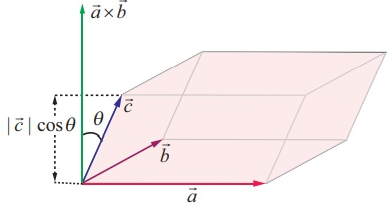
\( [\vec{a}\ \vec{b}\ \vec{c}] = \vec{a} \cdot (\vec{b} \times \vec{c}) \)
It is a scalar.
Determinant Form
\( [\vec{a}\ \vec{b}\ \vec{c}] = \begin{vmatrix} a_1 & a_2 & a_3 \\ b_1 & b_2 & b_3 \\ c_1 & c_2 & c_3 \end{vmatrix} \)
This is the most commonly used method in JEE.
Geometric Interpretation
- Magnitude gives volume of parallelepiped formed by vectors \( \vec{a}, \vec{b}, \vec{c} \).
- Half of this gives the volume of the tetrahedron.
- Sign indicates orientation but magnitude matters in geometry.
Condition for Coplanarity
Vectors \( \vec{a}, \vec{b}, \vec{c} \) are coplanar if and only if \( [\vec{a}\ \vec{b}\ \vec{c}] = 0 \)
Properties of Scalar Triple Product
- Cyclic permutations do not change value \( [\vec{a}\ \vec{b}\ \vec{c}] = [\vec{b}\ \vec{c}\ \vec{a}] = [\vec{c}\ \vec{a}\ \vec{b}] \)
- Interchange of any two vectors changes sign \( [\vec{a}\ \vec{b}\ \vec{c}] = -[\vec{b}\ \vec{a}\ \vec{c}] \)
- If two vectors are parallel, STP is zero.
- Linearity: \( [k\vec{a}\ \vec{b}\ \vec{c}] = k[\vec{a}\ \vec{b}\ \vec{c}] \)
Example
Find the scalar triple product of vectors \( \vec{a} = (1, 2, 3) \), \( \vec{b} = (2, 0, 1) \), \( \vec{c} = (1, -1, 2) \).
▶️ Answer / Explanation
\( [\vec{a}\ \vec{b}\ \vec{c}] = \begin{vmatrix} 1 & 2 & 3 \\ 2 & 0 & 1 \\ 1 & -1 & 2 \end{vmatrix} \)
\( = 1(0\cdot2 – 1(-1)) – 2(2\cdot2 – 1\cdot1) + 3(2(-1) – 0\cdot1) \)
\( = 1(0 + 1) – 2(4 – 1) + 3(-2) \)
\( = 1 – 6 – 6 = -11 \)
STP = -11
Example
Find the volume of the parallelepiped formed by vectors \( \vec{a} = (3, -1, 2) \), \( \vec{b} = (1, 4, 0) \), \( \vec{c} = (2, 1, 1) \).
▶️ Answer / Explanation
\( [\vec{a}\ \vec{b}\ \vec{c}] = \begin{vmatrix} 3 & -1 & 2 \\ 1 & 4 & 0 \\ 2 & 1 & 1 \end{vmatrix} \)
\( = 3(4\cdot1 – 0\cdot1) – (-1)(1\cdot1 – 0\cdot2) + 2(1\cdot1 – 4\cdot2) \)
\( = 3(4) + (1)(1) + 2(1 – 8) \)
\( = 12 + 1 + 2(-7) = 13 – 14 = -1 \)
Volume = |STP| = 1
Example
The vectors \( \vec{a} = (k, 1, 2) \), \( \vec{b} = (2, -1, 3) \), \( \vec{c} = (1, 4, -1) \) are coplanar. Find value of \( k \).
▶️ Answer / Explanation
Coplanar means STP = 0.
\( \begin{vmatrix} k & 1 & 2 \\ 2 & -1 & 3 \\ 1 & 4 & -1 \end{vmatrix} = 0 \)
Expand along first row:
\( k((-1)(-1) – 3\cdot4) – 1(2(-1) – 3\cdot1) + 2(2\cdot4 – (-1)\cdot1) = 0 \)
\( k(1 – 12) – ( -2 – 3) + 2(8 + 1) = 0 \)
\( k(-11) – (-5) + 18 = 0 \)
\( -11k + 5 + 18 = 0 \)
\( -11k + 23 = 0 \)
\( k = \dfrac{23}{11} \)
Thus \( k = \dfrac{23}{11} \)
Condition for Coplanarity of Four Points
Four points in 3D are said to be coplanar if they lie on the same plane. In other words, there exists a plane that passes through all four points. A powerful way to check coplanarity is by using the scalar triple product.
Geometric Idea
Three points always determine a plane. The fourth point must lie in that same plane for all four to be coplanar. This happens when the volume of the tetrahedron formed by the four points is zero.
Scalar Triple Product Condition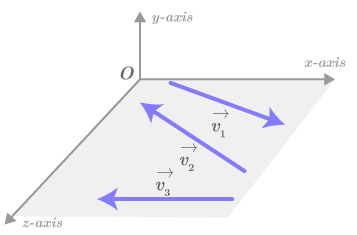
Let the four points be
\( A(x_1, y_1, z_1),\; B(x_2, y_2, z_2),\; C(x_3, y_3, z_3),\; D(x_4, y_4, z_4) \)
Vectors:
\( \overrightarrow{AB},\; \overrightarrow{AC},\; \overrightarrow{AD} \)
The four points are coplanar when
\( \overrightarrow{AB} \cdot (\overrightarrow{AC} \times \overrightarrow{AD}) = 0 \)
This ensures zero volume, hence coplanarity.
Determinant Form (Most Useful in JEE)
The points are coplanar when the determinant
\( \begin{vmatrix} x_2 – x_1 & y_2 – y_1 & z_2 – z_1 \\ x_3 – x_1 & y_3 – y_1 & z_3 – z_1 \\ x_4 – x_1 & y_4 – y_1 & z_4 – z_1 \end{vmatrix} = 0 \)
Important Notes for JEE
- If determinant is zero, points are coplanar.
- If determinant is non zero, points form a tetrahedron with non zero volume.
- Any point can be chosen as reference; result remains the same.
- Coplanarity is useful in plane equations, vectors, and 3D geometry problems.
Example
Check whether points \( A(1, 2, 3) \), \( B(2, 4, 6) \), \( C(3, 6, 9) \), and \( D(4, 8, 12) \) are coplanar.
▶️ Answer / Explanation
Compute vectors:
\( \overrightarrow{AB} = (1, 2, 3) \)
\( \overrightarrow{AC} = (2, 4, 6) \)
\( \overrightarrow{AD} = (3, 6, 9) \)
Form determinant:
\( \begin{vmatrix} 1 & 2 & 3 \\ 2 & 4 & 6 \\ 3 & 6 & 9 \end{vmatrix} \)
Rows are multiples of each other, determinant = 0.
Points are coplanar.
Example
Check if points \( A(1, 0, 2) \), \( B(3, -2, 4) \), \( C(5, 1, 3) \), \( D(7, -1, 5) \) are coplanar.
▶️ Answer / Explanation
Compute vectors using A as reference:
\( \overrightarrow{AB} = (2, -2, 2) \)
\( \overrightarrow{AC} = (4, 1, 1) \)
\( \overrightarrow{AD} = (6, -1, 3) \)
Determinant:
\( \begin{vmatrix} 2 & -2 & 2 \\ 4 & 1 & 1 \\ 6 & -1 & 3 \end{vmatrix} \)
Expand:
\( 2(1\cdot3 – 1(-1)) – (-2)(4\cdot3 – 1\cdot6) + 2(4(-1) – 1\cdot6) \)
\( = 2(3 + 1) – (-2)(12 – 6) + 2(-4 – 6) \)
\( = 2(4) + 2(6) + 2(-10) \)
\( = 8 + 12 – 20 = 0 \)
Points are coplanar.
Example
Check if points \( A(2, -1, 3) \), \( B(4, 2, 5) \), \( C(6, 1, 4) \), \( D(3, -3, 7) \) are coplanar.
▶️ Answer / Explanation
Compute vectors using A as reference:
\( \overrightarrow{AB} = (2, 3, 2) \)
\( \overrightarrow{AC} = (4, 2, 1) \)
\( \overrightarrow{AD} = (1, -2, 4) \)
Determinant:
\( \begin{vmatrix} 2 & 3 & 2 \\ 4 & 2 & 1 \\ 1 & -2 & 4 \end{vmatrix} \)
Expand:
\( 2(2\cdot4 – 1(-2)) – 3(4\cdot4 – 1\cdot1) + 2(4(-2) – 2\cdot1) \)
\( = 2(8 + 2) – 3(16 – 1) + 2(-8 – 2) \)
\( = 2(10) – 3(15) + 2(-10) \)
\( = 20 – 45 – 20 = -45 \)
Determinant \( \ne 0 \).
Points are not coplanar.