
Addition and Multiplication Theorems of Probability
These two theorems are the foundation of probability. Nearly every JEE probability problem uses these formulas.
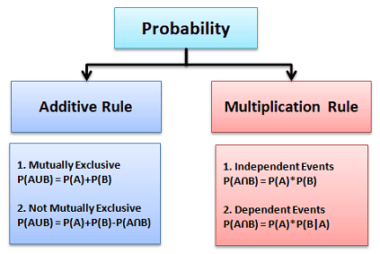
Addition Theorem of Probability
(a) For Mutually Exclusive Events
If two events cannot occur together (like getting 2 or 5 on a die):
\( P(A \cup B) = P(A) + P(B) \)
Because
\( P(A \cap B) = 0 \)
(b) General Addition Rule (Events may occur together)
\( P(A \cup B) = P(A) + P(B) – P(A \cap B) \)
This is the most frequently used rule in JEE.
(c) Extension to Three Events
\( P(A \cup B \cup C) = P(A) + P(B) + P(C)\newline – P(A \cap B) – P(B \cap C) – P(C \cap A) + P(A \cap B \cap C) \)
Multiplication Theorem of Probability
The multiplication theorem connects intersection of events with independence or conditional probability.
(a) General Multiplication Theorem
For any two events:
\( P(A \cap B) = P(A)\cdot P(B|A) \)
And also:
\( P(A \cap B) = P(B)\cdot P(A|B) \)
(b) Independent Events
Two events are independent if occurrence of one does not affect the other.
\( P(A \cap B) = P(A)P(B) \)
This special case is used heavily in JEE.
(c) Extension to Three Independent Events
\( P(A \cap B \cap C) = P(A)P(B)P(C) \)
Valid only when all three are mutually independent.
Useful Identities
- \( P(A \cup B)’ = P(A’ \cap B’) \)
- \( P(A \cap B)’ = P(A’ \cup B’) \)
- \( P(A \cup B) = 1 – P(A’ \cap B’) \)
- \( P(\text{none}) = 1 – P(\text{at least one}) \)
Example
Two dice are rolled. Find the probability of getting at least one 6.
▶️ Answer / Explanation
Use addition theorem. Let:
\( A = \) first die shows 6
\( B = \) second die shows 6
\( P(A) = \dfrac{1}{6},\ P(B) = \dfrac{1}{6} \)
\( P(A \cap B) = \dfrac{1}{36} \)
\( P(A \cup B) = P(A) + P(B) – P(A \cap B) \)
\( = \dfrac{1}{6} + \dfrac{1}{6} – \dfrac{1}{36} = \dfrac{11}{36} \)
Answer: \( \dfrac{11}{36} \)
Example
A coin is tossed three times. Find the probability of getting exactly two heads.
▶️ Answer / Explanation
Independent events: each toss
Possible sequences with exactly 2 heads: HHT, HTH, THH → 3 outcomes
Total outcomes = 8
\( P = \dfrac{3}{8} \)
Answer: \( \dfrac{3}{8} \)
Example
In a class, 70% students pass in Maths, 60% in Physics, and 50% in both. Find the probability that a randomly chosen student passes in at least one subject.
▶️ Answer / Explanation
Use addition theorem:
\( P(M \cup P) = P(M) + P(P) – P(M \cap P) \)
\( = 0.7 + 0.6 – 0.5 = 0.8 \)
Answer: 0.8