
Heights and Distances
Heights and distances is a direct application of trigonometry, specifically the trigonometric ratios of acute angles. Questions usually involve angles of elevation, angles of depression, and right triangle geometry.
Angle of Elevation
If an observer looks upward from the horizontal line of sight to an object, the angle made with the horizontal is the angle of elevation.
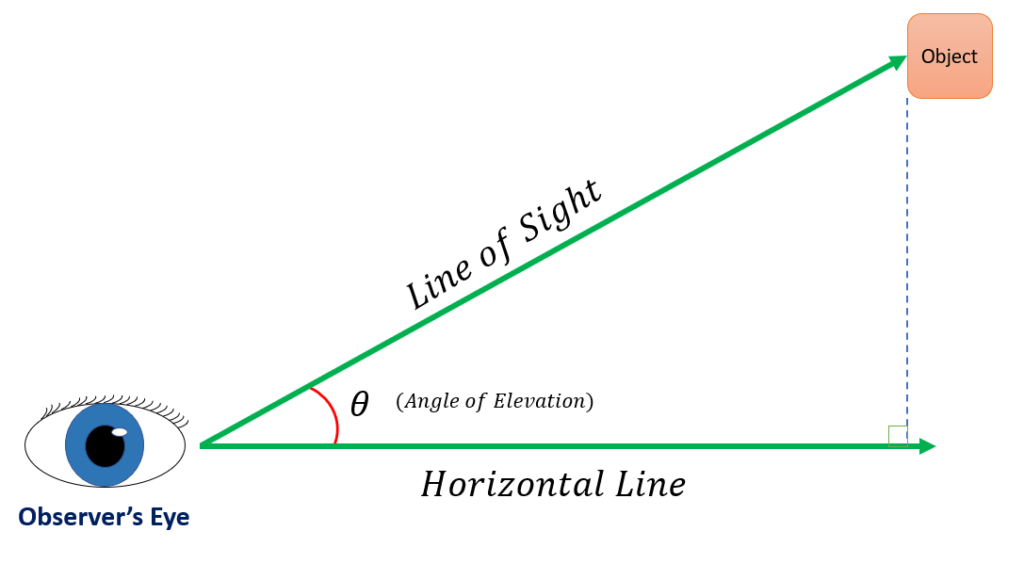
- Used when object is above the observer.
- Always measured from horizontal line.
Angle of Depression
If an observer looks downward from the horizontal toward an object, the angle formed is the angle of depression.
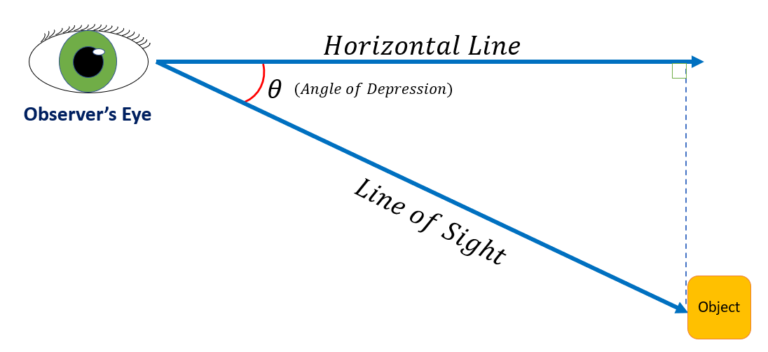
- Object is below the observer.
- Angle formed with horizontal line.
- Angle of depression = angle of elevation (alternate interior angles).
Standard Trigonometric Ratios Used
- \( \tan\theta = \dfrac{\text{Opposite}}{\text{Adjacent}} \)
- \( \sin\theta = \dfrac{\text{Opposite}}{\text{Hypotenuse}} \)
- \( \cos\theta = \dfrac{\text{Adjacent}}{\text{Hypotenuse}} \)
Most JEE questions rely heavily on \( \tan\theta \).
Common Geometric Configurations
- Vertical height of tower or building.
- Horizontal distance between observer and object.
- Two observers looking at same object.
- Object moving towards or away from observer.
- Angle changes over time.
Useful Observations
- Increase in angle of elevation implies decrease in distance.
- When object is moving upward or downward, height changes.
- Angles formed by depression equal angles of elevation.
- Use geometry carefully to avoid sign mistakes.
Standard Results (Very Important)
(a) Same tower, two angles of elevation \( \alpha \) and \( \beta \)
Let height = \( h \), distances = \( d_1 \) and \( d_2 \).
\( \tan\alpha = \dfrac{h}{d_1} \), \( \tan\beta = \dfrac{h}{d_2} \)
If the observer moves closer or farther:
\( d_1 – d_2 = \text{horizontal distance travelled} \)
(b) Angles of elevation from two different heights
Used when observer is at two levels of a building.
(c) Object between two observers
Use \( \tan\theta = \dfrac{\text{height}}{\text{distance}} \) on both sides.
(d) Angle of depression
Angle of depression from the top equals the angle of elevation from the ground.
Example
A tower is 20 meters high. Find the distance from the foot of the tower where the angle of elevation to the top is \( 45^\circ \).
▶️ Answer / Explanation
Use \( \tan 45^\circ = 1 \)
\( \tan 45^\circ = \dfrac{20}{d} \Rightarrow 1 = \dfrac{20}{d} \Rightarrow d = 20 \)
Distance = 20 meters
Example
From a point 50 meters away from a building, the angle of elevation of the top is \( 30^\circ \). Find the height of the building.
▶️ Answer / Explanation
\( \tan 30^\circ = \dfrac{h}{50} \)
\( \dfrac{1}{\sqrt{3}} = \dfrac{h}{50} \Rightarrow h = \dfrac{50}{\sqrt{3}} \)
Rationalize: \( h = \dfrac{50\sqrt{3}}{3} \)
Height = \( \dfrac{50\sqrt{3}}{3} \) meters
Example
From the top of a 60 meter high tower, the angle of depression of a car on the road is \( 30^\circ \). Find the horizontal distance of the car from the tower.
▶️ Answer / Explanation
Angle of depression = angle of elevation from the car.
Let horizontal distance = \( d \)
\( \tan 30^\circ = \dfrac{60}{d} \)
\( \dfrac{1}{\sqrt{3}} = \dfrac{60}{d} \Rightarrow d = 60\sqrt{3} \)
Horizontal distance = \( 60\sqrt{3} \) meters