
1. Nature of Roots (Based on Discriminant)
For a quadratic equation \( ax^2 + bx + c = 0 \), the discriminant is given by:
\( D = b^2 – 4ac \)
The nature of roots depends on the value of \( D \):
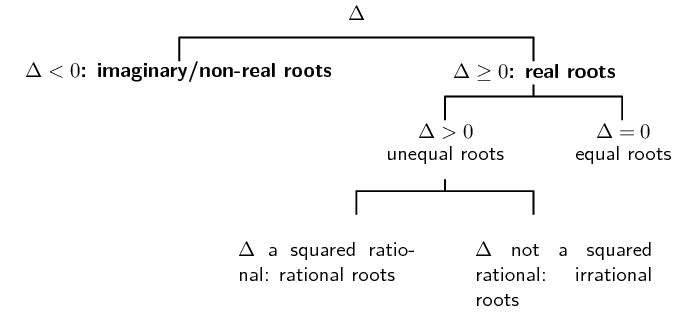
| Discriminant (D) | Nature of Roots | Example |
|---|---|---|
| \( D > 0 \) | Two distinct real roots | \( x^2 – 5x + 6 = 0 \) |
| \( D = 0 \) | Two equal real roots | \( x^2 – 4x + 4 = 0 \) |
| \( D < 0 \) | Two non-real complex conjugate roots | \( x^2 – 2x + 5 = 0 \) |
2. Formula for Roots
The roots of \( ax^2 + bx + c = 0 \) are given by:
\( x = \dfrac{-b \pm \sqrt{b^2 – 4ac}}{2a} \)
3. Formation of Equation from Given Roots
If the roots of a quadratic equation are \( \alpha \) and \( \beta \), the equation is:
\( x^2 – (\alpha + \beta)x + \alpha\beta = 0 \)
If one root is given in terms of the other, the same relation can be used to find both roots and form the equation.
Example
Find the nature of the roots of \( 2x^2 – 3x + 1 = 0 \).
▶️ Answer / Explanation
Step 1: Identify coefficients: \( a = 2, b = -3, c = 1 \)
Step 2: Discriminant \( D = b^2 – 4ac = (-3)^2 – 4(2)(1) = 9 – 8 = 1 \)
Step 3: Since \( D > 0 \), the equation has two distinct real roots.
Step 4: Roots are \( x = \dfrac{3 \pm 1}{4} \Rightarrow x = 1, \dfrac{1}{2} \)
Conclusion: Roots are real and unequal.
Example
Find the quadratic equation whose roots are \( 3 \) and \( 4 \).
▶️ Answer / Explanation
Step 1: Sum of roots \( = 3 + 4 = 7 \)
Product of roots \( = 3 \times 4 = 12 \)
Step 2: Required equation: \( x^2 – (\alpha + \beta)x + \alpha\beta = 0 \)
\( \Rightarrow x^2 – 7x + 12 = 0 \)
Conclusion: The required equation is \( x^2 – 7x + 12 = 0 \).
Example
Find the quadratic equation whose roots are \( 2 + 3i \) and \( 2 – 3i \).
▶️ Answer / Explanation
Step 1: For complex conjugate roots:
\( \alpha = 2 + 3i, \; \beta = 2 – 3i \)
Step 2: Sum \( = \alpha + \beta = 4 \)
Product \( = \alpha\beta = (2 + 3i)(2 – 3i) = 4 + 9 = 13 \)
Step 3: Equation: \( x^2 – (\alpha + \beta)x + \alpha\beta = 0 \)
\( \Rightarrow x^2 – 4x + 13 = 0 \)
Step 4: Discriminant \( D = (-4)^2 – 4(1)(13) = 16 – 52 = -36 \lt 0 \)
Conclusion: The equation \( x^2 – 4x + 13 = 0 \) has complex conjugate roots \( 2 \pm 3i \).
Nature of Roots in terms of Graph (Position of Parabola with respect to x-axis)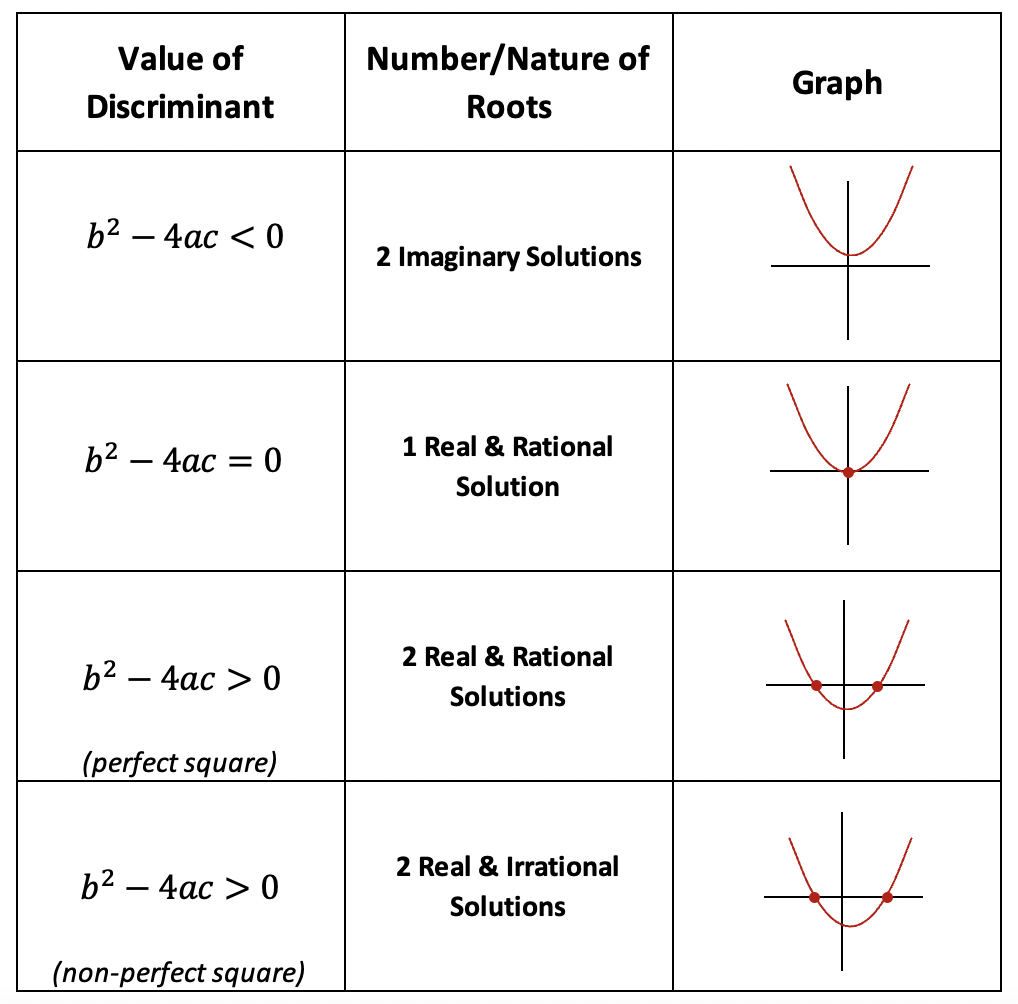
1. Standard Form of a Quadratic Equation
The general quadratic equation is given by:
\( y = ax^2 + bx + c \), where \( a \ne 0 \)
The graph of this equation is a parabola.
- If \( a > 0 \), the parabola opens upward.
- If \( a < 0 \), the parabola opens downward.
2. Discriminant and Graphical Meaning
The nature of the roots of the quadratic equation \( ax^2 + bx + c = 0 \) depends on the value of the discriminant \( D = b^2 – 4ac \):
| Value of \( D \) | Nature of Roots | Graphical Representation |
|---|---|---|
| \( D > 0 \) | Two distinct real roots | Parabola cuts the x-axis at two distinct points. |
| \( D = 0 \) | Two equal real roots | Parabola touches the x-axis (vertex on the x-axis). |
| \( D < 0 \) | No real roots (complex roots) | Parabola does not intersect the x-axis. |
3. Vertex of the Parabola
The vertex of the parabola \( y = ax^2 + bx + c \) is given by:

\( \left( \dfrac{-b}{2a}, \dfrac{-D}{4a} \right) \)
This shows how the discriminant \( D \) affects the vertical position of the vertex relative to the x-axis.
Example
Determine the nature of roots and sketch position of the parabola for \( y = x^2 – 5x + 6 \).
▶️ Answer / Explanation
Step 1: \( a = 1, b = -5, c = 6 \)
Step 2: \( D = b^2 – 4ac = (-5)^2 – 4(1)(6) = 25 – 24 = 1 \)
Step 3: Since \( D > 0 \), two distinct real roots exist.
Step 4: Roots are \( x = 2 \) and \( x = 3 \)
Step 5: Parabola opens upward (since \( a > 0 \)) and cuts the x-axis at two points \( x=2, 3 \).
Example
For the quadratic \( y = 2x^2 + 4x + 2 \), determine the nature of the roots and describe its graph.
▶️ Answer / Explanation
Step 1: \( a = 2, b = 4, c = 2 \)
Step 2: \( D = b^2 – 4ac = 16 – 16 = 0 \)
Step 3: Since \( D = 0 \), roots are real and equal.
Step 4: The vertex lies on the x-axis at \( x = -\dfrac{b}{2a} = -1 \)
Step 5: The parabola touches the x-axis at \( x = -1 \).
Example
Examine the position of the parabola for \( y = 3x^2 + 2x + 5 \) with respect to the x-axis.
▶️ Answer / Explanation
Step 1: \( a = 3, b = 2, c = 5 \)
Step 2: \( D = b^2 – 4ac = 4 – 60 = -56 \lt 0 \)
Step 3: Since \( D < 0 \), there are no real roots.
Step 4: The parabola opens upward (as \( a > 0 \)) and lies entirely above the x-axis.
Step 5: Its vertex is at \( \left( -\dfrac{b}{2a}, \dfrac{-D}{4a} \right) = \left( -\dfrac{1}{3}, \dfrac{56}{12} \right) \)
Conclusion: The parabola does not intersect the x-axis; roots are complex.
Cubic Equation
A cubic equation is a polynomial equation of degree three of the form: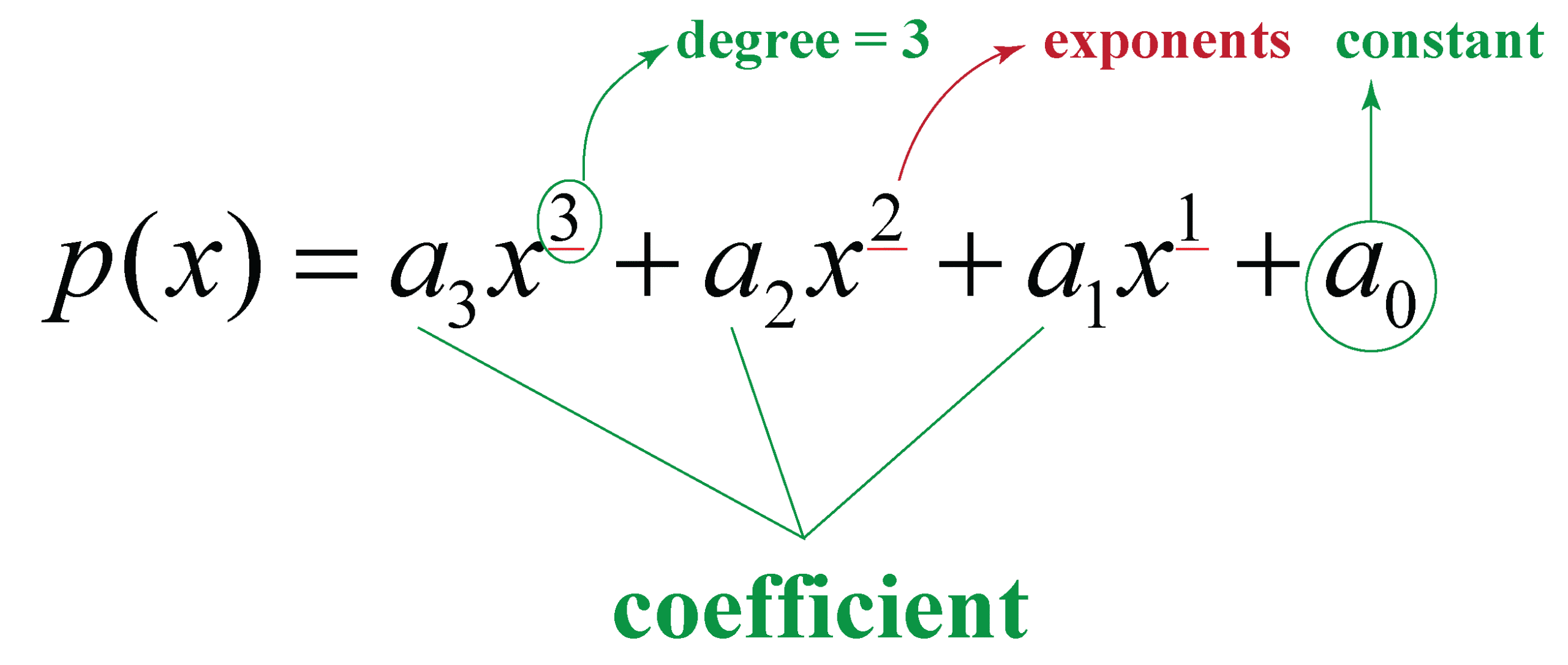
\( ax^3 + bx^2 + cx + d = 0 \), where \( a \ne 0 \)
It has three roots which may be real or complex (some possibly repeated).
General Properties
- The equation has exactly three roots (real or complex).
- If all coefficients are real and one root is complex, then the other complex root must be its conjugate.
- The graph of a cubic polynomial always cuts the x-axis at least once (so at least one real root always exists).
Relations Between Roots and Coefficients
Let the roots of \( ax^3 + bx^2 + cx + d = 0 \) be \( \alpha, \beta, \gamma \).
Dividing through by \( a \):
\( x^3 + \dfrac{b}{a}x^2 + \dfrac{c}{a}x + \dfrac{d}{a} = 0 \)
Then the relationships between roots and coefficients are:
| Quantity | Formula |
|---|---|
| Sum of roots | \( \alpha + \beta + \gamma = -\dfrac{b}{a} \) |
| Sum of products of roots (taken two at a time) | \( \alpha\beta + \beta\gamma + \gamma\alpha = \dfrac{c}{a} \) |
| Product of roots | \( \alpha\beta\gamma = -\dfrac{d}{a} \) |
Formation of a Cubic Equation from Given Roots
If roots are \( \alpha, \beta, \gamma \), the equation is:
\( (x – \alpha)(x – \beta)(x – \gamma) = 0 \)
Expanding:
\( x^3 – (\alpha + \beta + \gamma)x^2 + (\alpha\beta + \beta\gamma + \gamma\alpha)x – \alpha\beta\gamma = 0 \)
Nature of Roots
For a cubic equation \( ax^3 + bx^2 + cx + d = 0 \):
- At least one root is real.
- If the discriminant \( \Delta = 0 \), roots are not all distinct (some repeated).
- If \( \Delta > 0 \), all roots are real and distinct.
- If \( \Delta < 0 \), one root is real and two are complex conjugates.
Example
Find the cubic equation whose roots are \( 1, 2, 3 \).
▶️ Answer / Explanation
Step 1: Sum of roots = \( 1 + 2 + 3 = 6 \)
Sum of products two at a time = \( (1\cdot2 + 2\cdot3 + 3\cdot1) = 11 \)
Product of roots = \( 1\cdot2\cdot3 = 6 \)
Step 2: Equation: \( x^3 – 6x^2 + 11x – 6 = 0 \)
Answer: \( x^3 – 6x^2 + 11x – 6 = 0 \)
Example
Find the cubic equation whose roots are \( 1, 2, \) and \( -3 \).
▶️ Answer / Explanation
Step 1: Sum of roots = \( 1 + 2 – 3 = 0 \)
Sum of products two at a time = \( (1\cdot2 + 2\cdot(-3) + (-3)\cdot1) = 2 – 6 – 3 = -7 \)
Product of roots = \( 1\cdot2\cdot(-3) = -6 \)
Step 2: Equation: \( x^3 – 0x^2 – 7x + 6 = 0 \)
Answer: \( x^3 – 7x + 6 = 0 \)
Example
Find the cubic equation whose roots are \( 2, 3 + i, 3 – i \).
▶️ Answer / Explanation
Step 1: Sum of roots = \( 2 + (3 + i) + (3 – i) = 8 \)
Sum of products two at a time = \( (2\cdot(3 + i) + 2\cdot(3 – i) + (3 + i)(3 – i)) = (6 + 2i + 6 – 2i + 10) = 22 \)
Product of roots = \( 2(3 + i)(3 – i) = 2(9 + 1) = 20 \)
Step 2: Equation: \( x^3 – 8x^2 + 22x – 20 = 0 \)
Answer: \( x^3 – 8x^2 + 22x – 20 = 0 \)
Location of Roots of Quadratic and Cubic Equations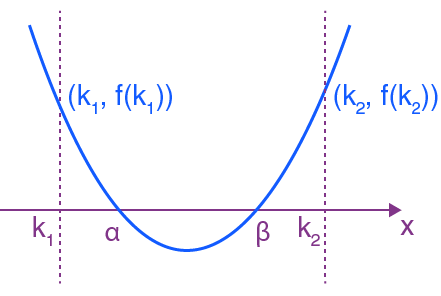
The location of roots refers to the interval(s) on the real number line where the roots of a given equation lie.
For a quadratic equation \( f(x) = ax^2 + bx + c = 0 \), or a cubic \( f(x) = ax^3 + bx^2 + cx + d = 0 \):
- We find intervals in which the roots exist using sign changes of f(x).
- We can determine whether the roots are positive, negative, or between two numbers.
Conditions for Roots in Quadratic Equation \( ax^2 + bx + c = 0 \)
| Condition | Meaning / Nature of Roots |
|---|---|
| \( D = b^2 – 4ac > 0 \) | Two distinct real roots |
| \( D = 0 \) | Two equal real roots |
| \( D < 0 \) | Complex conjugate roots |
Location of Real Roots on the Number Line
Let \( f(x) = ax^2 + bx + c \). Suppose \( f(x_1) \) and \( f(x_2) \) have opposite signs.
If \( f(x_1) \cdot f(x_2) < 0 \), then a real root lies between \( x_1 \) and \( x_2 \).
This follows from the Intermediate Value Theorem.
Conditions for Both Roots Positive or Negative
For \( ax^2 + bx + c = 0 \):
- Both roots positive: \( \begin{cases} D \ge 0, \\ \dfrac{b}{a} < 0, \\ \dfrac{c}{a} > 0 \end{cases} \)
- Both roots negative: \( \begin{cases} D \ge 0, \\ \dfrac{b}{a} > 0, \\ \dfrac{c}{a} > 0 \end{cases} \)
For Roots Between Two Numbers \( \alpha \) and \( \beta \)
To check if both roots of \( f(x) = 0 \) lie between \( x = \alpha \) and \( x = \beta \):
- \( f(\alpha) \) and \( f(\beta) \) have the same sign.
- \( f(x) = 0 \) has two real roots (so \( D > 0 \)).
- \( f(x) \) changes sign twice between \( \alpha \) and \( \beta \).
Location of Roots for Cubic Equation
For \( f(x) = ax^3 + bx^2 + cx + d = 0 \):
- At least one real root always exists.
- To find approximate location of the real root, test sign changes in \( f(x) \) over intervals.
- Use Rolle’s Theorem or derivative \( f'(x) \) to locate turning points (where roots may occur between changes in sign).
Example
Find whether the roots of \( x^2 – 5x + 6 = 0 \) are positive or negative.
▶️ Answer / Explanation
Step 1: \( a = 1, b = -5, c = 6 \)
Step 2: \( D = (-5)^2 – 4(1)(6) = 25 – 24 = 1 > 0 \)
Step 3: \( \dfrac{b}{a} = -5 < 0 \), \( \dfrac{c}{a} = 6 > 0 \)
Conclusion: Both roots are real and positive.
Example
Show that both roots of \( x^2 – 4x + 3 = 0 \) lie between 1 and 3.
▶️ Answer / Explanation
Step 1: Evaluate at the boundaries.
\( f(1) = 1 – 4 + 3 = 0 \), \( f(3) = 9 – 12 + 3 = 0 \)
Step 2: Since \( f(1) = 0 \) and \( f(3) = 0 \), roots lie at or within [1, 3].
Step 3: Actual roots = 1 and 3 (confirmed by factorization \( (x – 1)(x – 3) = 0 \)).
Conclusion: Both roots lie in the given interval [1, 3].
Example
Find the interval in which the real root of \( x^3 – 7x + 6 = 0 \) lies.
▶️ Answer / Explanation
Step 1: Test sign of \( f(x) = x^3 – 7x + 6 \) at integer points.
\( f(0) = 6 \), \( f(1) = 0 \), \( f(2) = 8 – 14 + 6 = 0 \)
Roots at \( x = 1, 2 \). But there might be another root.
Step 2: Try \( x = -3 \): \( (-27) + 21 + 6 = 0 \)
Thus, real roots are \( -3, 1, 2 \).
Step 3: Between each sign change, a real root exists.
Conclusion: Real roots lie at \( x = -3, 1, 2 \). Each lies in its own interval of sign change.