IIT JEE Main Maths -Unit 2- Relations between roots and coefficients- Study Notes-New Syllabus
IIT JEE Main Maths -Unit 2- Relations between roots and coefficients – Study Notes – New syllabus
IIT JEE Main Maths -Unit 2- Relations between roots and coefficients – Study Notes -IIT JEE Main Maths – per latest Syllabus.
Key Concepts:
- Relations Between Roots and Coefficients & Formation of Quadratic Equation from Given Roots
Relations Between Roots and Coefficients & Formation of Quadratic Equation from Given Roots
1. Relations Between Roots and Coefficients![]()
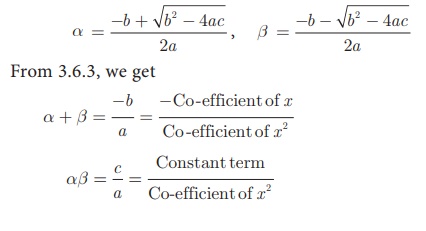
Let the quadratic equation be
\( ax^2 + bx + c = 0 \), where \( a \ne 0 \).
If \( \alpha \) and \( \beta \) are the roots of the equation, then by factorization:
\( a(x – \alpha)(x – \beta) = 0 \)
Expanding,
\( ax^2 – a(\alpha + \beta)x + a\alpha\beta = 0 \)
Comparing with \( ax^2 + bx + c = 0 \), we get:
- Sum of roots: \( \alpha + \beta = -\dfrac{b}{a} \)
- Product of roots: \( \alpha\beta = \dfrac{c}{a} \)
These are called the relations between roots and coefficients.
2. Formation of Quadratic Equation from Given Roots![]()
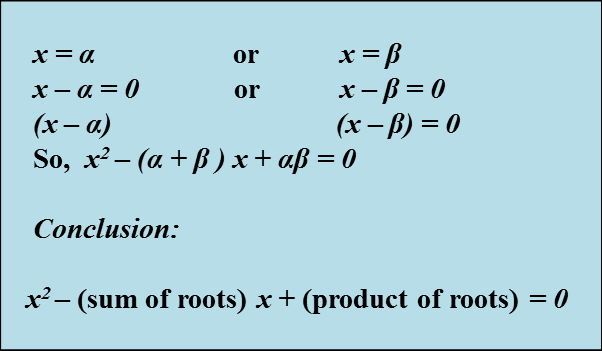
If \( \alpha \) and \( \beta \) are given roots, then the quadratic equation with these roots is:
\( x^2 – (\alpha + \beta)x + \alpha\beta = 0 \)
3. Special Cases
- (i) If the roots are real and distinct, the equation remains the same form.
- (ii) If the roots are equal (\( \alpha = \beta \)), the equation is \( (x – \alpha)^2 = 0 \).
- (iii) If the roots are complex conjugates \( p + iq \) and \( p – iq \), the equation is:
\( (x – (p + iq))(x – (p – iq)) = x^2 – 2px + (p^2 + q^2) = 0 \)
Example
If the roots of a quadratic equation are \( 2 \) and \( 3 \), find the equation.
▶️ Answer / Explanation
Step 1: Sum of roots = \( 2 + 3 = 5 \)
Step 2: Product of roots = \( 2 \times 3 = 6 \)
Step 3: Required equation: \( x^2 – (\alpha + \beta)x + \alpha\beta = 0 \)
\( \Rightarrow x^2 – 5x + 6 = 0 \)
Answer: \( x^2 – 5x + 6 = 0 \)
Example
The sum and product of the roots of a quadratic equation are \( \dfrac{1}{2} \) and \( \dfrac{1}{8} \) respectively. Find the equation.
▶️ Answer / Explanation
Step 1: \( \alpha + \beta = \dfrac{1}{2}, \; \alpha\beta = \dfrac{1}{8} \)
Step 2: Equation: \( x^2 – (\alpha + \beta)x + \alpha\beta = 0 \)
\( \Rightarrow x^2 – \dfrac{1}{2}x + \dfrac{1}{8} = 0 \)
Step 3: Multiply through by 8 to remove fractions: \( 8x^2 – 4x + 1 = 0 \)
Answer: \( 8x^2 – 4x + 1 = 0 \)
Example
Form the quadratic equation whose roots are \( 2 + 3i \) and \( 2 – 3i \).
▶️ Answer / Explanation
Step 1: Since the roots are complex conjugates:
\( \alpha = 2 + 3i, \quad \beta = 2 – 3i \)
Step 2: Sum = \( \alpha + \beta = 4 \)
Product = \( \alpha\beta = (2 + 3i)(2 – 3i) = 4 + 9 = 13 \)
Step 3: Equation: \( x^2 – (\alpha + \beta)x + \alpha\beta = 0 \)
\( \Rightarrow x^2 – 4x + 13 = 0 \)
Answer: \( x^2 – 4x + 13 = 0 \)
Conditions for Common Roots and Nature of Roots of Combined Quadratic Equations
1. Common Roots of Two Quadratic Equations
Let the two quadratic equations be:
(i) \( a_1x^2 + b_1x + c_1 = 0 \)
(ii) \( a_2x^2 + b_2x + c_2 = 0 \)
They may have:
- No common roots
- Exactly one common root
- Both roots common (i.e., equations are proportional)
2. Condition for One Common Root
If the two equations have exactly one root in common, then:
\(\dfrac{b_1}{a_1} \ne \dfrac{b_2}{a_2}\)
and the following determinant condition holds:
$ \begin{vmatrix} a_1 & b_1 & c_1 \\ a_2 & b_2 & c_2 \\ 0 & a_1b_2 – a_2b_1 & b_1c_2 – b_2c_1 \end{vmatrix} = 0 $
Alternate formula: If \( \alpha \) is the common root, eliminate \( \alpha \) between the two equations. Subtract the equations proportionally to obtain the relation between coefficients.
3. Condition for Both Roots Common
If both roots are common, then both equations are proportional, i.e.
\(\dfrac{a_1}{a_2} = \dfrac{b_1}{b_2} = \dfrac{c_1}{c_2}\)
4. Relation Between Roots of Two Quadratics
If \( \alpha, \beta \) are roots of one equation, and \( p, q \) are roots of another, then:
- Common root ⇒ one of \( \alpha = p \) or \( \alpha = q \)
- Sum or product of roots of each can be used to compare or derive relations between equations.
Example
Find whether the equations \( x^2 – 5x + 6 = 0 \) and \( x^2 – 3x + 2 = 0 \) have any common root.
▶️ Answer / Explanation
Step 1: Roots of first equation: \( x = 2, 3 \)
Step 2: Roots of second equation: \( x = 1, 2 \)
Step 3: Common root = \( 2 \)
Conclusion: The equations have one common root \( x = 2 \).
Example
Show that \( 2x^2 + 3x + 4 = 0 \) and \( 4x^2 + 6x + 8 = 0 \) have both roots common.
▶️ Answer / Explanation
Step 1: Compare ratios:
\( \dfrac{a_1}{a_2} = \dfrac{2}{4} = \dfrac{1}{2}, \quad \dfrac{b_1}{b_2} = \dfrac{3}{6} = \dfrac{1}{2}, \quad \dfrac{c_1}{c_2} = \dfrac{4}{8} = \dfrac{1}{2} \)
Step 2: Since all ratios are equal, \( \dfrac{a_1}{a_2} = \dfrac{b_1}{b_2} = \dfrac{c_1}{c_2} \)
Conclusion: The equations are proportional, hence both roots are common.
Example
Find the condition that the equations \( a_1x^2 + b_1x + c_1 = 0 \) and \( a_2x^2 + b_2x + c_2 = 0 \) have exactly one common root.
▶️ Answer / Explanation
Step 1: Let \( \alpha \) be the common root. Then,
\( a_1\alpha^2 + b_1\alpha + c_1 = 0 \) …(i)
\( a_2\alpha^2 + b_2\alpha + c_2 = 0 \) …(ii)
Step 2: Multiply (i) by \( a_2 \) and (ii) by \( a_1 \), then subtract:
\( a_2b_1\alpha + a_2c_1 – a_1b_2\alpha – a_1c_2 = 0 \)
\( \Rightarrow (a_2b_1 – a_1b_2)\alpha = a_1c_2 – a_2c_1 \)
\( \Rightarrow \alpha = \dfrac{a_1c_2 – a_2c_1}{a_2b_1 – a_1b_2} \)
Step 3: Substitute this value of \( \alpha \) into either equation to get the condition for one common root:
$ \begin{vmatrix} a_1 & b_1 & c_1 \ a_2 & b_2 & c_2 \ 0 & a_1b_2 – a_2b_1 & b_1c_2 – b_2c_1 \end{vmatrix} = 0 ]
Step 4: This determinant must vanish for one common root to exist.
