
Matrix Operations: Addition, Subtraction, Scalar Multiplication, and Equality of Matrices
1. Equality of Matrices
Two matrices \( A = [a_{ij}]_{m \times n} \) and \( B = [b_{ij}]_{m \times n} \) are said to be equal if:
- They are of the same order, i.e., have the same number of rows and columns.
- Each corresponding element is equal: \( a_{ij} = b_{ij} \).
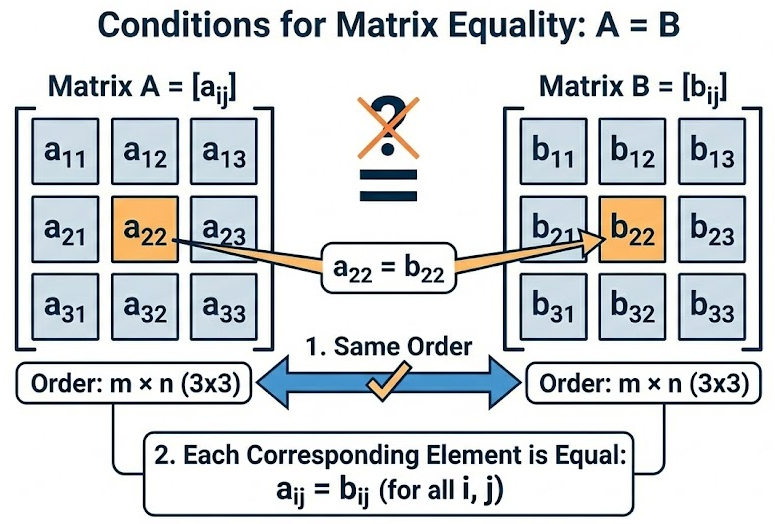
Example: \(\begin{bmatrix}2 & 3\\4 & 5\end{bmatrix} = \begin{bmatrix}2 & 3\\4 & 5\end{bmatrix}\)
2. Addition of Matrices
Let \( A = [a_{ij}]_{m \times n} \) and \( B = [b_{ij}]_{m \times n} \). Then their sum is defined as:
\( A + B = [a_{ij} + b_{ij}]_{m \times n} \)

Conditions: Matrices must have the same order.
3. Subtraction of Matrices
Let \( A = [a_{ij}]_{m \times n} \) and \( B = [b_{ij}]_{m \times n} \). Then their difference is defined as:
\( A – B = [a_{ij} – b_{ij}]_{m \times n} \)
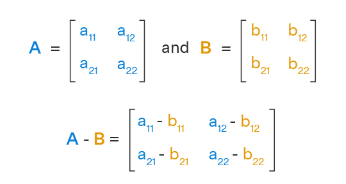
Conditions: Matrices must be of the same order.
4. Scalar Multiplication
If \( A = [a_{ij}]_{m \times n} \) and \( k \) is a real (or complex) number, then the scalar multiple of \( A \) is defined as:
\( kA = [k \cdot a_{ij}]_{m \times n} \)
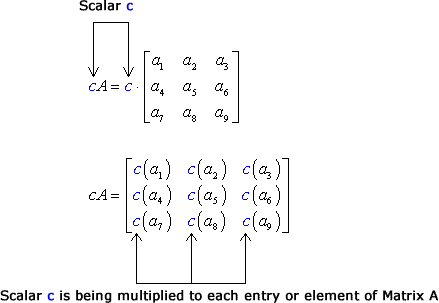
Example: If \( A = \begin{bmatrix}1 & -2\\3 & 4\end{bmatrix} \) and \( k = 2 \), then \( 2A = \begin{bmatrix}2 & -4\\6 & 8\end{bmatrix} \).
5. Properties of Matrix Addition and Scalar Multiplication
| Property | Statement |
|---|---|
| Commutative | \( A + B = B + A \) |
| Associative | \( (A + B) + C = A + (B + C) \) |
| Existence of Additive Identity | There exists a zero matrix \( O \) such that \( A + O = A \) |
| Existence of Additive Inverse | For every matrix \( A \), there exists \( -A \) such that \( A + (-A) = O \) |
| Distributive | \( k(A + B) = kA + kB \) |
Example
Let \( A = \begin{bmatrix}1 & 2\\3 & 4\end{bmatrix} \) and \( B = \begin{bmatrix}4 & 3\\2 & 1\end{bmatrix} \). Find \( A + B \) and \( A – B \).
▶️ Answer / Explanation
\( A + B = \begin{bmatrix}1+4 & 2+3\\3+2 & 4+1\end{bmatrix} = \begin{bmatrix}5 & 5\\5 & 5\end{bmatrix} \)
\( A – B = \begin{bmatrix}1-4 & 2-3\\3-2 & 4-1\end{bmatrix} = \begin{bmatrix}-3 & -1\\1 & 3\end{bmatrix} \)
Example
If \( A = \begin{bmatrix}2 & -1\\0 & 3\end{bmatrix} \), find \( 3A – 2I \), where \( I \) is the identity matrix of order 2.
▶️ Answer / Explanation
\( 3A = \begin{bmatrix}6 & -3\\0 & 9\end{bmatrix} \), \( 2I = \begin{bmatrix}2 & 0\\0 & 2\end{bmatrix} \)
So, \( 3A – 2I = \begin{bmatrix}6-2 & -3-0\\0-0 & 9-2\end{bmatrix} = \begin{bmatrix}4 & -3\\0 & 7\end{bmatrix} \)
Example
Let \( A = \begin{bmatrix}1 & 2\\3 & 4\end{bmatrix} \) and \( B = \begin{bmatrix}-1 & 1\\2 & 0\end{bmatrix} \). Verify that \( 2(A + B) = 2A + 2B \).
▶️ Answer / Explanation
Step 1: \( A + B = \begin{bmatrix}1-1 & 2+1\\3+2 & 4+0\end{bmatrix} = \begin{bmatrix}0 & 3\\5 & 4\end{bmatrix} \)
\( 2(A + B) = \begin{bmatrix}0 & 6\\10 & 8\end{bmatrix} \)
Step 2: \( 2A = \begin{bmatrix}2 & 4\\6 & 8\end{bmatrix}, \quad 2B = \begin{bmatrix}-2 & 2\\4 & 0\end{bmatrix} \)
\( 2A + 2B = \begin{bmatrix}0 & 6\\10 & 8\end{bmatrix} \)
Conclusion: \( 2(A + B) = 2A + 2B \). Verified.
Matrix Multiplication and Its Properties
Definition
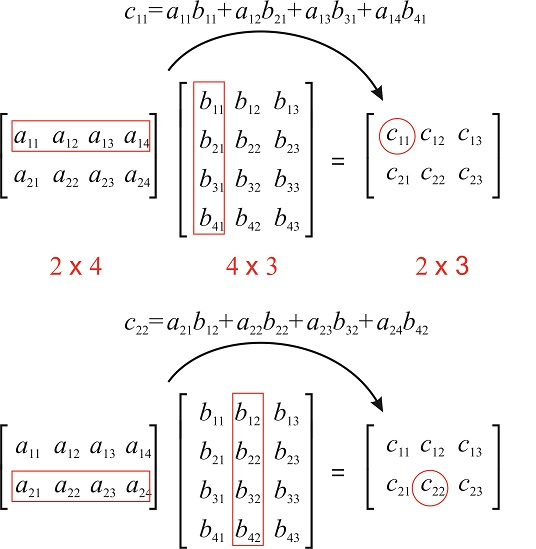
Let \( A = [a_{ij}]_{m \times n} \) and \( B = [b_{ij}]_{n \times p} \).
Then, the product \( AB \) is defined and will be a matrix of order \( m \times p \), given by:
\( (AB)_{ij} = \sum_{k=1}^{n} a_{ik}b_{kj} \)
Condition for Multiplication: The number of columns of the first matrix (A) must be equal to the number of rows of the second matrix (B).
Order of the product: \( (m \times p) \)
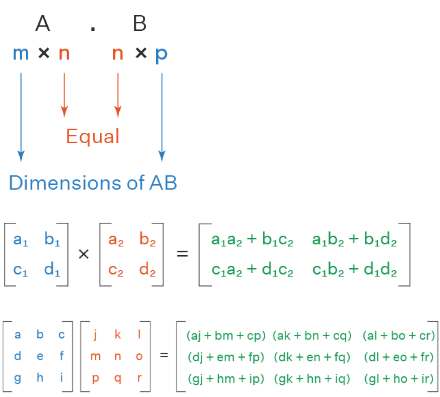
Example of Matrix Multiplication
If \( A = \begin{bmatrix}1 & 2\\3 & 4\end{bmatrix} \) and \( B = \begin{bmatrix}2 & 0\\1 & 2\end{bmatrix} \), then:
\( AB = \begin{bmatrix}(1)(2)+(2)(1) & (1)(0)+(2)(2)\\(3)(2)+(4)(1) & (3)(0)+(4)(2)\end{bmatrix} = \begin{bmatrix}4 & 4\\10 & 8\end{bmatrix} \)
Important Properties of Matrix Multiplication
| Property | Description |
|---|---|
| Closure Property | If \( A \) and \( B \) are two matrices of appropriate order, \( AB \) is also a matrix of defined order. |
| Non-Commutative Property | In general, \( AB \ne BA \) |
| Associative Property | \( A(BC) = (AB)C \) |
| Distributive Property | \( A(B + C) = AB + AC \) |
| Existence of Multiplicative Identity | \( AI = IA = A \), where \( I \) is the identity matrix of suitable order. |
| Existence of Zero Matrix | \( A \times O = O \times A = O \) |
Note:
- Matrix multiplication is not commutative: \( AB \ne BA \) (in most cases).
- However, it is associative and distributive.
- Even if \( AB = O \), it doesn’t imply \( A = O \) or \( B = O \).
Example
Let \( A = \begin{bmatrix}1 & 0\\2 & 1\end{bmatrix} \) and \( B = \begin{bmatrix}3 & 2\\1 & 4\end{bmatrix} \). Find \( AB \) and \( BA \).
▶️ Answer / Explanation
Step 1: \( AB = \begin{bmatrix}(1)(3)+(0)(1) & (1)(2)+(0)(4)\\(2)(3)+(1)(1) & (2)(2)+(1)(4)\end{bmatrix} = \begin{bmatrix}3 & 2\\7 & 8\end{bmatrix} \)
Step 2: \( BA = \begin{bmatrix}(3)(1)+(2)(2) & (3)(0)+(2)(1)\\(1)(1)+(4)(2) & (1)(0)+(4)(1)\end{bmatrix} = \begin{bmatrix}7 & 2\\9 & 4\end{bmatrix} \)
Step 3: \( AB \ne BA \)
Conclusion: Matrix multiplication is not commutative.
Example
Let \( A = \begin{bmatrix}2 & 1\\0 & 3\end{bmatrix} \), \( B = \begin{bmatrix}1 & 4\\0 & 2\end{bmatrix} \), and \( C = \begin{bmatrix}1 & 0\\2 & 1\end{bmatrix} \). Verify the associative law \( A(BC) = (AB)C \).
▶️ Answer / Explanation
Step 1: Compute \( BC = \begin{bmatrix}1 & 4\\0 & 2\end{bmatrix}\begin{bmatrix}1 & 0\\2 & 1\end{bmatrix} = \begin{bmatrix}9 & 4\\4 & 2\end{bmatrix} \)
Step 2: \( A(BC) = \begin{bmatrix}2 & 1\\0 & 3\end{bmatrix}\begin{bmatrix}9 & 4\\4 & 2\end{bmatrix} = \begin{bmatrix}22 & 10\\12 & 6\end{bmatrix} \)
Step 3: Compute \( AB = \begin{bmatrix}2 & 1\\0 & 3\end{bmatrix}\begin{bmatrix}1 & 4\\0 & 2\end{bmatrix} = \begin{bmatrix}2 & 10\\0 & 6\end{bmatrix} \)
\((AB)C = \begin{bmatrix}2 & 10\\0 & 6\end{bmatrix}\begin{bmatrix}1 & 0\\2 & 1\end{bmatrix} = \begin{bmatrix}22 & 10\\12 & 6\end{bmatrix}\)
Conclusion: \( A(BC) = (AB)C \). Verified.
Example
If \( A = \begin{bmatrix}1 & 2\\3 & 4\end{bmatrix} \) and \( B = \begin{bmatrix}2 & 0\\1 & 2\end{bmatrix} \), find matrices \( P = AB \) and \( Q = BA \), and check if \( AB – BA = 2I \).
▶️ Answer / Explanation
Step 1: \( AB = \begin{bmatrix}1(2)+2(1) & 1(0)+2(2)\\3(2)+4(1) & 3(0)+4(2)\end{bmatrix} = \begin{bmatrix}4 & 4\\10 & 8\end{bmatrix} \)
Step 2: \( BA = \begin{bmatrix}2(1)+0(3) & 2(2)+0(4)\\1(1)+2(3) & 1(2)+2(4)\end{bmatrix} = \begin{bmatrix}2 & 4\\7 & 10\end{bmatrix} \)
Step 3: \( AB – BA = \begin{bmatrix}2 & 0\\3 & -2\end{bmatrix} \)
This is not \( 2I \) since \( 2I = \begin{bmatrix}2 & 0\\0 & 2\end{bmatrix} \).
Conclusion: \( AB – BA \ne 2I \). Matrix multiplication is non-commutative and non-symmetric.
Transpose of a Matrix and Its Properties
The transpose of a matrix \( A = [a_{ij}]_{m \times n} \) is obtained by interchanging its rows and columns.
\( A^T = [a_{ji}]_{n \times m} \)
That is, the element in the \( i^{th} \) row and \( j^{th} \) column of \( A \) becomes the element in the \( j^{th} \) row and \( i^{th} \) column of \( A^T \).
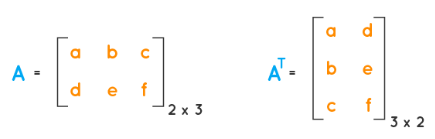
Example: If \( A = \begin{bmatrix}1 & 2 & 3\\4 & 5 & 6\end{bmatrix} \), then
\( A^T = \begin{bmatrix}1 & 4\\2 & 5\\3 & 6\end{bmatrix} \).
Properties of Transpose
| Property | Statement |
|---|---|
| (i) Double Transpose | \( (A^T)^T = A \) |
| (ii) Transpose of a Sum | \( (A + B)^T = A^T + B^T \) |
| (iii) Transpose of a Product | \( (AB)^T = B^T A^T \) |
| (iv) Transpose of a Scalar Multiple | \( (kA)^T = kA^T \), where \( k \) is a scalar. |
| (v) Transpose of Identity Matrix | \( I^T = I \) |
Symmetric and Skew-Symmetric Matrices (Relation with Transpose)
- Symmetric Matrix: \( A^T = A \)
- Skew-Symmetric Matrix: \( A^T = -A \)
- In a skew-symmetric matrix, all diagonal elements are zero.
Example
Find the transpose of \( A = \begin{bmatrix}2 & -1\\0 & 3\\4 & 5\end{bmatrix} \).
▶️ Answer / Explanation
\( A^T = \begin{bmatrix}2 & 0 & 4\\-1 & 3 & 5\end{bmatrix} \)
Verification: Interchange of rows and columns is correct.
Example
Let \( A = \begin{bmatrix}1 & 2\\3 & 4\end{bmatrix} \) and \( B = \begin{bmatrix}0 & 5\\6 & 7\end{bmatrix} \). Verify that \( (A + B)^T = A^T + B^T \).
▶️ Answer / Explanation
Step 1: \( A + B = \begin{bmatrix}1 & 2\\3 & 4\end{bmatrix} + \begin{bmatrix}0 & 5\\6 & 7\end{bmatrix} = \begin{bmatrix}1 & 7\\9 & 11\end{bmatrix} \)
\( (A + B)^T = \begin{bmatrix}1 & 9\\7 & 11\end{bmatrix} \)
Step 2: \( A^T = \begin{bmatrix}1 & 3\\2 & 4\end{bmatrix}, \; B^T = \begin{bmatrix}0 & 6\\5 & 7\end{bmatrix} \)
\( A^T + B^T = \begin{bmatrix}1 & 9\\7 & 11\end{bmatrix} \)
Conclusion: \( (A + B)^T = A^T + B^T \). Verified.
Example
If \( A = \begin{bmatrix}1 & 2\\3 & 4\end{bmatrix} \) and \( B = \begin{bmatrix}0 & 5\\6 & 7\end{bmatrix} \), verify that \( (AB)^T = B^T A^T \).
▶️ Answer / Explanation
Step 1: Compute \( AB \): \( AB = \begin{bmatrix}1 & 2\\3 & 4\end{bmatrix}\begin{bmatrix}0 & 5\\6 & 7\end{bmatrix} = \begin{bmatrix}12 & 19\\24 & 43\end{bmatrix} \)
Step 2: \( (AB)^T = \begin{bmatrix}12 & 24\\19 & 43\end{bmatrix} \)
Step 3: \( B^T = \begin{bmatrix}0 & 6\\5 & 7\end{bmatrix}, \; A^T = \begin{bmatrix}1 & 3\\2 & 4\end{bmatrix} \)
Compute \( B^T A^T = \begin{bmatrix}0 & 6\\5 & 7\end{bmatrix}\begin{bmatrix}1 & 3\\2 & 4\end{bmatrix} = \begin{bmatrix}12 & 24\\19 & 43\end{bmatrix} \)
Conclusion: \( (AB)^T = B^T A^T \). Verified.
Symmetric and Skew-Symmetric Matrices
1. Symmetric Matrix
A square matrix \( A = [a_{ij}] \) is called a symmetric matrix if:
\( A^T = A \)
That is, the elements are symmetrical about the main diagonal, i.e. \( a_{ij} = a_{ji} \) for all \( i, j \).
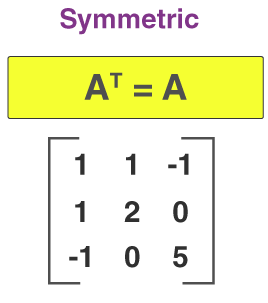
Example:
$ A = \begin{bmatrix} 2 & 3 & 4\\ 3 & 5 & 7\\ 4 & 7 & 9 \end{bmatrix} $
Here, \( a_{12} = a_{21} = 3 \), \( a_{13} = a_{31} = 4 \), \( a_{23} = a_{32} = 7 \).
Hence \( A^T = A \).
Skew-Symmetric Matrix
A square matrix \( A = [a_{ij}] \) is called a skew-symmetric matrix if:
\( A^T = -A \)
That is, \( a_{ij} = -a_{ji} \) for all \( i, j \).
Also, for diagonal elements, \( a_{ii} = -a_{ii} \Rightarrow a_{ii} = 0 \).
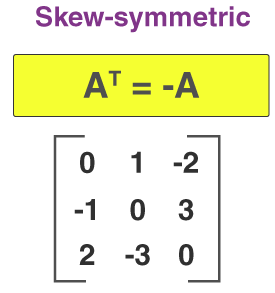
Example:
$ A = \begin{bmatrix} 0 & 2 & -3\\ -2 & 0 & 4\\ 3 & -4 & 0 \end{bmatrix} $
Here, \( A^T = \begin{bmatrix}0 & -2 & 3\\2 & 0 & -4\\-3 & 4 & 0\end{bmatrix} = -A \),
hence \( A \) is skew-symmetric.
Relation Between Any Square Matrix and Its Transpose
For any square matrix \( A \), we can express it as the sum of a symmetric and a skew-symmetric matrix:
\( A = \dfrac{A + A^T}{2} + \dfrac{A – A^T}{2} \)
Here:
- \( \dfrac{A + A^T}{2} \) is a symmetric matrix
- \( \dfrac{A – A^T}{2} \) is a skew-symmetric matrix
Important Properties
| Property | Description |
|---|---|
| 1 | The sum of two symmetric matrices is symmetric. |
| 2 | The sum of two skew-symmetric matrices is skew-symmetric. |
| 3 | The transpose of a symmetric matrix is itself symmetric. |
| 4 | The transpose of a skew-symmetric matrix is the negative of itself. |
| 5 | Every square matrix can be written as the sum of a symmetric and a skew-symmetric matrix. |
Example
Check whether the matrix \( A = \begin{bmatrix}2 & 3\\3 & 2\end{bmatrix} \) is symmetric or skew-symmetric.
▶️ Answer / Explanation
\( A^T = \begin{bmatrix}2 & 3\\3 & 2\end{bmatrix} = A \)
Conclusion: \( A \) is a symmetric matrix.
Example
Verify whether \( A = \begin{bmatrix}0 & 2 & -3\\-2 & 0 & 1\\3 & -1 & 0\end{bmatrix} \) is skew-symmetric.
▶️ Answer / Explanation
\( A^T = \begin{bmatrix}0 & -2 & 3\\2 & 0 & -1\\-3 & 1 & 0\end{bmatrix} = -A \)
Conclusion: \( A \) is skew-symmetric.
Example
Express the matrix \( A = \begin{bmatrix}2 & 4\\-1 & 3\end{bmatrix} \) as the sum of a symmetric and a skew-symmetric matrix.
▶️ Answer / Explanation
Step 1: Compute \( A^T = \begin{bmatrix}2 & -1\\4 & 3\end{bmatrix} \)
Step 2: Symmetric part: \( \dfrac{A + A^T}{2} = \dfrac{1}{2}\begin{bmatrix}4 & 3\\3 & 6\end{bmatrix} = \begin{bmatrix}2 & 1.5\\1.5 & 3\end{bmatrix} \)
Step 3: Skew-symmetric part: \( \dfrac{A – A^T}{2} = \dfrac{1}{2}\begin{bmatrix}0 & 5\\-5 & 0\end{bmatrix} = \begin{bmatrix}0 & 2.5\\-2.5 & 0\end{bmatrix} \)
Step 4: \( A = \begin{bmatrix}2 & 1.5\\1.5 & 3\end{bmatrix} + \begin{bmatrix}0 & 2.5\\-2.5 & 0\end{bmatrix} \)
Conclusion: \( A \) is expressed as the sum of symmetric and skew-symmetric matrices.