
Area of a Triangle Using Determinants
The area of a triangle whose vertices are \( A(x_1, y_1) \), \( B(x_2, y_2) \), and \( C(x_3, y_3) \) can be calculated using determinants.
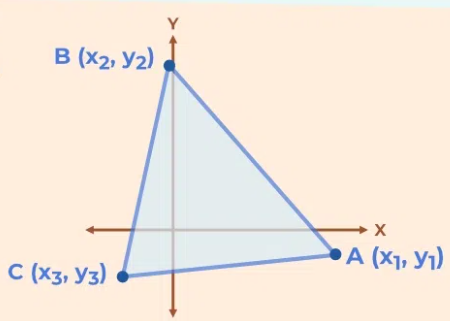
$ \text{Area} = \dfrac{1}{2} \begin{vmatrix} x_1 & y_1 & 1\\ x_2 & y_2 & 1\\ x_3 & y_3 & 1 \end{vmatrix} $
Since area is always positive, we take the absolute value:
$ \text{Area} = \dfrac{1}{2} \left| \begin{vmatrix} x_1 & y_1 & 1\\ x_2 & y_2 & 1\\ x_3 & y_3 & 1 \end{vmatrix} \right| $
Expansion Formula
Expanding the determinant along the first row:
$ \text{Area} = \dfrac{1}{2} |x_1(y_2 – y_3) + x_2(y_3 – y_1) + x_3(y_1 – y_2)| $
This is a commonly used formula in coordinate geometry to find the area directly from coordinates.
Collinearity Condition
If the three points are collinear, the area of the triangle formed by them is zero.
$ \begin{vmatrix} x_1 & y_1 & 1\\ x_2 & y_2 & 1\\ x_3 & y_3 & 1 \end{vmatrix} = 0 $
This determinant condition is often used in JEE questions to check if three points lie on the same straight line.
Geometrical Meaning
- The determinant gives twice the signed area of the triangle.
- The sign of the determinant indicates orientation (clockwise or anticlockwise order of vertices).
- Area is always taken as positive by using modulus.
Example
Find the area of a triangle whose vertices are \( A(1, 2) \), \( B(3, 5) \), and \( C(6, 1) \).
▶️ Answer / Explanation
Step 1: Use the determinant formula.
$ \text{Area} = \dfrac{1}{2} \left| \begin{vmatrix} 1 & 2 & 1\\ 3 & 5 & 1\\ 6 & 1 & 1 \end{vmatrix} \right| $
Step 2: Expand along the first row:
\( = \dfrac{1}{2} |1(5 – 1) – 2(3 – 6) + 1(3 – 30)| \)
\( = \dfrac{1}{2} |4 + 6 – 27| = \dfrac{1}{2} | -17 | = 8.5 \)
Answer: Area = \( 8.5 \text{ square units} \)
Example
Show that the points \( A(2, 3) \), \( B(4, 7) \), and \( C(6, 11) \) are collinear using determinants.
▶️ Answer / Explanation
$ \text{Area} = \dfrac{1}{2} \begin{vmatrix} 2 & 3 & 1\\ 4 & 7 & 1\\ 6 & 11 & 1 \end{vmatrix} $
Expanding along the first row:
\( = \dfrac{1}{2} [2(7 – 11) – 3(4 – 6) + 1(44 – 42)] \)
\( = \dfrac{1}{2} [-8 + 6 + 2] = \dfrac{1}{2}(0) = 0 \)
Conclusion: Since the area = 0, the points are collinear.
Conclusion: Since the area = 0, the points are collinear.
Example
Find the value of \( k \) if the points \( (2, 3) \), \( (4, k) \), and \( (6, -3) \) are collinear.
▶️ Answer / Explanation
For collinearity, the area = 0.
$ \begin{vmatrix} 2 & 3 & 1\\ 4 & k & 1\\ 6 & -3 & 1 \end{vmatrix} = 0 $
php-template Copy code
Expanding along the first row:
\( 2(k – (-3)) – 3(4 – 6) + 1(4(-3) – 6k) = 0 \)
\( 2(k + 3) – 3(-2) + (-12 – 6k) = 0 \)
\( 2k + 6 + 6 – 12 – 6k = 0 \)
\( -4k = 0 \Rightarrow k = 0 \)
Answer: \( k = 0 \)