
Minors and Cofactors
In determinants of order higher than 2, each element contributes to the overall value through a specific minor and cofactor. Understanding these concepts is essential for determinant expansion, inverse matrices, and adjoint calculations.
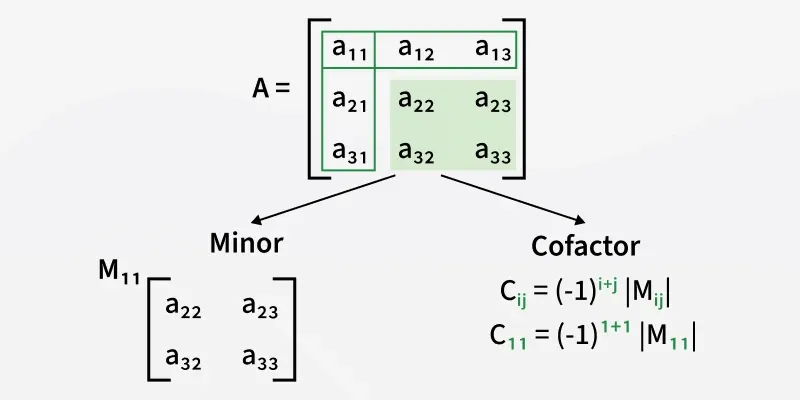
Minor of an Element
The minor of an element \( a_{ij} \) in a determinant is the determinant obtained by deleting the \( i^{th} \) row and \( j^{th} \) column of the original matrix.
It is denoted by \( M_{ij} \).
Example:
For $ A = \begin{bmatrix} 1 & 2 & 3\\ 4 & 5 & 6\\ 7 & 8 & 9 \end{bmatrix} $
the minor of \( a_{11} \) (which is 1) is
$ M_{11} = \begin{vmatrix} 5 & 6\\ 8 & 9 \end{vmatrix} = 45 – 48 = -3 $
Cofactor of an Element
The cofactor of an element \( a_{ij} \) is given by:
\( A_{ij} = (-1)^{i+j} \cdot M_{ij} \)
Here, \( (-1)^{i+j} \) gives the correct sign pattern (alternating + and -).
Sign Pattern of Cofactors
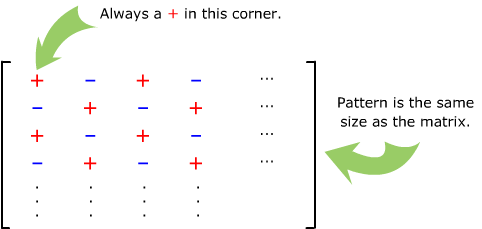
The signs of the cofactors for a 3 × 3 determinant are arranged as follows:
| + | − | + |
| − | + | − |
| + | − | + |
Expansion of a Determinant Using Minors and Cofactors
For a 3 × 3 determinant, expansion along the first row is:
$ |A| = a_{11}A_{11} + a_{12}A_{12} + a_{13}A_{13} $
You can expand along any row or column by multiplying each element with its cofactor.
Properties of Cofactors
| Property | Statement |
|---|---|
| 1 | Sum of the product of elements of any row (or column) with the cofactors of another row (or column) is zero. |
| 2 | Sum of the product of elements of any row (or column) with the cofactors of the same row (or column) gives the determinant value. |
$ a_{i1}A_{i1} + a_{i2}A_{i2} + a_{i3}A_{i3} = |A| $ and
$ a_{i1}A_{j1} + a_{i2}A_{j2} + a_{i3}A_{j3} = 0 \text{ (if } i \ne j) $
Example
Find the minor and cofactor of the element \( a_{11} = 1 \) in \( A = \begin{bmatrix}1 & 2 & 3\\4 & 5 & 6\\7 & 8 & 9\end{bmatrix} \).
▶️ Answer / Explanation
Minor \( M_{11} = \begin{vmatrix}5 & 6\\8 & 9\end{vmatrix} = 45 – 48 = -3 \)
Cofactor \( A_{11} = (+1) \times M_{11} = -3 \)
Answer: \( M_{11} = -3, \, A_{11} = -3 \)
Example
Find the determinant of \( A = \begin{bmatrix}2 & 3 & 1\\4 & 5 & 2\\6 & 7 & 3\end{bmatrix} \) by expanding along the second row.
▶️ Answer / Explanation
Expand along row 2:
\( |A| = 4A_{21} + 5A_{22} + 2A_{23} \)
Compute minors:
- \( M_{21} = \begin{vmatrix}3 & 1\\7 & 3\end{vmatrix} = 9 – 7 = 2 \)
- \( M_{22} = \begin{vmatrix}2 & 1\\6 & 3\end{vmatrix} = 6 – 6 = 0 \)
- \( M_{23} = \begin{vmatrix}2 & 3\\6 & 7\end{vmatrix} = 14 – 18 = -4 \)
Now cofactors:
\( A_{21} = (-1)^{2+1}M_{21} = -2, \; A_{22} = (+1)(0) = 0, \; A_{23} = (-1)^{2+3}(-4) = 4 \)
\( |A| = 4(-2) + 5(0) + 2(4) = -8 + 0 + 8 = 0 \)
Answer: \( |A| = 0 \)
Example
Verify that for \( A = \begin{bmatrix}1 & 2 & 3\\2 & 3 & 4\\3 & 4 & 5\end{bmatrix} \), the sum of products of elements of the first row and their cofactors equals the determinant of A.
▶️ Answer / Explanation
Step 1: Expand \( |A| \) along the first row:
\( |A| = 1A_{11} + 2A_{12} + 3A_{13} \)
Step 2: Compute minors:
- \( M_{11} = \begin{vmatrix}3 & 4\\4 & 5\end{vmatrix} = 15 – 16 = -1 \)
- \( M_{12} = \begin{vmatrix}2 & 4\\3 & 5\end{vmatrix} = 10 – 12 = -2 \)
- \( M_{13} = \begin{vmatrix}2 & 3\\3 & 4\end{vmatrix} = 8 – 9 = -1 \)
Step 3: Compute cofactors:
\( A_{11} = (-1)^{2}(-1) = -1 \), \( A_{12} = (-1)^{3}(-2) = 2 \), \( A_{13} = (-1)^{4}(-1) = -1 \)
Step 4: Substitute:
\( |A| = 1(-1) + 2(2) + 3(-1) = -1 + 4 – 3 = 0 \)
Conclusion: Verified that \( a_{11}A_{11} + a_{12}A_{12} + a_{13}A_{13} = |A| = 0 \).