Home / IIT- JEE / IIT-JEE Main / Unit 4- Combinations (nCr)- Study Notes

IIT JEE Main Maths -Unit 4- Combinations (nCr)- Study Notes-New Syllabus

IIT JEE Main Maths -Unit 4- Combinations (nCr) – Study Notes – New syllabus

IIT JEE Main Maths -Unit 4- Combinations (nCr) – Study Notes -IIT JEE Main Maths – per latest Syllabus.

Key Concepts:

  • Combinations — Definition, Formulae, and Properties (Including Selection with Restrictions)
  • Permutations and Combinations — Mixed Problems (Selection + Arrangement)

IIT JEE Main Maths -Study Notes – All Topics

Combinations — Definition, Formulae, and Properties (Including Selection with Restrictions)

A combination is a selection of some or all objects from a given set, without considering their order.

Example: Choosing 3 players from a team of 10 — the order in which they are chosen does not matter.
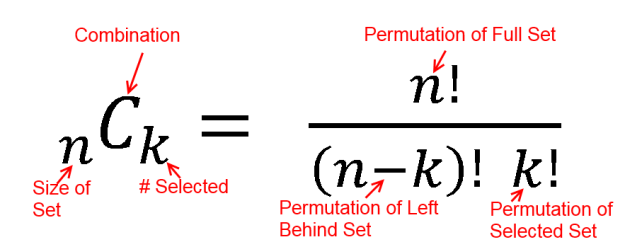
Formula for Combinations

If there are \( n \) distinct objects and we have to choose \( r \) of them, then the number of possible combinations is:

$ C(n, r) = nC_r = \dfrac{n!}{r!(n – r)!} $

Note: Since order does not matter, combinations are always fewer than permutations.

Relation between permutation and combination:

$ nP_r = nC_r \times r! $

 Important Values

  • \( nC_0 = nC_n = 1 \)
  • \( nC_1 = nC_{n – 1} = n \)

Properties of Combinations

PropertyFormula
Symmetry Property\( nC_r = nC_{n – r} \)
Pascal’s Identity\( nC_r + nC_{r – 1} = (n + 1)C_r \)
Summation Property\( \sum_{r=0}^n nC_r = 2^n \)

Combinations with Restrictions

  • If some particular object must always be included, reduce both \( n \) and \( r \) by 1:
    \( \text{New combinations} = (n – 1)C_{r – 1} \)
  • If some particular object must always be excluded, reduce only \( n \):
    \( \text{New combinations} = (n – 1)C_r \)

 Combination of All Subsets

Total number of subsets of a set of \( n \) elements = \( 2^n \).

Proof: $\sum_{r=0}^{n} nC_r = 2^n$

Relationship Between Permutation and Combination

$ nP_r = nC_r \times r! $

This relation helps to convert problems involving arrangements into selection-based forms.

Key Takeaways for JEE:

  • Combinations deal with selection, not order.
  • Use \( nC_r = \dfrac{n!}{r!(n – r)!} \) as the standard formula.
  • Apply symmetry: \( nC_r = nC_{n – r} \).
  • For “at least” or “at most” type problems, sum over required values of \( r \).
  • Combination questions often combine with restrictions or grouping logic.

Example 

In how many ways can a committee of 3 members be formed from 6 people?

▶️ Answer / Explanation

We are selecting 3 people out of 6 → order doesn’t matter.

\( 6C_3 = \dfrac{6!}{3!3!} = \dfrac{720}{36} = 20 \)

Answer: 20 possible committees.

Example 

From 8 men and 5 women, a committee of 4 persons is to be formed such that exactly 2 are women. In how many ways can this be done?

▶️ Answer / Explanation

Choose 2 women from 5 and 2 men from 8.

\( \text{Total ways} = 5C_2 \times 8C_2 = 10 \times 28 = 280 \)

Answer: 280 ways to form the committee.

Example 

Out of 10 people, 4 are teachers. A group of 5 persons is to be formed such that at least 1 teacher is included. Find the number of ways.

▶️ Answer / Explanation

Total people = 10 (4 teachers + 6 non-teachers).

Step 1: Total ways to form any group of 5 people = \( 10C_5 = 252 \).

Step 2: Subtract cases with no teacher.

No teacher ⇒ choose all from 6 non-teachers ⇒ \( 6C_5 = 6 \).

Step 3: Required = \( 252 – 6 = 246 \)

Answer: 246 possible groups.

Permutations and Combinations — Mixed Problems (Selection + Arrangement)

Many real-world and JEE problems involve both selection (combinations) and arrangement (permutations).

In such problems, we first choose the required elements (using combinations) and then arrange them (using permutations).

$ \text{Total number of ways} = (\text{Ways of selection}) \times (\text{Ways of arrangement}) $

General Rule

If you must select \( r \) items out of \( n \) and then arrange the selected items, the total number of ways is:

$ nC_r \times r! = nP_r $

This is the direct link between combinations and permutations.

Permutations vs. Combinations
FeaturePermutationsCombinations
DefinitionArrangements where order matters.Selections where order doesn’t matter.
Formula\( P(n,k)=\dfrac{n!}{(n-k)!} \)\( C(n,k)=\dfrac{n!}{k!(n-k)!} \)
Examples• Arranging Books on a Shelf
• Assigning Specific Roles or Positions
• Race Outcomes
• Creating Passwords or Codes
• Choosing Friends for a Group Activity
• Selecting Toppings for a Pizza
• Drawing Cards in a Card Game
• Forming a Committee

 Common JEE Scenarios

  • Forming words or numbers — choose letters/digits first, then arrange.
  • Committee formation with roles — select members, then assign positions.
  • Seating arrangements — select who sits, then arrange them in line or circle.

Example 

From 6 people, in how many ways can a group of 3 be selected and arranged in a row?

▶️ Answer / Explanation

Step 1: Select 3 people out of 6 → \( 6C_3 \) ways.

Step 2: Arrange 3 selected people in a row → \( 3! \) ways.

Total = \( 6C_3 \times 3! = 20 \times 6 = 120 \)

Answer: 120 ways.

Example 

In how many ways can a committee of 4 be formed from 8 people such that one of them is appointed as a leader?

▶️ Answer / Explanation

Step 1: Select 4 people from 8 → \( 8C_4 \) ways.

Step 2: Appoint 1 of the 4 as leader → \( 4C_1 = 4 \) ways.

Total = \( 8C_4 \times 4 = 70 \times 4 = 280 \)

Answer: 280 different committees can be formed.

Example 

From 8 friends, 5 are to be selected and seated around a circular table. In how many ways can this be done?

▶️ Answer / Explanation

Step 1: Select 5 friends out of 8 → \( 8C_5 = 56 \) ways.

Step 2: Arrange 5 people around a circular table → \( (5 – 1)! = 24 \) ways.

Step 3: Total = \( 56 \times 24 = 1344 \)

Answer: 1344 possible arrangements.

Special Cases & Tricks

  • At least / At most cases → use summation across possible \( r \) values.
  • Different roles (President, Secretary, etc.) → multiply by \( r! \) after selection.
  • Identical objects → divide by factorial of repetitions.
  • Seating around circle → use \( (n – 1)! \).

Example 

From 10 students, in how many ways can a President, Vice-President, and Secretary be chosen?

▶️ Answer / Explanation

Step 1: Select 3 students from 10 → \( 10C_3 \).

Step 2: Assign 3 roles (arrangements) → \( 3! \).

Total = \( 10C_3 \times 3! = 120 \times 6 = 720 \)

Answer: 720 ways to assign positions.

Scroll to Top