
General and Middle Terms in Binomial Expansion
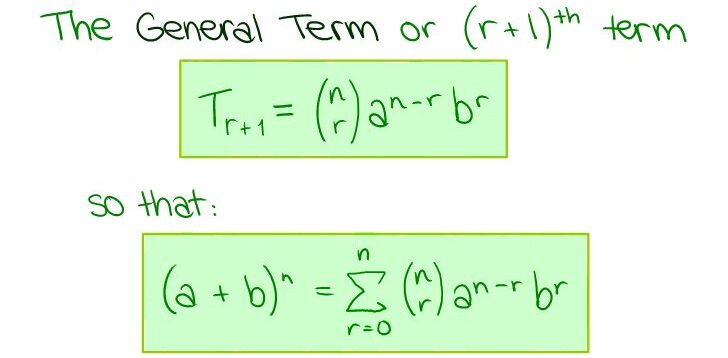
The general term (the \((r + 1)^{th}\) term) in the binomial expansion of \( (x + a)^n \) is given by:
$ T_{r+1} = \binom{n}{r} x^{n – r} a^r $
where \( r = 0, 1, 2, \dots, n \).
Coefficient of a Particular Power of \( x \)
To find the coefficient of \( x^k \) in the expansion of \( (x + a)^n \), we equate the power of \( x \) in the general term to \( k \):
$ n – r = k \Rightarrow r = n – k $
Then substitute \( r \) in \( T_{r+1} \) to find the coefficient.
Middle Term(s)
- If \( n \) is even, the expansion has one middle term → \( T_{\frac{n}{2} + 1} \)
- If \( n \) is odd, the expansion has two middle terms → \( T_{\frac{n + 1}{2}} \) and \( T_{\frac{n + 3}{2}} \)
For \( (x + a)^n \), total number of terms = \( n + 1 \).
Finding Ratio of Consecutive Terms
The ratio of consecutive terms \( T_{r+1} \) and \( T_r \) in a binomial expansion is:
$ \dfrac{T_{r+1}}{T_r} = \dfrac{n – r}{r + 1} \times \dfrac{a}{x} $
This is often used to find the greatest term or to determine a specific power.
Greatest Term in the Expansion
The term with the greatest numerical value occurs when \( r \) satisfies:
$ \dfrac{T_{r+1}}{T_r} > 1 \text{ and } \dfrac{T_{r+2}}{T_{r+1}} < 1 $
This gives approximately \( r = \left\lfloor \dfrac{n a}{a + x} \right\rfloor \).
Example
Find the general term in the expansion of \( (2x + 3)^6 \).
▶️ Answer / Explanation
General term:
\( T_{r+1} = \binom{6}{r} (2x)^{6 – r}(3)^r \)
= \( \binom{6}{r} 2^{6 – r} 3^r x^{6 – r} \)
Answer: \( T_{r+1} = \binom{6}{r} 2^{6 – r} 3^r x^{6 – r} \)
Example
Find the coefficient of \( x^5 \) in \( (2x – 3)^8 \).
▶️ Answer / Explanation
General term: \( T_{r+1} = \binom{8}{r}(2x)^{8 – r}(-3)^r \)
Power of \( x \) is \( 8 – r = 5 \Rightarrow r = 3 \).
Coefficient = \( \binom{8}{3} 2^5 (-3)^3 = 56 \times 32 \times (-27) = -48384 \)
Answer: Coefficient of \( x^5 = -48384 \)
Example
Find the middle term(s) in the expansion of \( (x^2 + \dfrac{1}{x})^9 \).
▶️ Answer / Explanation
Total terms = \( 9 + 1 = 10 \) → even number → two middle terms.
Middle terms = \( T_{\frac{10}{2}} = T_5 \) and \( T_{\frac{10}{2} + 1} = T_6 \).
General term: \( T_{r+1} = \binom{9}{r}(x^2)^{9 – r}\left(\dfrac{1}{x}\right)^r = \binom{9}{r} x^{18 – 3r} \)
For \( T_5 \): \( r = 4 \Rightarrow x^{18 – 12} = x^6 \)
For \( T_6 \): \( r = 5 \Rightarrow x^{18 – 15} = x^3 \)
Answer: Middle terms are \( T_5 = \binom{9}{4}x^6 \) and \( T_6 = \binom{9}{5}x^3 \).
Example
Find the greatest term in the expansion of \( (1.2 + 0.8)^8 \).
▶️ Answer / Explanation
Let \( a = 1.2, b = 0.8, n = 8 \)
Ratio of terms: \( \dfrac{T_{r+1}}{T_r} = \dfrac{8 – r}{r + 1} \times \dfrac{b}{a} = \dfrac{8 – r}{r + 1} \times \dfrac{0.8}{1.2} = \dfrac{2(8 – r)}{3(r + 1)} \)
Set \( \dfrac{T_{r+1}}{T_r} = 1 \Rightarrow 2(8 – r) = 3(r + 1) \)
\( 16 – 2r = 3r + 3 \Rightarrow 5r = 13 \Rightarrow r = 2.6 \)
Thus, greatest term is \( T_3 \) (since \( r = 2 \) gives integer term).
Answer: The greatest term is the 3rd term \( T_3 \).