
Harmonic Progression (H.P.) and Relation Between A.P., G.P., and H.P.
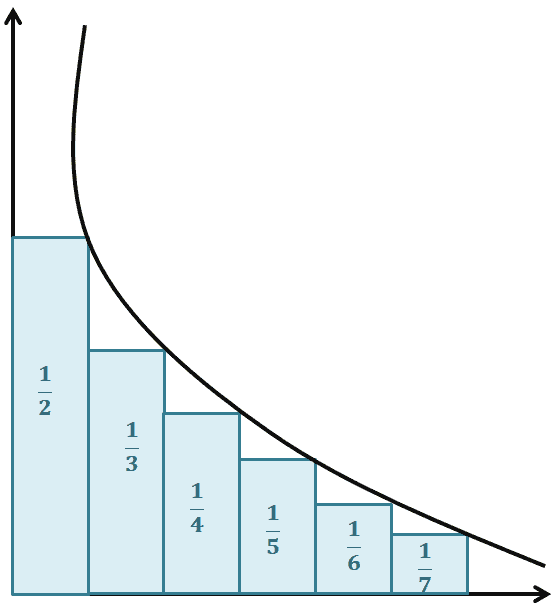
A Harmonic Progression (H.P.) is a sequence of numbers such that the reciprocals of its terms form an Arithmetic Progression (A.P.).
$ a_1, a_2, a_3, \dots \text{ are in H.P. if } \dfrac{1}{a_1}, \dfrac{1}{a_2}, \dfrac{1}{a_3}, \dots \text{ are in A.P.}$
General Form of an H.P.
If \( \dfrac{1}{a}, \dfrac{1}{a + d}, \dfrac{1}{a + 2d}, \dots \) are reciprocals forming an A.P., then:
$\text{H.P.} = \dfrac{1}{a},\, \dfrac{1}{a + d},\, \dfrac{1}{a + 2d},\, \dots $
nth Term of an H.P.
If \( \dfrac{1}{a_1}, \dfrac{1}{a_2}, \dots \) are in A.P., then the \( n \)th term of the H.P. is:
$a_n = \dfrac{1}{A + (n – 1)d} $
where \( A = \dfrac{1}{a_1} \) and \( d \) = common difference of the A.P. formed by reciprocals.
Harmonic Mean (H.M.)
The Harmonic Mean between two numbers \( a \) and \( b \) is given by:
$ H = \dfrac{2ab}{a + b}$
If three numbers \( a, H, b \) are in H.P., then their reciprocals \( \dfrac{1}{a}, \dfrac{1}{H}, \dfrac{1}{b} \) are in A.P.
Inserting Harmonic Means
If \( n \) harmonic means are inserted between \( a \) and \( b \), then their reciprocals form an A.P. between \( \dfrac{1}{a} \) and \( \dfrac{1}{b} \).
Hence, the reciprocals of the inserted H.M.s are:
$\dfrac{1}{a} + k\left(\dfrac{1}{b} – \dfrac{1}{a}\right)\dfrac{1}{n + 1}, \quad k = 1, 2, 3, \dots, n $
and their H.M.s are the reciprocals of these values.
Relationship Between A.P., G.P., and H.P.
For any two positive numbers \( a \) and \( b \):
$ A.M. \ge G.M. \ge H.M. $
and equality holds only when \( a = b \).
Also,
$ A.M. \times H.M. = (G.M.)^2 $
Relationship Between Sequences
- If \( a, b, c \) are in A.P., then \( \dfrac{1}{a}, \dfrac{1}{b}, \dfrac{1}{c} \) are in H.P.
- If \( a, b, c \) are in G.P., then \( \log a, \log b, \log c \) are in A.P.
- Conversely, if \( \dfrac{1}{a}, \dfrac{1}{b}, \dfrac{1}{c} \) are in A.P., then \( a, b, c \) are in H.P.
Example
Find the H.M. between 6 and 12.
▶️ Answer / Explanation
\( H = \dfrac{2ab}{a + b} = \dfrac{2(6)(12)}{6 + 12} = \dfrac{144}{18} = 8 \)
Answer: \( H = 8 \)
Example
The reciprocals of the terms of an H.P. form an A.P. whose first term is \( \dfrac{1}{2} \) and common difference \( \dfrac{1}{3} \). Find the 5th term of the H.P.
▶️ Answer / Explanation
\( \dfrac{1}{a_n} = \dfrac{1}{2} + (n – 1)\dfrac{1}{3} \)
For \( n = 5 \): \( \dfrac{1}{a_5} = \dfrac{1}{2} + 4 \times \dfrac{1}{3} = \dfrac{1}{2} + \dfrac{4}{3} = \dfrac{11}{6} \)
\( a_5 = \dfrac{6}{11} \)
Answer: 5th term = \( \dfrac{6}{11} \)
Example
Show that if A.M., G.M., and H.M. between two positive numbers \( a \) and \( b \) are \( A, G, H \) respectively, then \( A \times H = G^2 \).
▶️ Answer / Explanation
\( A = \dfrac{a + b}{2},\quad G = \sqrt{ab},\quad H = \dfrac{2ab}{a + b} \)
\( A \times H = \dfrac{a + b}{2} \times \dfrac{2ab}{a + b} = ab = (\sqrt{ab})^2 = G^2 \)
Hence proved: \( A \times H = G^2 \)
Key Takeaways for JEE:
- H.P. is the reciprocal of A.P.
- If \( a, b, c \) are in A.P. → \( \dfrac{1}{a}, \dfrac{1}{b}, \dfrac{1}{c} \) are in H.P.
- \( H = \dfrac{2ab}{a + b} \) and \( A \times H = G^2 \).
- When inserting H.M.s, work with reciprocals — they form an A.P.
- \( A \ge G \ge H \) is a fundamental inequality used in JEE inequality and optimization questions.
Combined Comparison Table (A.P., G.P., and H.P.)
| Type | nth Term | Common Parameter | Sum Formula |
|---|---|---|---|
| A.P. | \( a_n = a + (n – 1)d \) | Common difference \( d \) | \( S_n = \dfrac{n}{2}[2a + (n – 1)d] \) |
| G.P. | \( a_n = ar^{n – 1} \) | Common ratio \( r \) | \( S_n = \dfrac{a(r^n – 1)}{r – 1} \) |
| H.P. | \( a_n = \dfrac{1}{A + (n – 1)d} \) | Reciprocal of A.P. difference | No simple direct sum formula |