
Algebra of Functions
If \( f \) and \( g \) are two real-valued functions with overlapping domains, we can form new functions by performing algebraic operations on them. These are known as the algebra of functions.
The four basic operations are: Addition, Subtraction, Multiplication, and Division, along with an important fifth — Composition of Functions.
Domain for Operations
If \( f \) and \( g \) are functions defined on sets \( D_f \) and \( D_g \), then:
- For addition, subtraction, and multiplication: Domain = \( D_f \cap D_g \)
- For division: Domain = \( D_f \cap D_g \), excluding points where \( g(x) = 0 \)
- For composition: Domain = all \( x \in D_f \) such that \( f(x) \in D_g \)
Algebraic Operations
| Operation | Definition | Example |
|---|---|---|
| Sum | \( (f + g)(x) = f(x) + g(x) \) | If \( f(x)=x^2 \), \( g(x)=3x \), then \( (f+g)(x)=x^2+3x \) |
| Difference | \( (f – g)(x) = f(x) – g(x) \) | If \( f(x)=x^2 \), \( g(x)=3x \), then \( (f-g)(x)=x^2-3x \) |
| Product | \( (f \cdot g)(x) = f(x)g(x) \) | If \( f(x)=x \), \( g(x)=x+2 \), then \( (f\cdot g)(x)=x(x+2) \) |
| Quotient | \( \left(\dfrac{f}{g}\right)(x) = \dfrac{f(x)}{g(x)}, \, g(x)\ne0 \) | If \( f(x)=x^2 \), \( g(x)=x+1 \), then \( \dfrac{f}{g}(x)=\dfrac{x^2}{x+1} \) |
Composition of Functions
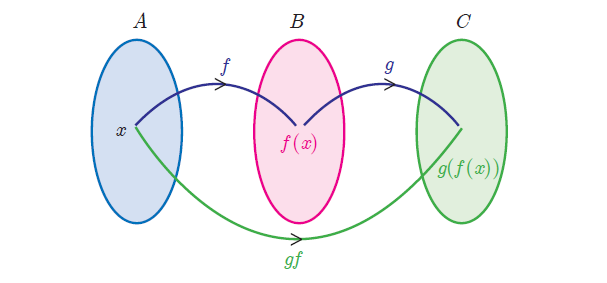
The composition of two functions \( f \) and \( g \) is denoted by \( (f \circ g)(x) \) and defined as:
$ (f \circ g)(x) = f(g(x)) $
Here, \( g(x) \) is first applied, and then \( f \) is applied to the result.
Domain: All \( x \in D_g \) such that \( g(x) \in D_f \).
Properties of Function Operations
- \( f + g = g + f \) (Commutative)
- \( f \cdot g = g \cdot f \) (Commutative)
- \( f + (g + h) = (f + g) + h \) (Associative)
- \( f \cdot (g \cdot h) = (f \cdot g) \cdot h \) (Associative)
- \( f \cdot (g + h) = f \cdot g + f \cdot h \) (Distributive)
- Composition is not commutative: \( f \circ g \ne g \circ f \) in general.
Identity and Inverse Functions
- Identity function: \( I(x) = x \). \( f \circ I = I \circ f = f \).
- Inverse function: If \( f: A \to B \) is bijective, then \( f^{-1}: B \to A \) exists such that \( f(f^{-1}(x)) = x = f^{-1}(f(x)) \).
Example
If \( f(x) = 2x + 3 \) and \( g(x) = x^2 \), find \( (f + g)(x) \) and \( (f \cdot g)(x) \).
▶️ Answer / Explanation
\( (f + g)(x) = f(x) + g(x) = (2x + 3) + x^2 = x^2 + 2x + 3 \)
\( (f \cdot g)(x) = f(x)g(x) = (2x + 3)(x^2) = 2x^3 + 3x^2 \)
Answer: \( (f + g)(x) = x^2 + 2x + 3, \quad (f \cdot g)(x) = 2x^3 + 3x^2 \)
Example
If \( f(x) = 3x + 1 \) and \( g(x) = x^2 \), find \( (f \circ g)(x) \) and \( (g \circ f)(x) \).
▶️ Answer / Explanation
\( (f \circ g)(x) = f(g(x)) = 3(x^2) + 1 = 3x^2 + 1 \)
\( (g \circ f)(x) = g(f(x)) = (3x + 1)^2 = 9x^2 + 6x + 1 \)
Hence, \( (f \circ g)(x) \ne (g \circ f)(x) \).
Example
Let \( f(x) = \sqrt{x – 1} \) and \( g(x) = x^2 + 1 \). Find the domain of \( (f \circ g)(x) \).
▶️ Answer / Explanation
\( (f \circ g)(x) = f(g(x)) = \sqrt{(x^2 + 1) – 1} = \sqrt{x^2} = |x| \)
Domain of \( g(x) \) = \( \mathbb{R} \).
Argument of sqrt ≥ 0 ⇒ \( x^2 \ge 0 \) (true for all \( x \)).
Domain: \( \mathbb{R} \)
Range: \( [0, \infty) \)
Shortcut Summary Table
| Operation | Formula | Domain Condition |
|---|---|---|
| Sum | \( (f + g)(x) = f(x) + g(x) \) | \( D_f \cap D_g \) |
| Difference | \( (f – g)(x) = f(x) – g(x) \) | \( D_f \cap D_g \) |
| Product | \( (f \cdot g)(x) = f(x)g(x) \) | \( D_f \cap D_g \) |
| Quotient | \( \dfrac{f(x)}{g(x)} \), \( g(x) \ne 0 \) | \( D_f \cap D_g – \{x | g(x)=0\} \) |
| Composition | \( (f \circ g)(x) = f(g(x)) \) | All \( x \in D_g \) where \( g(x) \in D_f \) |