
Continuity of a Function
The concept of continuity describes how smoothly a function behaves. Intuitively, a function is continuous at a point if its graph can be drawn there without lifting the pencil.
Mathematical Definition
A function \( f(x) \) is said to be continuous at a point \( x = a \) if:
$ \lim_{x \to a^-} f(x) = \lim_{x \to a^+} f(x) = f(a) $
This means:
- The left-hand limit (LHL) exists.
- The right-hand limit (RHL) exists.
- LHL = RHL = function value \( f(a) \).

If any of these three conditions fail → the function is discontinuous at \( x = a \).
Continuity at a Point — Step-by-Step Check
- Compute \( \lim_{x \to a^-} f(x) \).
- Compute \( \lim_{x \to a^+} f(x) \).
- If both exist and are equal, find \( f(a) \).
- If all three are equal, \( f \) is continuous at \( x = a \).
Continuity in an Interval
A function is continuous in an interval if it is continuous at every point of that interval.
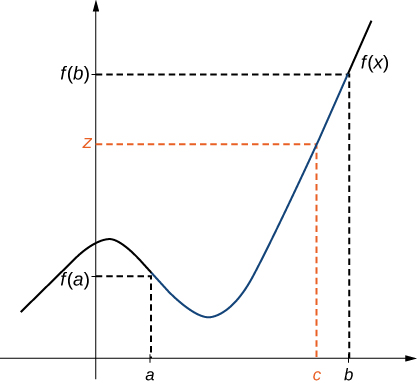
For closed interval \([a, b]\):
- Continuous at all interior points.
- \( \displaystyle \lim_{x \to a^+} f(x) = f(a) \)
- \( \displaystyle \lim_{x \to b^-} f(x) = f(b) \)
Algebra of Continuous Functions
If \( f(x) \) and \( g(x) \) are continuous at \( x = a \), then:
| Operation | Result |
|---|---|
| \( f(x) \pm g(x) \) | Continuous at \( x = a \) |
| \( f(x) \cdot g(x) \) | Continuous at \( x = a \) |
| \( \dfrac{f(x)}{g(x)} \) | Continuous at \( x = a \), if \( g(a) \ne 0 \) |
| \( f(g(x)) \) | Continuous at \( x = a \), if \( g(x) \) continuous at \( a \) and \( f \) continuous at \( g(a) \) |
Types of Discontinuities
There are 3 main types of discontinuities in real-valued functions:
| Type | Description | Example |
|---|---|---|
Removable Discontinuity | LHL = RHL, but ≠ f(a) or f(a) not defined | \( f(x) = \dfrac{x^2 – 1}{x – 1} \) at \( x = 1 \) |
Jump Discontinuity | LHL and RHL both exist but are unequal | Sign or step functions, e.g., \( f(x) = |x|/x \) |
Infinite Discontinuity | At least one of LHL or RHL tends to ±∞ | \( f(x) = \dfrac{1}{x – 2} \) at \( x = 2 \) |
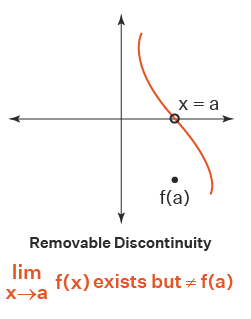
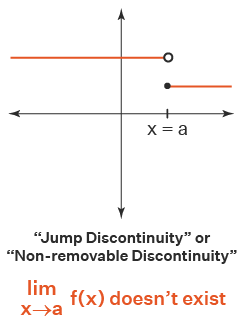
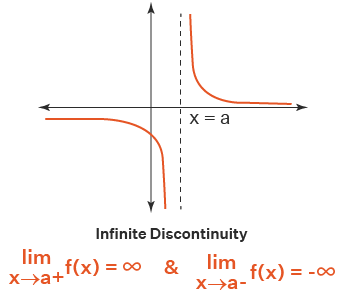
Graphical Interpretation
- Continuous function: Smooth curve, no breaks or jumps.
- Removable discontinuity: Hole in the curve (can be “filled”).
- Jump discontinuity: Sudden vertical gap.
- Infinite discontinuity: Vertical asymptote.
Example
Check continuity of \( f(x) = \dfrac{x^2 – 4}{x – 2} \) at \( x = 2 \).
▶️ Answer / Explanation
At \( x = 2 \), \( f(x) \) is not defined ⇒ possible discontinuity.
Simplify \( f(x) = x + 2 \) for \( x \ne 2 \).
\( \lim_{x \to 2} f(x) = 4 \).
If we redefine \( f(2) = 4 \), the function becomes continuous.
Type: Removable Discontinuity
Example
Check continuity of \( f(x) = |x|/x \) at \( x = 0 \).
▶️ Answer / Explanation
For \( x > 0 \): \( f(x) = 1 \), and for \( x < 0 \): \( f(x) = -1 \).
LHL = -1, RHL = +1 ⇒ not equal.
Type: Jump Discontinuity at \( x = 0 \)
Example
Check continuity of \( f(x) = \dfrac{1}{x – 1} \) at \( x = 1 \).
▶️ Answer / Explanation
As \( x \to 1^- \), \( f(x) \to -\infty \); as \( x \to 1^+ \), \( f(x) \to +\infty \).
No finite limit exists.
Type: Infinite Discontinuity at \( x = 1 \)