
Derivatives of Implicit, Parametric, and Inverse Trigonometric Functions
Implicit Differentiation
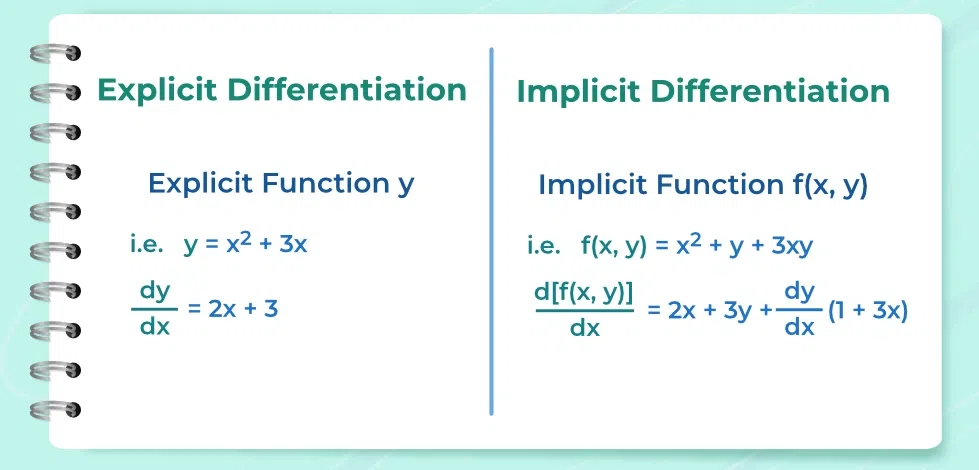
When \( y \) is not expressed explicitly as a function of \( x \), but both \( x \) and \( y \) are mixed in the same equation, we differentiate both sides with respect to \( x \), treating \( y \) as a function of \( x \).
Then use the chain rule: $ \dfrac{d}{dx}(y^n) = n y^{n-1} \dfrac{dy}{dx} $
Steps:
- Differentiate both sides of the given equation with respect to \( x \).
- Apply chain rule for terms containing \( y \).
- Collect all \( \dfrac{dy}{dx} \) terms on one side.
- Solve for \( \dfrac{dy}{dx} \).
Example
Find \( \dfrac{dy}{dx} \) if \( x^2 + y^2 = 25 \).
▶️ Answer / Explanation
Differentiating both sides w.r.t. \( x \):
\( 2x + 2y\dfrac{dy}{dx} = 0 \)
\( \Rightarrow \dfrac{dy}{dx} = -\dfrac{x}{y} \)
Answer: \( \dfrac{dy}{dx} = -\dfrac{x}{y} \)
Example
Find \( \dfrac{dy}{dx} \) if \( xy + y^2 = 10 \).
▶️ Answer / Explanation
Differentiating both sides w.r.t. \( x \):
\( x\dfrac{dy}{dx} + y + 2y\dfrac{dy}{dx} = 0 \)
\( \Rightarrow \dfrac{dy}{dx}(x + 2y) = -y \)
\( \Rightarrow \dfrac{dy}{dx} = -\dfrac{y}{x + 2y} \)
Answer: \( \dfrac{dy}{dx} = -\dfrac{y}{x + 2y} \)
Parametric Differentiation
When both \( x \) and \( y \) are expressed in terms of another variable (parameter) \( t \), we use the formula:
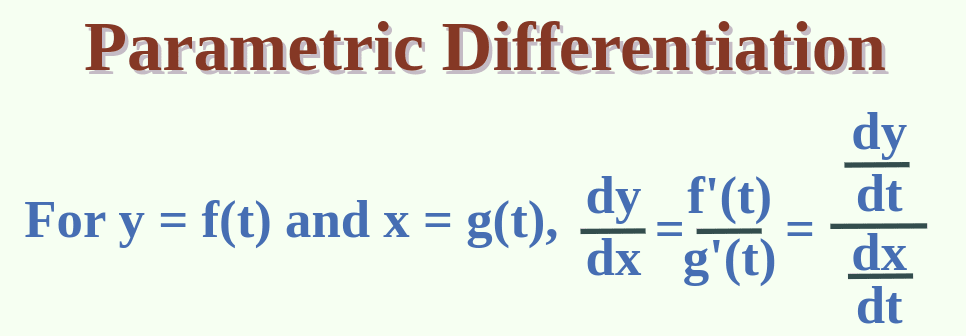
$ \dfrac{dy}{dx} = \dfrac{\dfrac{dy}{dt}}{\dfrac{dx}{dt}} $
Steps:
- Find \( \dfrac{dx}{dt} \) and \( \dfrac{dy}{dt} \).
- Then take the ratio \( \dfrac{dy}{dx} = \dfrac{dy/dt}{dx/dt} \).
Example
If \( x = \cos t \) and \( y = \sin t \), find \( \dfrac{dy}{dx} \).
▶️ Answer / Explanation
\( \dfrac{dx}{dt} = -\sin t, \; \dfrac{dy}{dt} = \cos t \).
\( \dfrac{dy}{dx} = \dfrac{\cos t}{-\sin t} = -\cot t \).
Answer: \( \dfrac{dy}{dx} = -\cot t \)
Example
If \( x = a(\cos t + t \sin t) \) and \( y = a(\sin t – t \cos t) \), find \( \dfrac{dy}{dx} \).
▶️ Answer / Explanation
\( \dfrac{dx}{dt} = a(-\sin t + \sin t + t \cos t) = a t \cos t \)
\( \dfrac{dy}{dt} = a(\cos t – \cos t + t \sin t) = a t \sin t \)
\( \Rightarrow \dfrac{dy}{dx} = \dfrac{a t \sin t}{a t \cos t} = \tan t \)
Answer: \( \dfrac{dy}{dx} = \tan t \)
Derivatives of Inverse Trigonometric Functions
Let’s recall the standard results:
| Function | Derivative | Domain |
|---|---|---|
| \( \sin^{-1} x \) | \( \dfrac{1}{\sqrt{1 – x^2}} \) | \( |x| \le 1 \) |
| \( \cos^{-1} x \) | \( -\dfrac{1}{\sqrt{1 – x^2}} \) | \( |x| \le 1 \) |
| \( \tan^{-1} x \) | \( \dfrac{1}{1 + x^2} \) | All real \( x \) |
| \( \cot^{-1} x \) | \( -\dfrac{1}{1 + x^2} \) | All real \( x \) |
| \( \sec^{-1} x \) | \( \dfrac{1}{|x|\sqrt{x^2 – 1}} \) | \( |x| \ge 1 \) |
| \( \csc^{-1} x \) | \( -\dfrac{1}{|x|\sqrt{x^2 – 1}} \) | \( |x| \ge 1 \) |
Example
Find \( \dfrac{d}{dx}(\sin^{-1}(2x)) \).
▶️ Answer / Explanation
Using chain rule:
\( \dfrac{d}{dx}(\sin^{-1}(2x)) = \dfrac{1}{\sqrt{1 – (2x)^2}} \cdot 2 = \dfrac{2}{\sqrt{1 – 4x^2}} \).
Answer: \( \dfrac{2}{\sqrt{1 – 4x^2}} \)
Example
Find \( \dfrac{d}{dx}(\tan^{-1}\sqrt{\dfrac{1 – x}{1 + x}}) \).
▶️ Answer / Explanation
Let \( y = \tan^{-1}\sqrt{\dfrac{1 – x}{1 + x}} \).
Using the trigonometric identity: \( \tan y = \sqrt{\dfrac{1 – x}{1 + x}} \Rightarrow \tan^2 y = \dfrac{1 – x}{1 + x} \).
\( \Rightarrow x = \cos(2y) \). Differentiating: \( \dfrac{dx}{dy} = -2\sin(2y) \Rightarrow \dfrac{dy}{dx} = -\dfrac{1}{2\sin(2y)} \).
Since \( \sin(2y) = \dfrac{2\tan y}{1 + \tan^2 y} \), substituting gives: \( \dfrac{dy}{dx} = -\dfrac{1 + \tan^2 y}{4\tan y} \).
Substitute \( \tan y = \sqrt{\dfrac{1 – x}{1 + x}} \): Answer: \( \dfrac{dy}{dx} = -\dfrac{1}{2\sqrt{1 – x^2}} \)