
Applications of Derivatives — Maxima, Minima, and the First Derivative Test
The concepts of maximum and minimum values of a function are crucial in calculus and have wide applications in optimization problems. Derivatives help us find where a function reaches its highest (maximum) or lowest (minimum) values — both locally and globally.
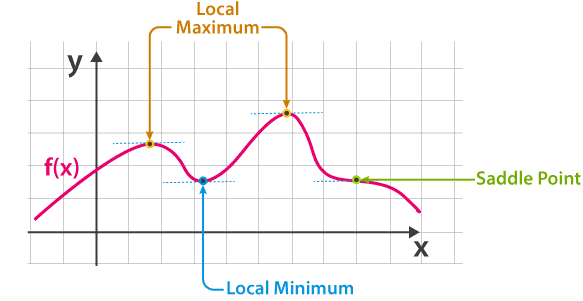
Definitions
- Local (Relative) Maximum: A function \( f(x) \) has a local maximum at \( x = a \) if \( f(a) \ge f(x) \) for all \( x \) near \( a \).
- Local (Relative) Minimum: A function \( f(x) \) has a local minimum at \( x = a \) if \( f(a) \le f(x) \) for all \( x \) near \( a \).
- Stationary Point: A point where \( f'(x) = 0 \) (slope of tangent = 0). It may be a maximum, minimum, or point of inflection.
First Derivative Test (Sign Change Test)
To determine whether a stationary point is a maximum or minimum:
| Condition on \( f'(x) \) | Nature of \( f(x) \) |
|---|---|
| Changes from + to – at \( x = a \) | Local Maximum at \( x = a \) |
| Changes from – to + at \( x = a \) | Local Minimum at \( x = a \) |
| No sign change | Neither Max nor Min (Inflection Point) |
Procedure (Using First Derivative Test)
- Find \( f'(x) \).
- Set \( f'(x) = 0 \) and solve for critical points.
- Check sign of \( f'(x) \) before and after each critical point.
- Conclude whether it’s a maximum or minimum.
Second Derivative Test (Quick Method)
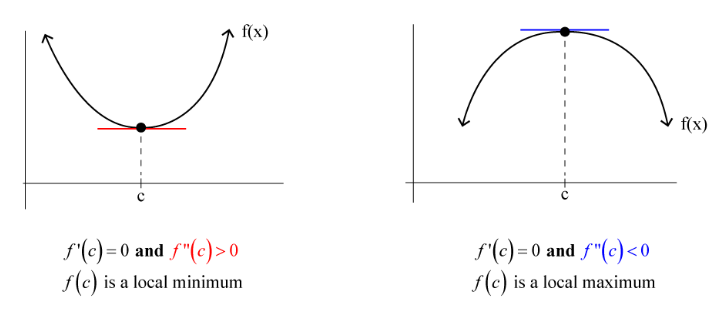
If \( f'(a) = 0 \) and \( f”(a) \) exists, then:
| Condition | Conclusion |
|---|---|
| \( f”(a) > 0 \) | Local Minimum at \( x = a \) |
| \( f”(a) < 0 \) | Local Maximum at \( x = a \) |
| \( f”(a) = 0 \) | Test fails (Use First Derivative Test) |
Relation Between First and Second Derivative Tests
- First Derivative Test: Uses change in sign of \( f'(x) \).
- Second Derivative Test: Uses the sign of \( f”(x) \) at critical points.
- Both give same result when \( f”(x) \ne 0 \).
- If \( f”(x) = 0 \), first derivative test must be used.
Graphical Meaning
- At a maximum, the curve bends downward (\( f”(x) < 0 \)).
- At a minimum, the curve bends upward (\( f”(x) > 0 \)).
- At an inflection point, concavity changes and \( f”(x) = 0 \).
Example
Find the local maxima and minima of \( f(x) = x^2 – 4x + 5 \).
▶️ Answer / Explanation
Step 1: \( f'(x) = 2x – 4 \). Set \( f'(x) = 0 \Rightarrow 2x – 4 = 0 \Rightarrow x = 2 \).
Step 2: \( f”(x) = 2 \gt 0 \), hence local minimum at \( x = 2 \).
Step 3: \( f(2) = 2^2 – 4(2) + 5 = 1 \).
Answer: Local Minimum = 1 at \( x = 2 \). No Maximum.
Example
Find the intervals of increase/decrease and local extrema of \( f(x) = x^3 – 3x^2 + 4 \).
▶️ Answer / Explanation
Step 1: \( f'(x) = 3x^2 – 6x = 3x(x – 2) \).
Critical points: \( x = 0, 2 \).
Step 2: \( f”(x) = 6x – 6 \).
- At \( x = 0 \): \( f”(0) = -6 \lt 0 \) → Local Maximum.
- At \( x = 2 \): \( f”(2) = 6 \gt 0 \) → Local Minimum.
Step 3: \( f(0) = 4, \; f(2) = 8 – 12 + 4 = 0 \).
Answer: Local Max = 4 at \( x = 0 \), Local Min = 0 at \( x = 2 \). Increasing on \( (-\infty, 0) \cup (2, \infty) \); Decreasing on \( (0, 2) \).
Example
Find local maxima and minima of \( f(x) = \sin x + \cos x \) in \( [0, 2\pi] \).
▶️ Answer / Explanation
Step 1: \( f'(x) = \cos x – \sin x = 0 \Rightarrow \tan x = 1 \Rightarrow x = \dfrac{\pi}{4}, \dfrac{5\pi}{4} \).
Step 2: \( f”(x) = -\sin x – \cos x \).
- At \( x = \dfrac{\pi}{4} \): \( f” = -\sqrt{2} \lt 0 \) → Local Maximum.
- At \( x = \dfrac{5\pi}{4} \): \( f” = \sqrt{2} \gt 0 \) → Local Minimum.
Step 3: \( f(\dfrac{\pi}{4}) = \sqrt{2}, \quad f(\dfrac{5\pi}{4}) = -\sqrt{2} \).
Answer: Local Max = \( \sqrt{2} \) at \( x = \dfrac{\pi}{4} \); Local Min = \( -\sqrt{2} \) at \( x = \dfrac{5\pi}{4} \).
Applications of Derivatives — Second Derivative Test and Points of Inflection
The Second Derivative Test helps determine whether a stationary point (where \( f'(x) = 0 \)) is a maximum, minimum, or a point of inflection. It uses the concavity of the function at that point, determined by the sign of \( f”(x) \).
Statement of the Second Derivative Test
If \( f'(a) = 0 \) and \( f”(a) \) exists, then:
| Condition | Nature of \( f(x) \) at \( x = a \) |
|---|---|
| \( f”(a) > 0 \) | Local Minimum |
| \( f”(a) < 0 \) | Local Maximum |
| \( f”(a) = 0 \) | Test fails (use First Derivative Test) |
Geometrical Meaning
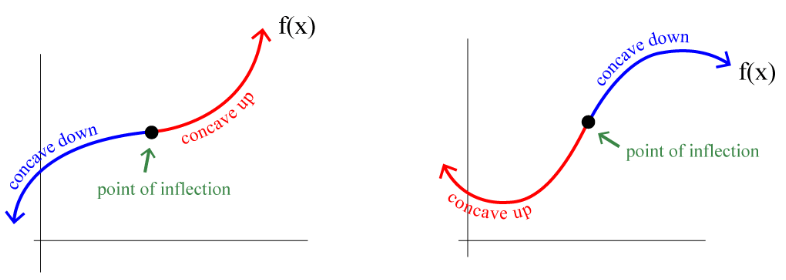
- If \( f”(x) > 0 \): The curve is concave upward (like a cup) — tangent lies below the curve → local minimum.
- If \( f”(x) < 0 \): The curve is concave downward (like a hill) — tangent lies above the curve → local maximum.
- If \( f”(x) = 0 \): The concavity changes — possible point of inflection.
Point of Inflection
A point on the curve \( y = f(x) \) where the concavity changes (from upward to downward or vice versa) is called a point of inflection.
At a point of inflection:
- \( f”(x) = 0 \), and
- \( f”(x) \) changes sign.
Note: If \( f”(x) = 0 \) but does not change sign, then it is not an inflection point.
Step-by-Step Procedure
- Compute \( f'(x) \) and find where \( f'(x) = 0 \) (stationary points).
- Find \( f”(x) \).
- Evaluate \( f”(x) \) at each stationary point.
- Apply the sign test:
- \( f”(x) > 0 \): Minimum
- \( f”(x) < 0 \): Maximum
- \( f”(x) = 0 \): Test fails — check sign change or use first derivative test.
Example
Find the nature of the stationary point of \( f(x) = x^2 – 6x + 10 \).
▶️ Answer / Explanation
Step 1: \( f'(x) = 2x – 6 = 0 \Rightarrow x = 3 \).
Step 2: \( f”(x) = 2 \gt 0 \Rightarrow \) local minimum at \( x = 3 \).
Step 3: \( f(3) = 9 – 18 + 10 = 1 \).
Answer: Minimum value = 1 at \( x = 3 \).
Example
Find the points of local maximum, minimum, and inflection for \( f(x) = x^3 – 6x^2 + 9x + 1 \).
▶️ Answer / Explanation
Step 1: \( f'(x) = 3x^2 – 12x + 9 = 3(x – 1)(x – 3) \).
Critical points: \( x = 1, 3 \).
Step 2: \( f”(x) = 6x – 12 \).
- \( f”(1) = -6 \lt 0 \) → local maximum at \( x = 1 \).
- \( f”(3) = 6 \gt 0 \) → local minimum at \( x = 3 \).
Step 3: Find possible inflection point: \( f”(x) = 0 \Rightarrow 6x – 12 = 0 \Rightarrow x = 2 \).
Check sign change: For \( x < 2, f”(x) < 0 \); for \( x > 2, f”(x) > 0 \) → concavity changes.
Answer: Local Max at \( x = 1 \), Local Min at \( x = 3 \), Point of Inflection at \( x = 2 \).
Example
Find intervals of concavity and the points of inflection for \( f(x) = \sin x \) on \( [0, 2\pi] \).
▶️ Answer / Explanation
Step 1: \( f'(x) = \cos x \), \( f”(x) = -\sin x \).
\( f”(x) = 0 \Rightarrow \sin x = 0 \Rightarrow x = 0, \pi, 2\pi \).
Check sign of \( f”(x) \):
- \( (0, \pi) \): \( \sin x > 0 \Rightarrow f”(x) < 0 \) → concave downward.
- \( (\pi, 2\pi) \): \( \sin x < 0 \Rightarrow f”(x) > 0 \) → concave upward.
Answer: Concave down on \( (0, \pi) \), concave up on \( (\pi, 2\pi) \), Points of inflection at \( x = 0, \pi, 2\pi \).
Concavity and Convexity Summary
| Condition | Nature of Curve |
|---|---|
| \( f”(x) > 0 \) | Concave Upward (Convex) |
| \( f”(x) < 0 \) | Concave Downward (Concave) |
| \( f”(x) = 0 \) and sign changes | Point of Inflection |