
Second Order Derivatives
The second derivative of a function measures the rate of change of the first derivative. In simple terms, it tells us how the slope of a curve is changing.
If \( y = f(x) \), then:
$ \dfrac{dy}{dx} = f'(x) \quad \text{and} \quad \dfrac{d^2y}{dx^2} = f”(x) = \dfrac{d}{dx}\left(\dfrac{dy}{dx}\right) $
The second order derivative is defined as:
$ f”(x) = \lim_{h \to 0} \dfrac{f'(x + h) – f'(x)}{h} $
It represents the rate of change of the first derivative with respect to \( x \).
Physical Meaning
- In motion problems, if \( s = f(t) \):
- \( \dfrac{ds}{dt} \) = velocity
- \( \dfrac{d^2s}{dt^2} \) = acceleration
- In general, \( f”(x) \) indicates the curvature or concavity of a function’s graph.
Geometrical Interpretation
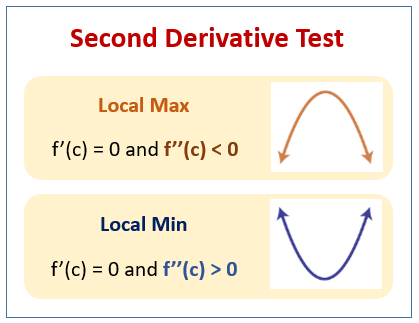
- If \( f”(x) > 0 \): The function is concave upward (like a “U”), and \( f(x) \) is increasing faster.
- If \( f”(x) < 0 \): The function is concave downward (like an inverted “U”), and \( f(x) \) is decreasing faster.
- If \( f”(x) = 0 \): The point may be an inflection point (where concavity changes).
Notations Used
| Form | Notation |
|---|---|
| First Derivative | \( \dfrac{dy}{dx}, \; y’, \; f'(x) \) |
| Second Derivative | \( \dfrac{d^2y}{dx^2}, \; y”, \; f”(x) \) |
Higher Order Derivatives
We can continue differentiating further:
$ \dfrac{d^3y}{dx^3}, \; \dfrac{d^4y}{dx^4}, \; \dots, \; \dfrac{d^n y}{dx^n} $
These are called the third, fourth, nth order derivatives respectively.
Rules for Finding Second Derivative
- Differentiation rules (sum, product, quotient, chain) apply the same way to \( f'(x) \).
- Use implicit differentiation when \( y \) appears with \( x \).
- For parametric functions, use: $ \dfrac{d^2y}{dx^2} = \dfrac{\dfrac{d}{dt}\left(\dfrac{dy}{dx}\right)}{\dfrac{dx}{dt}} $
Example
Find \( \dfrac{d^2y}{dx^2} \) if \( y = x^3 – 2x^2 + 3x – 5 \).
▶️ Answer / Explanation
\( \dfrac{dy}{dx} = 3x^2 – 4x + 3 \)
\( \dfrac{d^2y}{dx^2} = 6x – 4 \)
Answer: \( \dfrac{d^2y}{dx^2} = 6x – 4 \)
Example
Find \( \dfrac{d^2y}{dx^2} \) if \( y = \sin x + \cos x \).
▶️ Answer / Explanation
First derivative: \( \dfrac{dy}{dx} = \cos x – \sin x \)
Second derivative: \( \dfrac{d^2y}{dx^2} = -\sin x – \cos x = -( \sin x + \cos x) \)
Answer: \( \dfrac{d^2y}{dx^2} = -( \sin x + \cos x) \)
Example
If \( x = a\cos t \) and \( y = a\sin t \), find \( \dfrac{d^2y}{dx^2} \).
▶️ Answer / Explanation
\( \dfrac{dy}{dt} = a\cos t, \; \dfrac{dx}{dt} = -a\sin t \)
\( \Rightarrow \dfrac{dy}{dx} = \dfrac{a\cos t}{-a\sin t} = -\cot t \)
Differentiating again w.r.t. \( t \): \( \dfrac{d}{dt}\left(\dfrac{dy}{dx}\right) = \csc^2 t \)
Now, \( \dfrac{d^2y}{dx^2} = \dfrac{\dfrac{d}{dt}\left(\dfrac{dy}{dx}\right)}{\dfrac{dx}{dt}} = \dfrac{\csc^2 t}{-a\sin t} = -\dfrac{1}{a\sin^3 t} \).
Answer: \( \dfrac{d^2y}{dx^2} = -\dfrac{1}{a\sin^3 t} \)
Application of Second Derivative — Test for Concavity and Turning Points
- If \( f”(x) > 0 \): The curve is concave upward (local minimum).
- If \( f”(x) < 0 \): The curve is concave downward (local maximum).
- If \( f”(x) = 0 \): Possible point of inflection.
At a critical point where \( f'(x) = 0 \):
| Condition | Nature of Point |
|---|---|
| \( f”(x) > 0 \) | Local Minimum |
| \( f”(x) < 0 \) | Local Maximum |
| \( f”(x) = 0 \) | Point of Inflection (possible) |