
Applications of Derivatives — Tangents, Normals, and Approximation
Derivatives are powerful tools to find the slope of curves, the equation of tangents and normals at specific points, and for approximating values of functions near a given point.
If \( y = f(x) \), then the derivative \( \dfrac{dy}{dx} \) at a point \( x = a \) gives the slope of the tangent to the curve at that point.
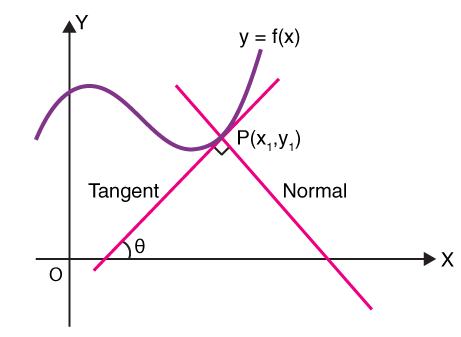
Tangent to a Curve
The tangent line to a curve at a point \( P(x_1, y_1) \) is the straight line that just touches the curve at that point and has the same slope as the curve there.
Equation of tangent to \( y = f(x) \) at \( x = x_1 \):
$ y – y_1 = f'(x_1)(x – x_1) $
Here, \( f'(x_1) \) = slope of tangent.
Normal to a Curve
The normal line to a curve at a point is the line perpendicular to the tangent at that point.
Equation of normal:
$ y – y_1 = -\dfrac{1}{f'(x_1)}(x – x_1) $
Here, slope of normal = \( -\dfrac{1}{\text{slope of tangent}} \).
For Implicit Functions
If the curve is given implicitly as \( F(x, y) = 0 \), then:
$ \dfrac{dy}{dx} = -\dfrac{\dfrac{\partial F}{\partial x}}{\dfrac{\partial F}{\partial y}} $
This value can be used in tangent or normal equations at the desired point.
Approximation using Derivatives
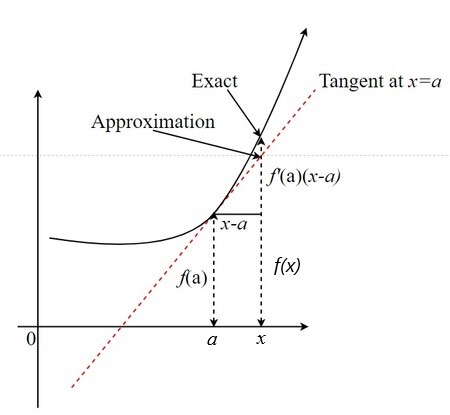
If \( y = f(x) \), and \( x \) changes slightly from \( a \) to \( a + \Delta x \), then:
$ f(a + \Delta x) \approx f(a) + f'(a)\Delta x $
This is used for estimating function values when \( \Delta x \) is small — a key application of the derivative in linear approximation.
Important Special Forms
- Circle \( x^2 + y^2 = a^2 \)
Tangent at \( (x_1, y_1) \): \( xx_1 + yy_1 = a^2 \)
Normal: \( x_1x + y_1y = x_1^2 + y_1^2 \) - Parabola \( y^2 = 4ax \)
Tangent at \( (x_1, y_1) \): \( yy_1 = 2a(x + x_1) \)
Normal: \( y = -\dfrac{y_1}{2a}(x – x_1) + y_1 \)
Linear Approximation Summary
| Formula | Meaning |
|---|---|
| \( f(a + \Delta x) \approx f(a) + f'(a)\Delta x \) | Linear approximation of function near \( x = a \) |
| \( \Delta y \approx f'(a)\Delta x \) | Change in \( y \) ≈ slope × change in \( x \) |
Example
Find the equation of the tangent to the curve \( y = x^2 + 3x + 1 \) at the point where \( x = 1 \).
▶️ Answer / Explanation
Step 1: \( f'(x) = 2x + 3 \).
At \( x = 1 \), slope \( m = 2(1) + 3 = 5 \).
Step 2: \( y_1 = 1^2 + 3(1) + 1 = 5 \).
Step 3: Equation of tangent: \( y – 5 = 5(x – 1) \Rightarrow y = 5x \).
Answer: Tangent line: \( y = 5x \).
Example
Find the equation of the normal to \( y = x^3 – 3x + 2 \) at \( x = 2 \).
▶️ Answer / Explanation
Step 1: \( f'(x) = 3x^2 – 3 \).
At \( x = 2 \): \( f'(2) = 3(4) – 3 = 9 \).
Step 2: \( y_1 = 2^3 – 3(2) + 2 = 4 \).
Step 3: Slope of tangent = 9, so slope of normal = \( -\dfrac{1}{9} \).
Equation: \( y – 4 = -\dfrac{1}{9}(x – 2) \).
Answer: \( y = -\dfrac{1}{9}x + \dfrac{38}{9} \).
Example
Find the equation of the tangent to the curve \( x^2 + xy + y^2 = 7 \) at the point (2, 1).
▶️ Answer / Explanation
Differentiating implicitly: \( 2x + y + x\dfrac{dy}{dx} + 2y\dfrac{dy}{dx} = 0 \).
\( \Rightarrow \dfrac{dy}{dx}(x + 2y) = -(2x + y) \Rightarrow \dfrac{dy}{dx} = -\dfrac{2x + y}{x + 2y} \).
At (2, 1): \( \dfrac{dy}{dx} = -\dfrac{2(2) + 1}{2 + 2(1)} = -\dfrac{5}{4} \).
Equation of tangent: \( y – 1 = -\dfrac{5}{4}(x – 2) \Rightarrow 5x + 4y – 14 = 0 \).
Answer: Tangent: \( 5x + 4y – 14 = 0 \).
Example
Use derivative to approximate \( \sqrt{25.5} \).
▶️ Answer / Explanation
Let \( f(x) = \sqrt{x} \Rightarrow f'(x) = \dfrac{1}{2\sqrt{x}} \).
Take \( a = 25 \), \( \Delta x = 0.5 \).
\( f(25.5) \approx f(25) + f'(25)\Delta x \).
\( f(25) = 5, \quad f'(25) = \dfrac{1}{10} \).
\( f(25.5) \approx 5 + \dfrac{1}{10}(0.5) = 5.05 \).
Actual value: \( \sqrt{25.5} \approx 5.049 \).
Answer: Approximation = 5.05 (accurate to 2 decimal places).