
Formation of Differential Equations (By Eliminating Constants)
The process of formation of a differential equation involves finding an equation that contains derivatives of a function but does not contain any arbitrary constants.
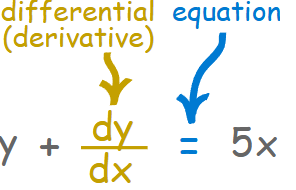
This is done by differentiating the given relation between variables successively and then eliminating the arbitrary constants.
General Method
Suppose a relation between \( x \) and \( y \) is given as
\( F(x, y, a, b) = 0 \)
where \( a, b \) are arbitrary constants.
Then the steps for formation of a differential equation are:
- Differentiate the given equation successively with respect to \( x \), as many times as there are arbitrary constants.
- Eliminate the arbitrary constants using these equations.
- The resulting equation is the required differential equation.
Order of the Formed Differential Equation
If the given family of curves involves n arbitrary constants, then the differential equation formed by eliminating them will be of order n.
- One arbitrary constant → First order differential equation
- Two arbitrary constants → Second order differential equation
- And so on.
Example of Concept
If the equation of a family of curves is \( y = mx + c \):
- There are two arbitrary constants \( m \) and \( c \).
- The differential equation formed by eliminating \( m \) and \( c \) will be of order 2.
Example
Find the differential equation of all straight lines passing through the origin.
▶️ Answer / Explanation
Step 1: Equation of the family of straight lines through origin: \( y = mx \), where \( m \) is the slope.
Step 2: Differentiate with respect to \( x \): \( \dfrac{dy}{dx} = m. \)
Step 3: Eliminate \( m \): From \( y = mx \Rightarrow m = \dfrac{y}{x} \).
Thus, \( \dfrac{dy}{dx} = \dfrac{y}{x}. \)
Required Differential Equation: \( \boxed{x\dfrac{dy}{dx} = y.} \)
Example
Form the differential equation of all circles with center on the x-axis and radius \( r \).
▶️ Answer / Explanation
Step 1: Equation of such circles: \( (x – a)^2 + y^2 = r^2 \), where \( a \) and \( r \) are constants.
Step 2: Differentiate w.r.t. \( x \): \( 2(x – a) + 2y\dfrac{dy}{dx} = 0 \Rightarrow (x – a) = -y\dfrac{dy}{dx}. \)
Step 3: Substitute this in the original equation to eliminate \( a \):
\( [x – (-y\dfrac{dy}{dx})]^2 + y^2 = r^2 \Rightarrow (x + y\dfrac{dy}{dx})^2 + y^2 = r^2. \)
Step 4: Differentiate again to remove \( r \): Differentiate both sides w.r.t. \( x \): \( 2(x + y\dfrac{dy}{dx})(1 + \dfrac{dy}{dx} + y\dfrac{d^2y}{dx^2}) + 2y\dfrac{dy}{dx} = 0. \)
Required Differential Equation: \( (x + y\dfrac{dy}{dx})(1 + (\dfrac{dy}{dx})^2 + y\dfrac{d^2y}{dx^2}) + y\dfrac{dy}{dx} = 0. \)
Order: 2 (since two constants \( a, r \) were present).
Example
Find the differential equation of the family \( y = A e^{2x} + B e^{-3x} \).
▶️ Answer / Explanation
Step 1: Differentiate once: \( \dfrac{dy}{dx} = 2A e^{2x} – 3B e^{-3x}. \)
Step 2: Differentiate again: \( \dfrac{d^2y}{dx^2} = 4A e^{2x} + 9B e^{-3x}. \)
Step 3: To eliminate \( A \) and \( B \), solve the system:
\( y = A e^{2x} + B e^{-3x} \)
\( \dfrac{dy}{dx} = 2A e^{2x} – 3B e^{-3x} \)
Multiplying the first by 2 and adding to the second: \( \dfrac{dy}{dx} + 3y = 5A e^{2x}. \)
Differentiate once more to remove \( A \) and \( B \): \( \dfrac{d^3y}{dx^3} + y” – 6y’ – 9y = 0. \)
Required Differential Equation: \( \boxed{y” – 5y’ – 6y = 0.} \)
Order: 2 (since there were two arbitrary constants).
Important Notes
- If the equation contains \( n \) arbitrary constants, the resulting differential equation will be of order \( n \).
- Each differentiation helps eliminate one constant.
- The resulting equation must contain derivatives of \( y \) but no arbitrary constants.
Solutions of Differential Equations — General and Particular Solutions
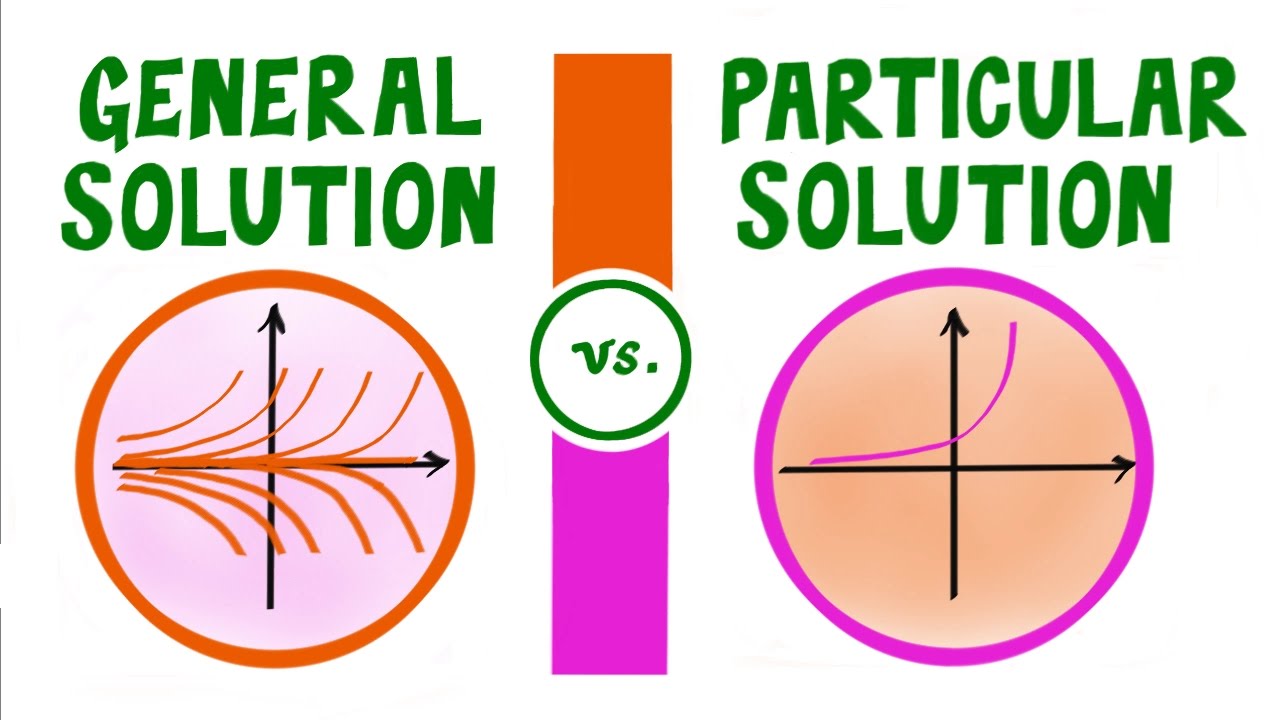
A differential equation represents a relationship between a function and its derivatives. The goal of solving a differential equation is to find the original function that satisfies it.
Solution of a Differential Equation
A solution of a differential equation is a function \( y = \phi(x) \) which, when substituted into the equation, satisfies it identically for all values of \( x \) in its domain.
Types of Solutions
There are two main types of solutions to a differential equation:
| Type | Description | Form |
|---|---|---|
| General Solution | The solution containing as many arbitrary constants as the order of the equation. | \( y = f(x, C_1, C_2, \dots, C_n) \) |
| Particular Solution | Obtained by giving specific numerical values to the arbitrary constants in the general solution. | \( y = f(x) \) (after constants are assigned) |
General Solution
If a differential equation is of order \( n \), its general solution will contain \( n \) arbitrary constants.
Example: \( \dfrac{dy}{dx} = ky \)
Integrating, we get \( y = Ae^{kx} \), which contains one arbitrary constant \( A \). Thus, it is a general solution.
Particular Solution
A particular solution is obtained from the general solution by applying given initial conditions or boundary conditions.
These conditions usually specify the value of \( y \) and possibly some of its derivatives at particular points of \( x \).
Example: If \( y(0) = 2 \), substitute \( x = 0, y = 2 \) in the general solution to find the constant.
Important Relation Between Them
- Every particular solution is derived from the general solution.
- But not every particular solution contains arbitrary constants.
- Number of constants = order of the differential equation.
Example
Find the general and particular solutions of \( \dfrac{dy}{dx} = 3x^2 \) if \( y(0) = 5 \).
▶️ Answer / Explanation
Step 1: Integrate both sides: \( \int dy = \int 3x^2\,dx \Rightarrow y = x^3 + C. \)
General Solution: \( y = x^3 + C. \)
Step 2: Apply condition \( y(0) = 5 \): \( 5 = 0 + C \Rightarrow C = 5. \)
Particular Solution: \( y = x^3 + 5. \)
Example
Solve \( \dfrac{dy}{dx} = ky \), and find the particular solution if \( y = 3 \) when \( x = 0 \).
▶️ Answer / Explanation
Step 1: Separate variables: \( \dfrac{dy}{y} = k\,dx. \)
Step 2: Integrate both sides: \( \ln y = kx + C. \)
\( \Rightarrow y = Ae^{kx}, \text{ where } A = e^C. \)
General Solution: \( y = Ae^{kx}. \)
Step 3: Use \( y = 3 \) when \( x = 0 \): \( 3 = Ae^0 \Rightarrow A = 3. \)
Particular Solution: \( y = 3e^{kx}. \)
Example
Find the general and particular solutions of \( \dfrac{d^2y}{dx^2} = 6x \) if \( y(0) = 2 \) and \( \dfrac{dy}{dx}(0) = 3 \).
▶️ Answer / Explanation
Step 1: Integrate once to get first derivative: \( \dfrac{dy}{dx} = \int 6x\,dx = 3x^2 + C_1. \)
Step 2: Integrate again to get \( y \): \( y = \int (3x^2 + C_1)\,dx = x^3 + C_1x + C_2. \)
General Solution: \( y = x^3 + C_1x + C_2. \)
Step 3: Apply conditions:
- \( y(0) = 2 \Rightarrow C_2 = 2 \)
- \( \dfrac{dy}{dx}(0) = 3 \Rightarrow 3 = 0 + C_1 \Rightarrow C_1 = 3 \)
Particular Solution: \( y = x^3 + 3x + 2. \)
General vs. Particular Solution
| Feature | General Solution | Particular Solution |
|---|---|---|
| Contains Constants | Yes, as many as the order | No constants (specific values substituted) |
| Represents | Family of curves | A single curve |
| Obtained by | Integrating differential equation | Applying initial/boundary conditions |
| Example | \( y = Ae^{kx} \) | \( y = 3e^{kx} \) |