
Homogeneous Differential Equations
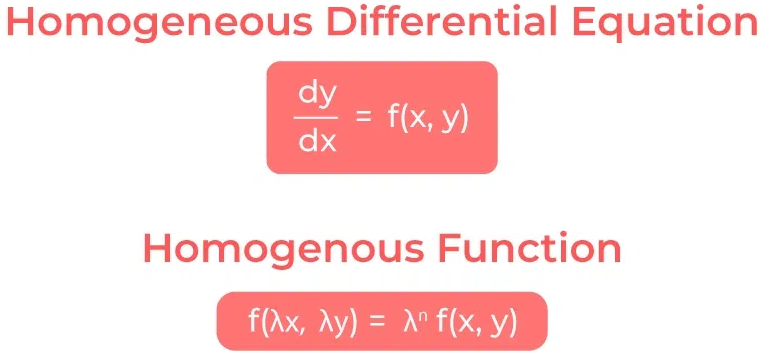
A homogeneous differential equation is a type of first-order differential equation that can be expressed in the form:
$ \dfrac{dy}{dx} = f\left(\dfrac{y}{x}\right) $
Such equations have the same degree in both variables \( x \) and \( y \), which allows simplification by substitution \( y = vx \).
Definition
A function \( f(x, y) \) is said to be homogeneous of degree n if
$ f(tx, ty) = t^n f(x, y) $
If a differential equation can be written as \( \dfrac{dy}{dx} = \dfrac{f(x, y)}{g(x, y)} \), where both \( f \) and \( g \) are homogeneous functions of the same degree, then the equation is called a homogeneous differential equation.
Standard Form
$ \dfrac{dy}{dx} = \dfrac{f(y/x)}{g(y/x)} $
To solve such equations, we use the substitution:
$ y = vx \quad \text{and} \quad \dfrac{dy}{dx} = v + x\dfrac{dv}{dx}. $
Method of Solving Homogeneous Differential Equations
- Express the given equation in the form \( \dfrac{dy}{dx} = f(y/x) \).
- Put \( y = vx \), so that \( \dfrac{dy}{dx} = v + x\dfrac{dv}{dx} \).
- Substitute into the original equation to get an equation in \( v \) and \( x \).
- Rearrange to make it in separable form.
- Integrate both sides and simplify to get the required relation between \( x \) and \( y \).
Example
Solve \( \dfrac{dy}{dx} = \dfrac{x + y}{x – y} \).
▶️ Answer / Explanation
Step 1: Check homogeneity:
Both numerator and denominator are degree 1 → homogeneous equation.
Step 2: Substitute \( y = vx \Rightarrow \dfrac{dy}{dx} = v + x\dfrac{dv}{dx}. \)
Then \( v + x\dfrac{dv}{dx} = \dfrac{x + vx}{x – vx} = \dfrac{1 + v}{1 – v}. \)
Step 3: Simplify and separate:
\( x\dfrac{dv}{dx} = \dfrac{1 + v}{1 – v} – v = \dfrac{1 + v – v(1 – v)}{1 – v} = \dfrac{1 + v^2}{1 – v}. \)
\( \Rightarrow \dfrac{1 – v}{1 + v^2}\,dv = \dfrac{dx}{x}. \)
Step 4: Integrate both sides:
\( \int \dfrac{1 – v}{1 + v^2}\,dv = \int \dfrac{dx}{x}. \)
\( \Rightarrow \tan^{-1}v – \dfrac{1}{2}\ln(1 + v^2) = \ln|x| + C. \)
Step 5: Substitute back \( v = \dfrac{y}{x} \):
\( \boxed{\tan^{-1}\left(\dfrac{y}{x}\right) – \dfrac{1}{2}\ln(x^2 + y^2) = \ln|x| + C.} \)
Example
Solve \( \dfrac{dy}{dx} = \dfrac{x^2 + y^2}{xy} \).
▶️ Answer / Explanation
Step 1: Both numerator and denominator are degree 2 → homogeneous equation.
Step 2: Substitute \( y = vx \Rightarrow \dfrac{dy}{dx} = v + x\dfrac{dv}{dx}. \)
\( v + x\dfrac{dv}{dx} = \dfrac{x^2 + v^2x^2}{vx^2} = \dfrac{1 + v^2}{v}. \)
Step 3: Simplify and separate:
\( x\dfrac{dv}{dx} = \dfrac{1 + v^2}{v} – v = \dfrac{1 + v^2 – v^2}{v} = \dfrac{1}{v}. \)
\( \Rightarrow v\,dv = \dfrac{dx}{x}. \)
Step 4: Integrate both sides:
\( \int v\,dv = \int \dfrac{dx}{x}. \)
\( \Rightarrow \dfrac{v^2}{2} = \ln|x| + C. \)
Step 5: Substitute \( v = \dfrac{y}{x} \):
\( \boxed{\dfrac{y^2}{2x^2} = \ln|x| + C.} \)
Example
Solve \( x\dfrac{dy}{dx} = x + y \).
▶️ Answer / Explanation
Step 1: Divide both sides by \( x \): \( \dfrac{dy}{dx} = 1 + \dfrac{y}{x}. \)
Thus, it is homogeneous.
Step 2: Substitute \( y = vx \Rightarrow \dfrac{dy}{dx} = v + x\dfrac{dv}{dx}. \)
Then, \( v + x\dfrac{dv}{dx} = 1 + v \Rightarrow x\dfrac{dv}{dx} = 1. \)
Step 3: Separate and integrate:
\( dv = \dfrac{dx}{x}. \Rightarrow v = \ln|x| + C. \)
Step 4: Substitute \( v = \dfrac{y}{x} \): \( \dfrac{y}{x} = \ln|x| + C. \)
Step 5: Simplify:
\( \boxed{y = x(\ln|x| + C).} \)