
Methods of Solving First-Order Differential Equations — Variable Separable Form
A first-order differential equation is one that involves \( y \) and its first derivative \( \dfrac{dy}{dx} \), but no higher-order derivatives.
When the variables \( x \) and \( y \) can be separated so that all terms in \( y \) (and \( dy \)) appear on one side and all terms in \( x \) (and \( dx \)) on the other, it is called a variable separable differential equation.
General Form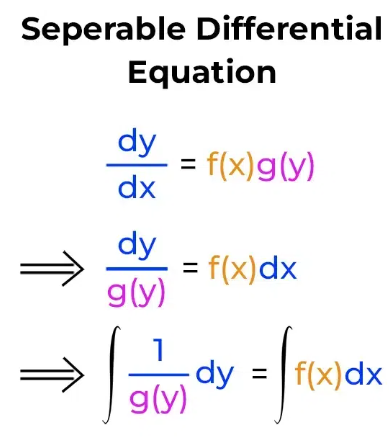
A differential equation is said to be of separable variables if it can be expressed as:
$ \dfrac{dy}{dx} = f(x) \, g(y) $
This can be rearranged as:
$ \dfrac{dy}{g(y)} = f(x)\,dx $
Now, both sides can be integrated separately.
Method of Solution
- Rewrite the equation so that all \( y \) terms (including \( dy \)) are on one side and all \( x \) terms (including \( dx \)) are on the other.
- Integrate both sides with respect to their own variables.
- Simplify to get the required relation between \( x \) and \( y \).
- Add the constant of integration \( C \).
$ \int \dfrac{1}{g(y)}\,dy = \int f(x)\,dx + C $
Note
- This method can only be used when the equation can be separated into pure \( x \)-terms and \( y \)-terms.
- If it cannot be rearranged in this form, another method (like homogeneous or linear) must be used.
Example
Solve \( \dfrac{dy}{dx} = 2x(1 + y^2) \).
▶️ Answer / Explanation
Step 1: Separate the variables:
\( \dfrac{dy}{1 + y^2} = 2x\,dx \).
Step 2: Integrate both sides:
\( \int \dfrac{dy}{1 + y^2} = \int 2x\,dx \).
\( \tan^{-1}y = x^2 + C. \)
Step 3: Final solution:
\( \boxed{y = \tan(x^2 + C)}. \)
Example
Solve \( \dfrac{dy}{dx} = \dfrac{x}{y} \), given that \( y = 2 \) when \( x = 1 \).
▶️ Answer / Explanation
Step 1: Separate variables:
\( y\,dy = x\,dx. \)
Step 2: Integrate both sides:
\( \int y\,dy = \int x\,dx \Rightarrow \dfrac{y^2}{2} = \dfrac{x^2}{2} + C. \)
\( y^2 = x^2 + 2C. \)
Step 3: Apply condition \( y = 2 \) when \( x = 1 \):
\( 4 = 1 + 2C \Rightarrow C = \dfrac{3}{2}. \)
Particular Solution: \( \boxed{y^2 = x^2 + 3.} \)
Example
Solve \( \dfrac{dy}{dx} = \dfrac{y^2 – 1}{x^2} \).
▶️ Answer / Explanation
Step 1: Separate variables:
\( \dfrac{dy}{y^2 – 1} = \dfrac{dx}{x^2}. \)
Step 2: Simplify LHS using partial fractions:
\( \dfrac{1}{y^2 – 1} = \dfrac{1}{2}\left[\dfrac{1}{y – 1} – \dfrac{1}{y + 1}\right]. \)
Step 3: Integrate both sides:
\( \dfrac{1}{2}\int \left[\dfrac{1}{y – 1} – \dfrac{1}{y + 1}\right] dy = \int x^{-2}dx. \)
\( \dfrac{1}{2}\ln\left|\dfrac{y – 1}{y + 1}\right| = -\dfrac{1}{x} + C. \)
Step 4: Simplify:
\( \boxed{\ln\left|\dfrac{y – 1}{y + 1}\right| = -\dfrac{2}{x} + C.} \)
Key Points to Remember
- Always rearrange the equation before integrating.
- Add the constant of integration \( C \) after completing the integration.
- If given, apply initial or boundary conditions to find a particular solution.
- This method is valid only if variables can be separated algebraically.
Summary
| Step | Description |
|---|---|
| 1 | Rewrite equation in separable form \( f(y)\,dy = g(x)\,dx \) |
| 2 | Integrate both sides with respect to \( x \) and \( y \) |
| 3 | Add the constant of integration \( C \) |
| 4 | If given, apply initial condition to find \( C \) |
| 5 | Simplify to get the required solution |