
SAT MAth Practice questions – all topics
- Advanced Math Weightage: 35% Questions: 13-15
- Equivalent expressions
- Nonlinear equations in one variable and systems of equations in two variables
- Nonlinear functions
SAT MAth and English – full syllabus practice tests
Question Medium
$
x^2-3 x-1=0
$
What is one of the solutions of the given equation?
A) \(\frac{-3+\sqrt{13}}{2}\)
B) \(\frac{-3+\sqrt{5}}{2}\)
C) \(\frac{3+\sqrt{5}}{2}\)
D) \(\frac{3+\sqrt{13}}{2}\)
▶️Answer/Explanation
Ans: D
To solve the quadratic equation \(x^2 – 3x – 1 = 0\), we can use the quadratic formula:
\[
x = \frac{-b \pm \sqrt{b^2 – 4ac}}{2a}
\]
For the given equation \(x^2 – 3x – 1 = 0\), we have:
\[ a = 1, \; b = -3, \; c = -1 \]
Substitute these values into the quadratic formula:
\[
x = \frac{-(-3) \pm \sqrt{(-3)^2 – 4 \cdot 1 \cdot (-1)}}{2 \cdot 1}
\]
\[
x = \frac{3 \pm \sqrt{9 + 4}}{2}
\]
\[
x = \frac{3 \pm \sqrt{13}}{2}
\]
So, one of the solutions is:
\[
\boxed{\frac{3 + \sqrt{13}}{2}}
\]
Question medium
Which quadratic equation has no real solutions?
A. \(3 x^2-3=0\)
B. \(3 x^2+3 x=0\)
c. \(3 x^2+3 x+3=0\)
D. \(3 x^2-6 x+3=0\)
▶️Answer/Explanation
Ans:C
To determine which quadratic equation has no real solutions, we can use the discriminant (\(b^2 – 4ac\)) of the quadratic formula (\(x = \frac{{-b \pm \sqrt{{b^2 – 4ac}}}}{{2a}}\)). If the discriminant is negative, then the quadratic equation has no real solutions.
A. \(3x^2 – 3 = 0\)
Here, \(a = 3\), \(b = 0\), and \(c = -3\).
\[b^2 – 4ac = 0^2 – 4 \cdot 3 \cdot (-3) = 36\]
Since the discriminant is positive, this equation has real solutions.
B. \(3x^2 + 3x = 0\)
Here, \(a = 3\), \(b = 3\), and \(c = 0\).
\[b^2 – 4ac = 3^2 – 4 \cdot 3 \cdot 0 = 9\]
Since the discriminant is positive, this equation has real solutions.
C. \(3x^2 + 3x + 3 = 0\)
Here, \(a = 3\), \(b = 3\), and \(c = 3\).
\[b^2 – 4ac = 3^2 – 4 \cdot 3 \cdot 3 = -27\]
Since the discriminant is negative, this equation has no real solutions.
D. \(3x^2 – 6x + 3 = 0\)
Here, \(a = 3\), \(b = -6\), and \(c = 3\).
\[b^2 – 4ac = (-6)^2 – 4 \cdot 3 \cdot 3 = 0\]
Since the discriminant is zero, this equation has one real solution.
Question medium

An architect is asked to construct an opening in a wall in the shape of a parabola. The blueprint of the architect’s design is shown. The formula
$
y=\frac{-x(x-8)}{k}
$
where \(k\) is a constant, can be used to determine the height \(y\), in feet, of the opening at a horizontal distance of \(x\) feet from the left side of the opening. Based on the architect’s blueprint, what is the value of \(k ?\)
A. 4
B. 2
C. \(\frac{1}{2}\)
D. \(\frac{1}{4}\)
▶️Answer/Explanation
Ans:B
To find the value of \(k\), we can use the given information that when \(x = 4\), \(y = 8\). Substituting these values into the equation:
\[
8 = \frac{-4(4-8)}{k}
\]
Now, let’s solve for \(k\):
\[
8 = \frac{-4(-4)}{k}
\]
\[
8 = \frac{-16}{k}
\]
To isolate \(k\), we can cross multiply:
\[
8k = -16
\]
Now, divide both sides by 8:
\[
k = \frac{-16}{8} = -2
\]
So, the value of \(k\) is \(-2\).
Question Medium
\[
x^2+6 x+c=0
\]
In the given equation, \(c\) is a constant. The equation has exactly two distinct real solutions. Which statement about the value of \(c\) must be true?
A) \(c=6\)
B) \(c>9\)
C) \(c=9\)
D) \(c<9\)
▶️Answer/Explanation
D
To have exactly two distinct real solutions in the quadratic equation \(x^2 + 6x + c = 0\), the discriminant (\(b^2 – 4ac\)) must be positive, where \(a = 1\), \(b = 6\), and \(c\) is the constant term.
The discriminant formula is \(b^2 – 4ac\).
Substituting the given values:
\[ (6)^2 – 4(1)(c) > 0 \]
\[ 36 – 4c > 0 \]
\[ 36 > 4c \]
\[ 9 > c \]
So, the correct statement about the value of \(c\) is:
\[ \boxed{D) \, c < 9} \]
Question medium
\((3x)^{2}-4(3x)-12=0\)
What is the positive solution to the given equation?
▶️Answer/Explanation
Ans: 2
\[
(3x)^2 – 4(3x) – 12 = 0 \\
9x^2 – 12x – 12 = 0
\]
We can simplify this by dividing both sides by 3:
\[
3x^2 – 4x – 4 = 0
\]
Using the quadratic formula:
\[
x = \frac{-b \pm \sqrt{b^2 – 4ac}}{2a}
\]
\[
x = \frac{4 \pm \sqrt{(-4)^2 – 4(3)(-4)}}{2(3)}
\]
\[
x = \frac{4 \pm \sqrt{16 + 48}}{6}
\]
\[
x = \frac{4 \pm \sqrt{64}}{6}
\]
\[
x = \frac{4 \pm 8}{6}
\]
The positive solution is:
\[
x = \frac{4 + 8}{6} = \frac{12}{6} = 2
\]
So, the positive solution to the equation is \(x = 2\).
Question medium
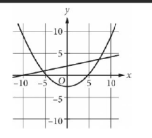
A system of equations consists of a quadratic equation and a linear equation. The equations in this system are graphed in the xy-plane above. How many solutions does this system have?
A.0
B.1
C.2
D.3
▶️Answer/Explanation
Ans: C
Rationale
Choice C is correct. The solutions to a system of two equations correspond to points where the graphs of the equations intersect. The given graphs intersect at 2 points; therefore, the system has 2 solutions. Choice A is incorrect because the graphs intersect. Choice B is incorrect because the graphs intersect more than once. Choice D is incorrect. It’s not possible for the graph of a quadratic equation and the graph of a linear equation to intersect more than twice.
Question medium
y=x+1
\(y=x^2+x\)
If (x,y) is a solution to the system of equations above, which of the following could be the value of x ?
A1
B.0
C.2
D.3
▶️Answer/Explanation
Ans: A
Rationale
Choice A is correct. It is given that y =x+1 and \(y = x^2 + x\). Setting the values for y equal to each other yields \(x + 1=x^2 +x\). Subtracting x from each side of this equation yields \(x^2=1\). Therefore, x can equal 1 or —1. Of these, only —11 is given as a choice.
Choice B is incorrect. If x=0, then x+1=1 but \(x^2 +x=0^2 +0=0\neq 1\). Choice C is incorrect. If x=2 then x+1= 3,but \(x^2 +x=2^2 +2=6 \neq 3\). Choice D is incorrect. If x =3, then x+1=4,but \(x^2 +x=3^2 +3=12 \neq 4\).
Question medium
\(x^2—x-1=0\)
What values satisfy the equation above?
A.x=1 and x=2
B.\(x=-\frac{1}{2}\) and \(\frac{3}{2}\)
C. \(x=\frac{1+\sqrt{5}}{2}\) and \(x=\frac{1-\sqrt{5}}{2}\)
D.\(x=\frac{-1+\sqrt{5}}{2}\) and \(x=\frac{-1-\sqrt{5}}{2}\)
▶️Answer/Explanation
Ans: C
Rationale
Choice C is correct. Using the quadratic formula to solve the given expression yields \(x=\frac{-(-1)\pm \sqrt{(-1)^2}-(4)(1)(-1)}{(2)(1)} =\frac{1\pm \sqrt{5}}{2}\) . Therefore, \(x=\frac{1+\sqrt{5}}{2}\) and \(x=\frac{1-\sqrt{5}}{2}\) satisfy the given equation.
Choices A and B are incorrect and may result from incorrectly factoring or incorrectly applying the quadratic formula. Choice D is incorrect and may result from a sign error.
Question medium
(x-4)(x+2)(x-1)=0
What is the product of the solutions to the given equation?
A.8
B.3
C.-3
D.-8
▶️Answer/Explanation
Ans: D
Rationale
Choice D is correct. By the zero-product property, if (x —4)(x +2)(x —1) =0, then x —4 =0, x+2 =0, or x—1=0. Solving each of these equations for y yields x =4, x = — 2, or x = 1. The product of these solutions is(4)(-2)(1)=-8.
Choice A is incorrect and may result from sign errors made when solving the given equation. Choice B is incorrect and may result from finding the sum, not the product, of the solutions. Choice C is incorrect and may result from finding the sum, not the product, of the solutions in addition to making sign errors when solving the given equation.
Question medium
\(\frac{2(x+1)}{x+5}=1-\frac{1}{x+5}\)
What is the solution to the equation above?
A.0
B.2
C.3
D.5
▶️Answer/Explanation
Ans: B
Rationale
Choice B is correct. Since \(\frac{x+5}{x+5}\) is equivalent to 1, the right-hand side of the given equation can be rewritten as \(\frac{x+5}{x+5}-\frac{1}{x+5}\) or \(\frac{x+4}{x+5}\). Since the left- and right-hand sides of the equation \(\frac{2(x+1)}{x+5}=1-\frac{1}{x+5}\) have the same denominator, it follows that 2(x + 1) = x + 4. Applying the distributive property of multiplication to the expression 2(x + 1) yields 2(x)+2(1), or 2x + 2. Therefore, 2x +2 = x +4. Subtracting x and 2 from both sides of this equation yields x = 2. Choices A, C, and D are incorrect. If x =0,then \(\frac{2(0+1)}{0+5}=1-\frac{1}{0+5}\). This can be rewritten as \(\frac{2}{5}=\frac{4}{5}\), which is a false statement. Therefore, 0 isn’t a solution to the given equation. Substituting 3 and 5 into the given equation yields similarly false statements.
Question medium
\(y=x^2—4x+4\)
y=4-x
If the ordered pair (x, y) satisfies the system of equations above, what is one possible value of x ?
▶️Answer/Explanation
Ans: Rationale
The correct answer is either 0 or 3. For an ordered pair to satisfy a system of equations, both the x- and y values of the ordered pair must satisfy each equation in the system. Both expressions on the right-hand side of the given equations are equal to y, therefore, it follows that both expressions on the right-hand side of the equations are equal to each other: \(x^2-4x+4=4 —x\). This equation can be rewritten as \(x^2-3x= 0\), and then through factoring, the equation becomes x(x—3)=0.Because the product of the two factors is equal to 0, it can be concluded that either x =0 or x —3 = 0, or rather, x = 0 or x = 3. Note that 0 and 3 are examples of ways to enter a correct answer.
Question medium
An oceanographer uses the equation \(s=\frac{3}{2}p\) to model the speed s, in knots, of an ocean wave, where p represents the period of the wave, in seconds. Which of the following represents the period of the wave in terms of the speed of the wave?
A.\(p=\frac{2}{3}s\)
B.\(p=\frac{3}{2}s\)
C.\(p=\frac{2}{3}+s\)
D.\(p=\frac{3}{2}+s\)
▶️Answer/Explanation
Ans: A
Rationale
Choice A is correct. It’s given that p represents the period of the ocean wave, so the equation \(s=\frac{3}{2}p\) can be solved for p to represent the period of the wave in terms of the speed of the wave. Multiplying both sides of the equation by the reciprocal of \(\frac{3}{2}\) will isolate p. This yields \(\frac{2}{3}s=\frac{2}{3}(\frac{3}{2}p)\) which simplifies to \(\frac{2}{3}s=p\). Therefore, \(p=\frac{2}{3}s\).
Choices B, C, and D are incorrect and may result from errors made when rearranging the equation to solve for P.
Question medium
In the xy-plane, what is the y-coordinate of the point of intersection of the graphs of \(y=(x—1)^2\) and y=2x-3?
▶️Answer/Explanation
Ans: Rationale
The correct answer is 1. The point of intersection of the graphs of the given equations is the solution to the system of the two equations. Since \(y=(x—1)^2\) and y = 2x —3, it follows that \((x-1)^2=2x-3\), or (x—1)x(—1)=2x-3. Applying the distributive property to the left-hand side of this equation yields \(x^2-2x+1=2x-3\), Subtracting 2x from and adding 3 to both sides of this equation yields \(x^2—4x+4=0\). Factoring the left-hand side of this equation yields (x-2)(x-2)=0. By the zero product property, if (x—2)(x—2) =0, it follows that x —2 = 0. Adding 2 to both sides of x —2 = 0 yields x= 2. Substituting 2 for x in either of the given equations yields y = 1. For example, substituting 2 for x in the second given equation yields y =2(2)—3, or y = 1. Therefore, the point of intersection of the graphs of the given equations is (2,1). The y-coordinate of this point is 1.
Question medium
(x+2)(x+3)=(x-2)(x-3)+10
Which of the following is a solution to the given equation?
A. l
B.0
C.-2
D.-5
▶️Answer/Explanation
Ans: A
Rationale
Choice A is correct. Applying the distributive property on the left- and right-hand sides of the given equation yields \(x^2+2x+3x+6=x^2-2x—3x+6+10\), or \(x^2+5x+6=x^2—5x+16\). Subtracting \(x^2\) from and adding 5x to both sides of this equation yields 10x + 6 = 16. Subtracting 6 from both sides of this equation and then dividing both sides by 10 yields x = 1.
Choices B, C, and D are incorrect. Substituting 0, =2, or =5 for x in the given equation will result in a false statement. If x= 0, the given equation becomes 6 = 16; if x= — 2, the given equation becomes 0 = 30; and if x = —5, the given equation becomes 6 = 66. Therefore, the values 0, =2, and —5 aren’t solutions to the given equation.
Question medium
\(x^2—ax+12=0\)
In the equation above, a is a constant and a> 0. If the equation has two integer solutions, what is a possible value of a ?
▶️Answer/Explanation
Ans: Rationale
The correct answer is either 7, 8, or 13. Since the given equation has two integer solutions, the expression on the left-hand side of this equation can be factored as (x + c)(x +d), where c and d are also integers. The product of c and d must equal the constant term of the original quadratic expression, which is 12. Additionally, the sum of c and d must be a negative number since it’s given that a > 0, but the sign preceding a in the given equation is negative. The possible pairs of values for ¢ and d that satisfy both of these conditions are —4 and —3,—pand —2, and —12 and —1. Since the value of — a is the sum of c and d, the possible values of _ 5 are —4+(-3)=—-7,-6+(—2)=—8,and —12+(—1) = —13. It follows that the possible values of a are 7, 8, and 13. Note that 7, 8, and 13 are examples of ways to enter a correct answer.
Question medium
The speed of sound in dry air, v, can be modeled by the formula v=331.3+0.606T, where T is the temperature in degrees Celsius and v is measured in meters per second. Which of the following correctly expresses T in terms of v ?
A.\(T=\frac{v+0.606}{331.1}\)
B.\(T=\frac{v-0.606}{331.1}\)
C.\(T=\frac{v+331.1}{0.606}\)
D.\(T=\frac{v-331.1}{0.606}\)
▶️Answer/Explanation
Ans: D
Rationale
Choice D is correct. To express T in terms of v, subtract 331.3 from both sides of the equation, which gives v —331.3 = 0.606T. Dividing both sides of the equation by 0.606 gives\(T=\frac{v-331.1}{0.606}\).
Choices A, B, and C are incorrect and are the result of incorrect steps while solving for T.
Question medium
Blood volume, \(V_B\) in a human can be determined using the equation \(V_B=\frac{V_P}{1-H}\),where \(V_P\) is the plasma volume and H is the hematocrit (the
fraction of blood volume that is red blood cells). Which of the following correctly expresses the hematocrit in terms of the blood volume and the plasma volume?
A.\(H=1-\frac{V_P}{V_B}\)
B.\(H=\frac{V_B}{V_P}\)
C.\(H=1+\frac{V_B}{V_P}\)
D.\(H=V_B-V_P\)
▶️Answer/Explanation
Ans: A
Rationale
Choice A is correct. The hematocrit can be expressed in terms of the blood volume and the plasma volume by solving the given equation \(V_B=\frac{V_P}{1-H}\) for H. Multiplying both sides of this equation by (1-H) yields \(V_B(1 —H)= V_P\). Dividing both sides by \(V_B\) yields \(1-H=\frac{V_P}{V_B}\). Subtracting 1 from both sides yields \(-H=-1+\frac{V_P}{V_B}\). Dividingboth sides by =1 yields \(H=1-\frac{V_P}{V_B}\). Choices B, C, and D are incorrect and may result from errors made when manipulating the equation.
Question medium
x+y=17
xy=72
If one solution to the system of equations above is (x,y), what is one possible value of x ?
▶️Answer/Explanation
Ans: Rationale
The correct answer is either 8 or 9. The first equation can be rewritten as y = 17 —x. Substituting 17 —x for y in the second equation gives x(17 —x) =72. By applying the distributive property, this can be rewritten as \(17x—x^2= 72\). Subtracting 72 from both sides of the equation yields \(x^2-17x+72= 0\). Factoring the left-hand side of this equation yields (x —8)(x —9) = 0. Applying the Zero Product Property, it follows that x —8 =0 and x—9=0. Solving each equation for x yields x = 8 and x = 9 respectively. Note that 8 and 9 are examples of
ways to enter a correct answer.
Question medium
\(x^2=6x+y\)
y=—6x+36
A solution to the given system of equations is (x,y). Which of the following is a possible value of xy ?
A.0
B.6
C.12
D.36
▶️Answer/Explanation
Ans: A
Rationale
Choice A is correct. Solutions to the given system of equations are ordered pairs (x,y) that satisfy both equations in the system. Adding the left-hand and right-hand sides of the equations in the system yields \(x^2 +y=6x+-6x+y+36\) or \(x^2 +y =y +36\). Subtracting y from both sides of this equation yields \(x^2=36\). Taking the square root of both sides of this equation yields x = 6 and x = —6. Therefore, there are two solutions to this system of equations, one with an x-coordinate of 6 and the other with an x-coordinate of —6. Substituting 6 for x in the second equation yields y = —6(6) + 36, or y = 0; therefore, one solution is (6,0). Similarly, substituting —6 for x in the second equation yields y = — 6(—6)+36, or y =72; therefore, the other solution is (—6,72) It follows then that if (x ,y) is a solution to the system, then possible values of xy are (6)(0)=0and (-6)(72)= —432. Only 0 is among the given choices.
Choice B is incorrect. This is the x-coordinate of one of the solutions, (6,0). Choice C is incorrect and may result from conceptual or computational errors. Choice D is incorrect. This is the square of the x-coordinate of one of the solutions, (6,0).
Question medium
\(x^2+x—12=0\)
If a is a solution of the equation above and a>0,what is the value of a ?
▶️Answer/Explanation
Ans: Rationale
The correct answer is 3. The solution to the given equation can be found by factoring the quadratic expression. The factors can be determined by finding two numbers with a sum of 1 and a product of —42. The two numbers that meet these constraints are 4 and —3. Therefore, the given equation can be rewritten as (x+4)(x-3)=0. It follows that the solutions to the equation are x = —4 or x = 3. Since it is given that a> 0, a must equal 3.
Question medium
T=0.01(P—40,000)
In a city, the property tax T, in dollars, is calculated using the formula above, where P is the value of the property, in dollars. Which of the following expresses the value of the property in terms of the property tax?
A.P=100T-400
B.P=100T+400
C.P=100T-40,000
D. P=100T+40,000
▶️Answer/Explanation
Ans: D
Rationale
Choice D is correct. To express the value of the property in terms of the property tax, the given equation must be solved for P. Multiplying both sides of the equation by 100 gives 100T = P —40,000. Adding 40,000 to both sides of the equation gives 100 T +40,000 = P. Therefore, P =100 T +40,000. Choice A is incorrect and may result from multiplying 40,000 by 0.01, then subtracting 400 from, instead of adding 400 to, the left-hand side of the equation. Choice B is incorrect and may result from multiplying 40,000 by 0.01. Choice C is incorrect and may result from subtracting instead of adding 40,000 from the left-hand side of the equation.
Question medium
\(v^2= \frac{LT}{m}\)
The formula above expresses the square of the speed v of a wave moving along a string in terms of tension T, mass m, and length L of the string. What is T in terms of m, v,and L?
A.\(T=\frac{mv^2}{L}\)
B.\(T=\frac{m}{v^2L}\)
C.\(T=\frac{mL}{v^2}\)
D.\(T=\frac{L}{mv^2}\)
▶️Answer/Explanation
Ans: A
Rationale
Choice A is correct. To write the formula as T in terms of m, v, and L means to isolate T on one side of the equation. First, multiply both sides of the equation by m, which gives \(mv^2=\frac{mLT}{m}\), which simplifies to \(mv^2=LT\). Next, divide both sides of the equation by L, which gives \(\frac{mv^2}{L}=\frac{LT}{L}\), which simplifies to \(T=\frac{mv^2}{L}\). Choices B, C, and D are incorrect and may be the result of incorrectly applying operations to each side of the equation.
Question medium
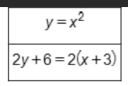
If (x, y) is a solution of the system of equations above and x> 0, what is the value of xy ?
A.1
B.2
C.3
D.9
▶️Answer/Explanation
Ans: A
Rationale
Choice A is correct. Substituting \(x^2\) for y in the second equation gives \(2(x^2) +6= 2(x+3)\). This equation can be solved as follows:
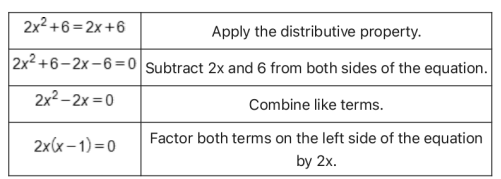
Thus, x =0 and x = 1 are the solutions to the system. Since x > 0, only x = 1 needs to be considered. The value of y when x =1 is \(y =x^2=1^2=1\). Therefore, the value of xy is (1)(1) =1.
Choices B, C, and D are incorrect and likely result from a computational or conceptual error when solving this system of equations.
Question medium
\(6x^2+5x—7=0 \)
What are the solutions to the given equation?
A.\( \frac{-5\pm \sqrt{25+168}}{12}\)
B.\( \frac{-6\pm \sqrt{25+168}}{12}\)
C.\( \frac{-5\pm \sqrt{36-168}}{12}\)
D.\( \frac{-6\pm \sqrt{36-168}}{12}\)
▶️Answer/Explanation
Ans: A
Rationale
Choice A is correct. The quadratic formula, \(x=\frac{-b\pm \sqrt{b^2-4ac}}{2a}\) , can be used to find the solutions to an equation in the form \(ax^2 + bx +c=0\). n the given equation, a =6, b =5, and c = — 7. Substituting these values into the quadratic formula gives \(x=\frac{-5\pm \sqrt{(-5)^2-4 \times 6 \times (-7)}}{2 \times 6}\) or \( \frac{-5\pm \sqrt{25+168}}{12}\).
Choice B is incorrect and may result from using \(x=\frac{-a\pm \sqrt{b^2-4ac}}{2a}\), as the quadratic formula. Choice C is incorrect and may result from using \(x=\frac{-b\pm \sqrt{a^2+4ac}}{2a}\) as the quadratic formula. Choice D is incorrect and may result from using \(x=\frac{-a\pm \sqrt{a^2+4ac}}{2a}\) as the quadratic formula.
Question medium
\(y=x^2-1\)
y=3
When the equations above are graphed in the xy-plane, what are the coordinates (x, y) of the points of intersection of the two graphs?
A.(2,3)
and (-2,3)
B.(2,4)
and (—2,4)
C.(3,8)
and (-3,8)
D.\((\sqrt{2}, 3)\)
and \((-\sqrt{2}, 3)\)
▶️Answer/Explanation
Ans: A
Rationale
Choice A is correct. The two equations form a system of equations, and the solutions to the system correspond to the points of intersection of the graphs. The solutions to the system can be found by substitution. Since the second equation gives y = 3, substituting 3 for y in the first equation gives \(3 = x^2 —1\). Adding 1 to both sides of the equation gives \(4 = x^2\). Solving by taking the square root of both sides of the equation gives x = +2. Since y =3 for all values of x for the second equation, the solutions are (2, 3) and (-2, 3). Therefore, the points of intersection of the two graphs are (2, 3) and (-2, 3). Choices B, C, and D are incorrect and may be the result of calculation errors.
Question medium
\(38x^2 = 38(9)\)
What is the negative solution to the given equation?
▶️Answer/Explanation
Ans: -3
Rationale
The correct answer is —3. Dividing both sides of the given equation by 38 yields \(x^2 = 9\). Taking the square root of both sides of this equation yields the solutions x= 3 and x = —3. Therefore, the negative solution to the given equation is —3.
Question medium
\(y=ax^2-c\)
In the equation above, a and c are positive constants. How many times does the graph of the equation above intersect the graph of the equation y=a+c in the xy-plane?
A. Zero
B. One
C. Two
D. More than two
▶️Answer/Explanation
Ans: C
Rationale
Choice C is correct. It is given that the constants a and c are both positive; therefore, the graph of the given quadratic equation is a parabola that opens up with a vertex on the y-axis at a point below the x-axis. The graph of the second equation provided is a horizontal line that lies above the x-axis. A horizontal line above the x-axis will intersect a parabola that opens up and has a vertex below the x-axis in exactly two points.
Choices A, B, and D are incorrect and are the result of not understanding the relationships of the graphs of the two equations given. Choice A is incorrect because the two graphs intersect. Choice B is incorrect because in order for there to be only one intersection point, the horizontal line would have to intersect the parabola at the vertex, but the vertex is below the x-axis and the line is above the x-axis. Choice D is incorrect because aline cannot intersect a parabola in more than two points.
Question medium
\(7x^2 — 20x — 32 = 0\) What is the positive solution to the given equation?
▶️Answer/Explanation
Ans: 4
Rationale
The correct answer is 4. The left-hand side of the given equation can be factored as 7x + 8x – 4. Therefore, the given equation, \(7x^2 – 20x – 32 = 0\), can be written as 7x + 8x – 4 = 0. Applying the zero product property to this equation yields 7x+ 8 =0 and x -4 = 0. Subtracting 8 from both sides of the equation 7x + 8 = 0 yields 7x = -8. Dividing both sides of this equation by 7 yields \(x=-\frac{8}{7}\). Adding 4 to both sides of the equation x – 4 = 0 yields x = 4. Therefore, the two solutions to the given equation, \(7x^2 – 20x – 32 = 0\), are \(-\frac{8}{7}\) and 4. It follows that 4 is the positive solution to the given equation.
Question medium
\(v=-\frac{w}{150x}\)
The given equation relates the distinct positive numbers v, w, and x. Which equation correctly expresses w in terms of v and x?
A w = —150vx
B.\(w=-\frac{150v}{x}\)
C.\(w=-\frac{x}{150v}\)
D.w=v+150x
▶️Answer/Explanation
Ans: A
Rationale
Choice A is correct. It’s given that x is positive. Therefore, multiplying each side of the given equation by -150x yields -150xv = w, which is equivalent to w = -150vx. Thus, the equation w = -150vx correctly expresses w in terms of v and x. Choice B is incorrect. This equation is equivalent to \(v=-\frac{wx}{150v}\). Choice C is incorrect. This equation is equivalent to \(v = —\frac{x}{150w}\). Choice D is incorrect. This equation is equivalent to v = w – 150x.