Question
Consider the function defined by f ( x ) = \(\frac{kx-5}{x-k}\), where x ∈ \(\mathbb{R}\) \ {k} and k2 ≠5 .
State the equation of the vertical asymptote on the graph of y = f ( x ) . [1]
State the equation of the horizontal asymptote on the graph of y = f ( x ) . [1]
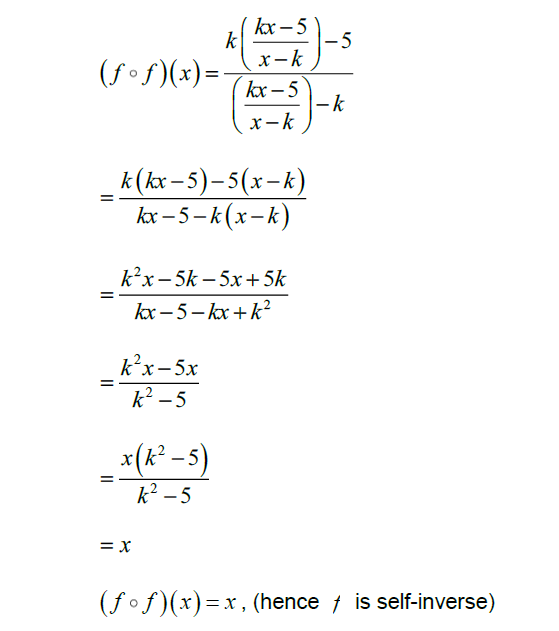
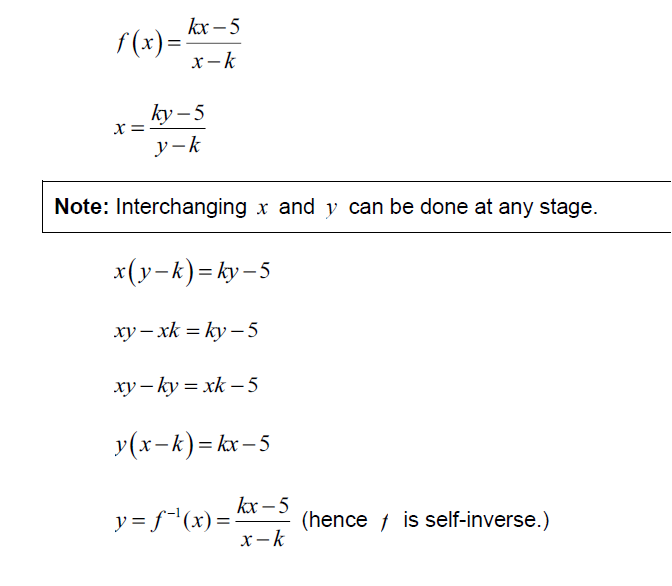
Use an algebraic method to determine whether f is a self-inverse function. [4] Consider the case where k = 3 .
Sketch the graph of y = f ( x ) , stating clearly the equations of any asymptotes and the coordinates of any points of intersections with the coordinate axes. [3]
The region bounded by the x-axis, the curve y = f ( x ) , and the lines x = 5 and x = 7 is rotated through 2π about the x-axis. Find the volume of the solid generated, giving your answer in the form π ( a + b ln 2 ) , where a , b ∈ \(\mathbb{Z}\). [6]
Answer/Explanation
Ans:
(a) x = k
(b) y = k
(c)
METHOD 1
METHOD 2
(d)
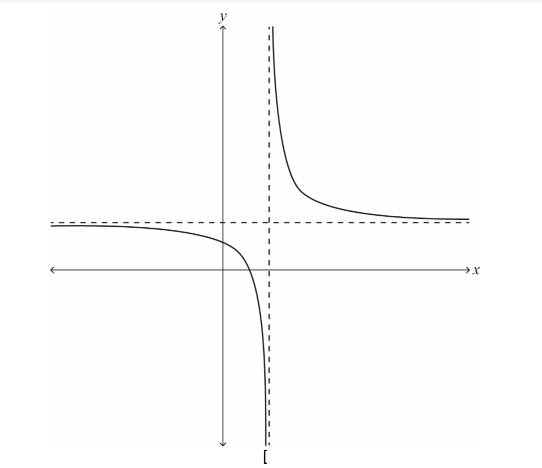
attempt to draw both branches of a rectangular hyperbola x=3 and y=3
(0,\(\frac{5}{3})and (\frac{5}{3}\),0)
(e)
METHOD 1
volume = \(\pi \int_{5}^{7}(\frac{3x-5}{x-3})^{2}\)dx
EITHER
attempt to express \(\frac{3x-5}{x-3} \)in the form \(p+ \frac{q}{x-3}\)
\(\frac{3x-5}{x-3}=3+\frac{4}{x-3}\)
OR attempt to expand
\((\frac{3x-5}{x-3})^{2}or (3x-5)^{2}\)and divide out
\((\frac{3x-5}{x-3})^{2} = 9+ \frac{24x-56}{(x-3)^{2}}\)
THEN
\((\frac{3x-5}{x-3})^{2}= 9+\frac{24}{x-3}+\frac{16}{(x-3)^{2}}\)
volume = \(\pi \int_{5}^{7}(9+\frac{24}{x-3}+\frac{16}{(x-3)^{2}})\)dx = \(\pi [9x+24ln(x-3)-\frac{16}{x-3}]^{7}_{5} =π [(63+ 24ln 4 − 4) − (45 + 24ln 2 −8)]=\pi (22+24ln2)\)
Question
The function f is defined by \(f(x) = \frac{{2x – 1}}{{x + 2}}\), with domain \(D = \{ x: – 1 \leqslant x \leqslant 8\} \).
Express \(f(x)\) in the form \(A + \frac{B}{{x + 2}}\), where \(A\) and \(B \in \mathbb{Z}\).[2]
Hence show that \(f'(x) > 0\) on D.[2]
State the range of f.[2]
(i) Find an expression for \({f^{ – 1}}(x)\).
(ii) Sketch the graph of \(y = f(x)\), showing the points of intersection with both axes.
(iii) On the same diagram, sketch the graph of \(y = f'(x)\).[8]
(i) On a different diagram, sketch the graph of \(y = f(|x|)\) where \(x \in D\).
(ii) Find all solutions of the equation \(f(|x|) = – \frac{1}{4}\).[7]
Answer/Explanation
Markscheme
by division or otherwise
\(f(x) = 2 – \frac{5}{{x + 2}}\) A1A1
[2 marks]
\(f'(x) = \frac{5}{{{{(x + 2)}^2}}}\) A1
> 0 as \({(x + 2)^2} > 0\) (on D) R1AG
Note: Do not penalise candidates who use the original form of the function to compute its derivative.
[2 marks]
\(S = \left[ { – 3,\frac{3}{2}} \right]\) A2
Note: Award A1A0 for the correct endpoints and an open interval.
[2 marks]
(i) EITHER
rearrange \(y = f(x)\) to make x the subject M1
obtain one-line equation, e.g. \(2x – 1 = xy + 2y\) A1
\(x = \frac{{2y + 1}}{{2 – y}}\) A1
OR
interchange x and y M1
obtain one-line equation, e.g. \(2y – 1 = xy + 2x\) A1
\(y = \frac{{2x + 1}}{{2 – x}}\) A1
THEN
\({f^{ – 1}}(x) = \frac{{2x + 1}}{{2 – x}}\) A1
Note: Accept \(\frac{5}{{2 – x}} – 2\)
(ii), (iii)
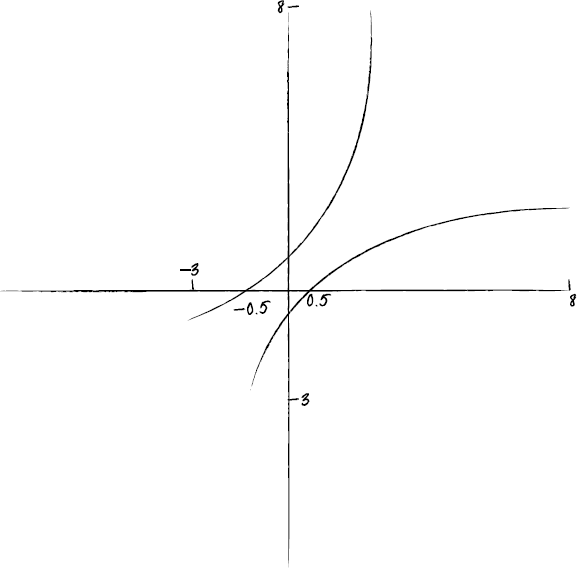
A1A1A1A1
[8 marks]
Note: Award A1 for correct shape of \(y = f(x)\).
Award A1 for x intercept \(\frac{1}{2}\) seen. Award A1 for y intercept \( – \frac{1}{2}\) seen.
Award A1 for the graph of \(y = {f^{ – 1}}(x)\) being the reflection of \(y = f(x)\) in the line \(y = x\). Candidates are not required to indicate the full domain, but \(y = f(x)\) should not be shown approaching \(x = – 2\). Candidates, in answering (iii), can FT on their sketch in (ii).
(i)
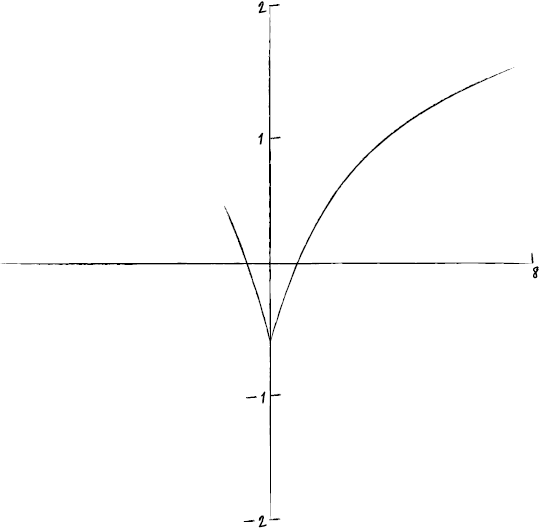
A1A1A1
Note: A1 for correct sketch \(x > 0\), A1 for symmetry, A1 for correct domain (from –1 to +8).
Note: Candidates can FT on their sketch in (d)(ii).
(ii) attempt to solve \(f(x) = – \frac{1}{4}\) (M1)
obtain \(x = \frac{2}{9}\) A1
use of symmetry or valid algebraic approach (M1)
obtain \(x = – \frac{2}{9}\) A1
[7 marks]
MAA HL 2.8-2.10 EXPONENTS AND LOGARITHMS-ashok
Question
(a) Solve the exponential equations (i) e3x+1 = 5 (ii) 23x+1 = 5
(b) Solve the logarithmic equations (i) In(3x + 1) = 5 (ii) log2(3x + 1) = 5
Answer/Explanation
Ans
(a) (i) \(x=\frac{In5-1}{3}\) (ii) \(x=\frac{log_25-1}{3}\)
(b) (i) \(x=\frac{e^5-1}{3}\) (ii) \(x=\frac{2^5-1}{3}\)
Question
(a) Let a = log2x, b = log2y, c = log2z. Write \(log_2(\frac{x^3\sqrt{y}}{z^4})\) in terms of a, b and c.
(b) Let A = log2x, B = log4y, C = log8z. Write \(log_2(\frac{x^3\sqrt{y}}{z^4})\) in terms of A, B and C.
Answer/Explanation
Ans
(a) \(log_2(\frac{x^3\sqrt{y}}{z^4})=3a+\frac{1}{2}b-4c\).
(b) \(log_2(\frac{x^3\sqrt{y}}{z^4})\)=3A+B-12C\)
Question
Solve the logarithmic equations:
(a) \(log_3(x+2)=1+\frac{log_3x}{2}\)
(b) \(log_2x=log_4(x+6)\)
Answer/Explanation
Ans
(a) x = 1, x = 4
(b) x = 3 (x = -2 rejected)
Question
Solve the logarithmic equations
(a) \(9log_8x=6+8log_z8\)
(b) \(9log_x5=log_5x\)
Answer/Explanation
Ans
(a) \(x = 16, x = \frac{1}{4}\)
(b) \(x=5^3(=125), x=5^{-3}(=\frac{1}{125})\)
Question
Solve the equation 23x+1 = 6x-1. Express your answer in the form \(\frac{In.a}{In.b}\)
METHOD A [Use in () first and then solve for x]
METHOD B [Much quicker! Transform in the form ax = b and then use In()
Answer/Explanation
Ans
\(x=\frac{In12}{In(3\4)}\)
Question
Solve the exponential equations:
(a) \(4^x – 9.2^x + 8 = 0\) (b) \(3^{2x+2} + 8(3)^{x+1} = 9\)
Answer/Explanation
Ans
(a) x = 0, x = 3 (b) x = -1
Question
Solve the exponential equations:
(a) \(e^{3x} +2e^x-3e^x=0\)
(b) \(e^{(x-3)}+2=e^{(x+3)}\) (express the result in the form \(In(\frac{pe^m}{e^n-1}0\), with p,m,n\(\epsilon \mathbb{Z}\).)
Answer/Explanation
Ans
(a) x = 0, x = In2 (b) \(x=In(\frac{2e^3}{e^6-1})\)
Question
Solve the equation
(a) xin x = e (b) xlog x = 10 (c) \(x^{log_7x}\) = 7 (d) \(x^{log_2x}\) = 16
Answer/Explanation
Ans
(a) x = e, x = 1/e, (b) x = 10, x = 1/10 (c) x = 7, x = 1/7 (d) x = 4, x =1/4
Question
Solve the simultaneous equation \(2^{x^2}=4^{y}\) and \(log_zy=\frac{3}{2}\)
Answer/Explanation
Ans
x = 4, y = 8
Question
Solve the simultaneous equation \(8^y =4^{2x+3}\) and \(log_2y=log_2x+4\)
Answer/Explanation
Ans
\(x=\frac{3}{22}, y =\frac{24}{11}\)
Question
Solve the simultaneous equations
\(log_2(y-1)=1+log_2x\)
\(2log_3y=2+log_3x\)
Answer/Explanation
Ans
x = 1, y = 3 or \(x=\frac{1}{4}, y=\frac{3}{2}\)
Question
Solve the simultaneous equations
\(log_2x-log_4y=4\)
\(log_2(x-2y)=5\)
Answer/Explanation
Ans
x = 64, y = 16
Question
Calculate the following sums
(a) In 2 + In 22 + In 23 + …. + In 210
(b) In 2 + (In 2)2 + (In 2)3 + … + (In 2)10
(c) In 2 + (In 2)2 + (In 2)3 + … (infinite sum)
Answer/Explanation
Ans
(a) 55 In 2 (b) \(frac{In2[(1-(In2)^10)]}{1-In2}\) (c) \(frac{In 2}{1- In 2}\)
Question
Consider the function f(x) = ex – 2.
(a) Find f-1
(b) Sketch the graphs of f and f-1 by indicating clearly any intercepts and asymptotes.
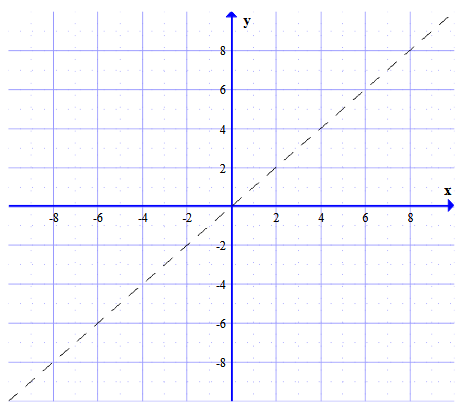
(c) Complete the table

Answer/Explanation
Ans
(a) f-1(x) = In(x + 2)
(b) For f, x-intercept: x = In 2, y-intercept: y = -1, Horizontal asymptote: y = -2
For f-1, x-intercept: x = -1, y-intercept: y = In 2, Vertical asymptote: x = -2
(d) For f, Domain: x ∈ R, Range : y>-2
For f-1, Domain: x>-2, Range: y∈R
Question
Consider the function f(x) = ex-2.
(a) Find f-1
(b) Sketch the graphs of f and f-1 by indicating clearly any intercepts and asymptotes.
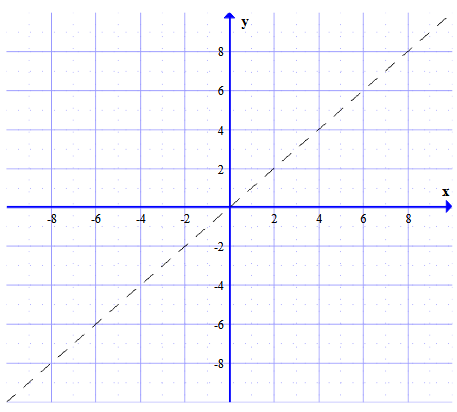
(c) Complete the table
Answer/Explanation
Ans
(a) f-1(x) = In(x +2)
(b) For f, there is no x-intercept, y-intercept: y = e2, Horizontal asymptote: y = 0
For f-1, x-intercept: x = e2, there is no y-intercept, Vertical asymptote: x = 0
(c) For f, Domain: x ∈ R, Range: y>0
For f-1, Domain: x>R, Range: y ∈ R
Question
Consider the function \(f(x)=e^{(x-3)}+2\)
(a) Find f-1
(b) Sketch the graphs of f and f-1 by indicating clearly any intercepts and asymptotes.
(c) Complete the table
(d) Solve the equation f(x0 = 6
Answer/Explanation
Ans
(a) f-1(x) = In(x-2)+3
(b) For f, y-intercept: (0, e-3+2), Horizontal asymptote: y = 2
For f-1, x-intercept: (e-3+2,0), Vertical asymptote: x = 2
(c) For f, Domain: x ∈ R, Range: y>2
For f-1, Domain: x>2, Range: y ∈ R
(d) x = In 4 + 3
Question
Solve \(log_{16}\sqrt[3]{100-x^2}=\frac{1}{2}\)
Answer/Explanation
Ans
\(16^{\frac{1}{2}}=\sqrt[3]{100-x^2}\)
\(4=\sqrt[3]{100-x^2}\)
\(64=100-x^2\)
\(x^2=36,\) so \(x=\pm 6\)
Question
Solve |In(x+3)|=1. Give your answers in exact form.
Answer/Explanation
Ans
Find two equations
Correct equation In(x+3)=1, In(x+3)=-1
In(x+3)=1\(\Rightarrow\) x=e-3
In(x+3)=-1\(\Rightarrow x =\frac{1}{e}-3(=e^{-1}-3)\)
Question
Solve, for x, the equation \(log_2(5x^2-x-2)=2+2log_2x.\)
Extra question
Hence, solve the equation \(log_2(5x^2-x-2)=lne^2+log_(\sqrt{2}x\)
Answer/Explanation
Ans
Given \(log_2(5x^2-x-2)=2+2log_2x\)
\(\Rightarrow log_2(5x^2-x-2)=log_24+2log^2x\)
\(\Rightarrow log_2(5x^2-x-2)=log_24x^2\)
\(\Rightarrow x^2-x-2=0\Rightarrow x=2\)
(negative solution not possible)
Extra question (after a change of base)
Question
Solve the equation \(2log_3(x-3)+log_1(x+1)=2\)
Extra question
Hence solve the equation \(2log_3(e^x-3)+log_1(e^x+1)=2\)
Answer/Explanation
Ans
METHOD 1
\(2log_3(x-3)-log_3(x+1)=2\)
\(log_3\frac{(x-3)^2}{x+1}=2\)
\(3^2=\frac{(x-3)^2}{x+1}\)
\(9x+9=x^2-6x+9\)
\(0=x^2-15x\)
\(x=15\)
METHOD 2
\(2log_3(x-3)+log_{\frac{1}{3}}(x+1)=2\)
Using change of base formula
\(\frac{2log(x-3)}{log3}+\frac{log(x+1)}{log_{\frac{1}{3}}}=2\)
\(x=15\)
Extra question
If you let y = ex, it is the same equation. Then \(ex = 15\Rightarrow x=In15\)
Question
Solve the equation \(9log_5x=25log_x5\), expressing your answers in the form \(5^{\frac{p}{q}}(p,q\epsilon Z)\)
Answer/Explanation
Ans
\(9log_5x=25log_x5\)
\(\Rightarrow 9log_5x=\frac{25}{log_5x}\)
\(\Rightarrow (log_5x)^2=\frac{25}{9}\)
\(\Rightarrow log_5x=\frac{\pm 5}{3}\)
\(\Rightarrow x = 5^{\frac{5}{3}}\) or \(x=5^{\frac{-5}{3}}\) (accept \(p=\pm ,q=3\))
Question
Solve 2(In x)2 = 3In x – 1 for x. Give your answers in exact form.
Answer/Explanation
Ans
\(\2(Inx)^2-3Inx+1=0\)
Attempting to factorise or using the quadratic formula
In \(x=\frac{1}{2}\), In \(x=1\)
\(x=\sqrt{e}, x=e\)
Question
Find \(\sum_{r=1}^{50}In(2^r)\), giving the answer in the form a In 2, where \(
a\epsilon \mathbb{Q}\).
Extra question
Find, \(\sum_{r=1}^{50}In x^r\) and \(\sum_{r=1}^{50}(In x)^r\) in terms of x
Answer/Explanation
Ans
\(\sum_{r=1}^{50}In(2^r)=\sum_{r=1}^{50}r(In 2)\)
=\((In2)\sum_{r=1}^{50}r\)
=\((In2)((\frac{50}{2})51))
=\(1275 In2\)
Extra question
(a) 1275 In 2 (b) \(\frac{In x[(1-(Inx)^50]}{1-In x}\)
Question
Find an expression for the sum of the first 35 terms of the series
In \(x^2+In\frac{x^2}{y^2}+In\frac{x^2}{y^2}+In\frac{x^2}{y^3}+…\)
giving your answer in the form \(In\frac{x^m}{y^n}\), where m,n\(\epsilon \mathbb{N}\).
Answer/Explanation
Ans
METHOD 1
\(Inx^2+In\frac{x^2}{y}+In\frac{x^2}{y^2}+In\frac{x^2}{y^3}+…\)
\(=Inx^2+(Inx^2-Iny)+(inx^2-2Iny)+(Inx^2-3Iny)+….\)
\(S_{35}=\frac{n}{2}(2u_1+(n-1)d)=\frac{35}{2}(2 Inx^2-34Iny)=35Inx^2-595 Iny^2\)
\(=Inx^{70}-Iny^{595}\)
\(=In\frac{x^{70}}{y^{595}}\) (Accept m = 70, n = 595)
METHOD 2
\(Inx^2+In\frac{x^2}{y}+In\frac{x^2}{y^2}+In\frac{x^2}{y^3}+…=In\frac{x^2x^2…x^2}{1y…y^{34}}\)
In the denominator, the sum of the powers of y is \((0+34)\frac{35}{2}=595\)
The required expression is
\(In\frac{x^{70}}{y^{595}}\) (Accept m = 70, n = 595)
Question
Find the exact value of x satisfying the equation \((3^x)(4^{2x+1})=6^{x+2}\).
Give your answer in the form \(\frac{In.a}{In.b}\) where \(a,b\epsilon \mathbb{Z}\).
Answer/Explanation
Ans
Taking logs, xIn3 + (2x+1)In4=(x+2)In6
\(x(In3+2In4-In6)=2In6-In4\)
\(x=\frac{2In6-In4}{(In3+2In4-In6)}\)
\(=\frac{In9}{In8}\)(Accept \(\frac{In81}{In64}\) or equivalent)
(or a = 9, b = 8)
Question
The solution of 22x+3 = 2x+1 + 3 can be expressed in the form a + log2b where a,b\(\epsilon \mathbb{Z}\). Find the value a and of b.
Answer/Explanation
Ans
\(2^{2x+3}-2^{x+1}-3=0\)
Let p = 2x
8p2 – 2p – 3 = 0
(2p + 1)(4p – 3)=0
\(p=-\frac{1}{2} or p=\frac{3}{4}\)
\(2^x=\frac{3}{4}\)
\(x=log_23=log_24\)
\(=-2+log_23,(a=-2,b=3)\)
Question
Solve \(2(5^{x+1})=1+\frac{3}{5^x}\), giving the answer in the form a + log5b, where a,b\(\epsilon \mathbb{Z}\).
Extra question
Solve the equation 10(25x)-5x-3=0
Answer/Explanation
Ans
\(2(5^{x+1})=1+\frac{3}{5^x}\)
\(10(5^x)=1+\frac{3}{5^x}\)
\(10(5^{2x})=5^x+3\)
\(10(5^{2x})-5^x-3=0(5(5^x)-3)(2(5^x)+1)=0\)
\(5^x=\frac{3}{5}\)
\(x=log_5\frac{3}{5}\)
\(x=-1+log_53\)
Extra question
If you let y = 5x, it is the same equation.
Question
(a) Solve the equation \(2(4^x)+4^{-x}=3\).
(b) (i) Solve the equation ax = e2x+1 where a>0, giving your answer for x in terms of a.
(ii) For what value of a does the equation have no solution?
Answer/Explanation
Ans
(a) Let y=4x
\(\Rightarrow 2y+\frac{1}{y}=3\)
\(\Rightarrow 2y^2-3y+1=0\)
\(\Rightarrow (2y-1)(y-1)=0\)
\(\Rightarrow y=\frac{1}{2}\) or 1
\(\Rightarrow 4^x=1\) or \(4^x=\frac{1}{2}\)
\(\Rightarrow x=-\frac{1}{2}\) or x = 0
(b) (i) EITHER
\(a^x=e^{2x+1}\)
x In a = 2x + 1
\(\Rightarrow x(In a-2)=1\)
\(\Rightarrow x=\frac{1}{In a-2}\)
OR
\(a^x=e^{2x+1}\)
\(log_aa^x=log_ae^{2x+1}\)
\(x = (2x+1)log_ae\)
\(x=\frac{log_ae}{1-2log_ae}\)
(ii) EITHER
The equation has no solution when In a = 2
\((\Rightarrow a=e^2)\)
OR
The equation has no solution when \(1-2log_ae=0\)
\((\Rightarrow In a =2\Rightarrow a=e^2)\)
Question
The function f is defined for x>2 by f(x) = In x + In(x – 2) – In (x2 – 4).
(a) Express f(x) in the form In(\(\frac{x}{x+a})\).
(b) Find an expression for f-1(x).
Extra question
Show analytically that the inverse of f-1(x) is the function f(x).
Answer/Explanation
Ans
(a) \(f(x)=In\frac{x(x82)}{x^2-4}\)
\(=In\frac{x}{x+2}\) (Accept a = 2)
(b) For switching variables \((x = In\frac{y}{y+2})\)
\(e^x=\frac{y}{y+2}\)
\(ye^x-y=y(e^x-1)=-2e^x\)
\(f^{-1}(x)=\frac{2e^x}{e^x-1}(=\frac{2e^x}{1-e^x}=\frac{2}{e^{-x}-1})\)
Question
Let y = log3 z, where z is a function of x. The diagram shows the straight line L, which represents the graph of y against x. Its gradient is 2.
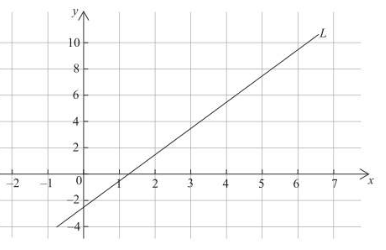
(a) Using the graph or otherwise, estimate the value of x when z = 9.
(b) The line L passes through the point \((1, log_3\frac{5}{9})\). Find an expression for z in terms of x.
Answer/Explanation
Ans
(a) \(z=9\Rightarrow y=log_3z=2\), thus x = 2.3
(b) \(log_3z-log_3\frac{5}{9}=2(x-1)\), thus \(log_3(\frac{9z}{5})=2(x-1)\)
\(z=\frac{5}{9}3^{2(x-1)}(=\frac{5}{81}9^x)\)
Question
Solve the equation \(\begin{vmatrix}
e^{2x} & -\frac{1}{x+2}
\end{vmatrix}=2\).
Answer/Explanation
Ans
\(e^{2x}-\frac{1}{x+2}=2\Rightarrow x = -2.50, x = 0.440\)
\(e^{2x}-\frac{1}{x+2}=-2\Rightarrow x = -1.51\)
Question
A sum of $100 is invested.
(a) If the interest is compounded annually at a rate 5% per year, find the total value V of the investment after 20 years.
(b) If the interest is compounded monthly at a rate of \(\frac{5}{12}\)% per month, find the minimum number of months for the value of the investment to exceed V.
Answer/Explanation
Ans
(a) \(V=100(1+0.05)^{20}\)
\(V=$265\) (accept $265.33)
(b) \(100(1+\frac{5}{1200})^n>265\)
\(nIn(1+\frac{5}{1200})>In(2.65)\)
\(\Rightarrow n = 235\)
Question
(a) The function f is defined by
\(f:x\rightarrow e^x-1-x\)
(i) Find the minimum value of f.
(ii) Prove that ex≥1 + x for all real values of x.
(b) Use the principle of mathematical induction to prove that
\((1+1)(1+\frac{1}{2})(1+\frac{1}{3})…(1+\frac{1}{n})=n+1\)
for all integers n≥1.
(c) Use the results of parts (a) and (b) to prove that
\(e^{(1+\frac{1}{2}+\frac{1}{3}+…+\frac{1}{n})}>n\)
(d) Find a value of n for which
\(1+\frac{1}{2}+\frac{1}{3}+…+\frac{1}{n}> 100\)
Answer/Explanation
Ans
(a) (i) The graph of y = f(x) is as follows:
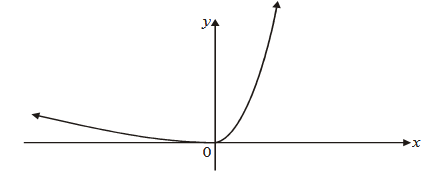
The minimum value of f(x) is 0
(ii) From part (i), f(x)≥0 for all x
\(\Rightarrow e^x-1-x≥0\)
\(\Rightarrow e^x≥1+x\)
(b) Let P(n) be the proposition: \((1+1)(1+\frac{1}{2})(1+\frac{1}{3})…(1+\frac{1}{n})=n+1\)
P(1) is true since (1 + 1) = 2 and n + 1 = 2 when n = 1
Assume P(k) is true for some integer k≥1.
That is, \((1+1)(1+\frac{1}{2})(1+\frac{1}{3})…(1+\frac{1}{k})=k+1\)
Then, \((1+1)(1+\frac{1}{2})(1+\frac{1}{3})…(1+\frac{1}{k})(1+\frac{1}{k+1})=(k+1)(1+\frac{1}{k+1})\)
\(=(k+1)+1\)
Thus, P(k) \(\Rightarrow \) P(k + 1), and so P(n) is true for all integers n≥1
(c) \(e^{(1+1/2+1/3+…+1/n)}=e^1e^{1/2}e^{1/3}…e^{1/n}\)
\(\geq (1+1)(1+\frac{1}{2})(1+\frac{1}{3})…(1+\frac{1}{n})(from (a)(ii))\)
\(=n+1\) (from (b))
>n
(d) \(1+\frac{1}{2}+\frac{1}{3}+…+\frac{1}{n}> 100\Rightarrow e^{(1+1/2+1/3+…+1/n)}> e^{100}\)
We require a value for n for which n>e100.
Any integer greater than e100 will do.
