Question
The following diagram wshows a sector OAB of radius 15 cm. The length of [AB]is 11 cm.

Find the area of the shaded region.
Answer/Explanation
Ans:
attempt to find AOB ˆ by right-angled trigonometry or the cosine rule
EITHER
AOB= 2arcsin \((\frac{5.5}{15})\)
OR
AOB= arccos \((\frac{15^{2}+15^{2}-11^{2}}{2\times 15\times 15})\)
THEN
= 0.750847… (=43.0204….)
shaded area = area of sector- area of triangle (=\(\frac{1}{2}r^{2}(\Theta -sin\Theta ))\)
= \(\frac{1}{2}\times 15^{2}\)(0.750847….-sin 0.750847…)
= 7.72\((cm^{2})\)
Question
Consider triangle ABC with \({\rm{B}}\hat {\rm{A}}{\rm{C}} = 37.8^\circ \) , AB = 8.75 and BC = 6 .
Find AC.
Answer/Explanation
Markscheme
METHOD 1
Attempting to use the cosine rule i.e. \({\text{B}}{{\text{C}}^2} = {\text{A}}{{\text{B}}^2} + {\text{A}}{{\text{C}}^2} – 2 \times {\text{AB}} \times {\text{AC}} \times \cos {\rm{B\hat AC}}\) (M1)
\({6^2} = {8.75^2} + {\text{A}}{{\text{C}}^2} – 2 \times 8.75 \times {\text{AC}} \times \cos 37.8^\circ \) (or equivalent) A1
Attempting to solve the quadratic in AC e.g. graphically, numerically or with quadratic formula M1A1
Evidence from a sketch graph or their quadratic formula (AC = …) that there are two values of AC to determine. (A1)
AC = 9.60 or AC = 4.22 A1A1 N4
Note: Award (M1)A1M1A1(A0)A1A0 for one correct value of AC.
[7 marks]
METHOD 2
Attempting to use the sine rule i.e. \(\frac{{{\rm{BC}}}}{{\sin {\rm{B\hat AC}}}} = \frac{{{\rm{AB}}}}{{\sin {\rm{A\hat CB}}}}\) (M1)
\(\sin C = \frac{{8.75\sin 37.8^\circ }}{6}\,\,\,\,\,{\text{( = 0.8938…)}}\) (A1)
C = 63.3576…° A1
C = 116.6423…° and B = 78.842…° or B = 25.5576…° A1
EITHER
Attempting to solve \(\frac{{{\text{AC}}}}{{\sin 78.842…^\circ }} = \frac{6}{{\sin 37.8^\circ }}{\text{ or }}\frac{{{\text{AC}}}}{{\sin 25.5576…^\circ }} = \frac{6}{{\sin 37.8^\circ }}\) M1
OR
Attempting to solve \({\text{A}}{{\text{C}}^2} = {8.75^2} + {6^2} – 2 \times 8.75 \times 6 \times \cos 25.5576…^\circ {\text{ or}}\)
\({\text{A}}{{\text{C}}^2} = {8.75^2} + {6^2} – 2 \times {8.75^2} \times 6 \times \cos 78.842…^\circ \) M1
\({\text{AC}} = 9.60{\text{ or AC}} = 4.22\) A1A1 N4
Note: Award (M1)(A1)A1A0M1A1A0 for one correct value of AC.
[7 marks]
Examiners report
A large proportion of candidates did not identify the ambiguous case and hence they only obtained one correct value of AC. A number of candidates prematurely rounded intermediate results (angles) causing inaccurate final answers.
Question
In a triangle ABC, \(\hat A = 35^\circ \), BC = 4 cm and AC = 6.5 cm. Find the possible values of \(\hat B\) and the corresponding values of AB.
Answer/Explanation
Markscheme
\(\frac{{\sin B}}{{6.5}} = \frac{{\sin 35^\circ }}{4}\) M1
\(\hat B = 68.8^\circ {\text{ or }}111^\circ \) A1A1
\(\hat C = 76.2^\circ \) or \(33.8^\circ \) (accept \(34^\circ \)) A1
\(\frac{{{\text{AB}}}}{{\sin C}} = \frac{{{\text{BC}}}}{{\sin A}}\)
\(\frac{{{\text{AB}}}}{{\sin 76.2^\circ }} = \frac{4}{{\sin 35^\circ }}\) (M1)
AB = 6.77 cm A1
\(\frac{{{\text{AB}}}}{{\sin 33.8^\circ }} = \frac{4}{{\sin 35^\circ }}\)
AB = 3.88 cm\(\,\,\,\,\,\)(accept 3.90) A1
[7 marks]
Examiners report
Most candidates realised that the sine rule was the best option although some used the more difficult cosine rule which was an alternative method. Many candidates failed to realise that there were two solutions even though the question suggested this. Many candidates were given an arithmetic penalty for giving one of the possible of values \({\hat B}\) as 112.2° instead of 111°.
Question
Consider the triangle ABC where \({\rm{B\hat AC}} = 70^\circ \), AB = 8 cm and AC = 7 cm. The point D on the side BC is such that \(\frac{{{\text{BD}}}}{{{\text{DC}}}} = 2\).
Determine the length of AD.
Answer/Explanation
Markscheme
use of cosine rule: \({\text{BC}} = \sqrt {({8^2} + {7^2} – 2 \times 7 \times 8\cos 70)} = 8.6426 \ldots \) (M1)A1
Note: Accept an expression for \({\text{B}}{{\text{C}}^2}\).
\({\text{BD}} = 5.7617 \ldots \,\,\,\,\,{\text{(CD}} = 2.88085 \ldots )\) A1
use of sine rule: \(\hat B = \arcsin \left( {\frac{{7\sin 70}}{{{\text{BC}}}}} \right) = 49.561 \ldots ^\circ \,\,\,\,\,(\hat C = 60.4387 \ldots ^\circ )\) (M1)A1
use of cosine rule: \({\text{AD}} = \sqrt {{8^2} + {\text{B}}{{\text{D}}^2} – 2 \times {\text{BD}} \times 8\cos B} = 6.12{\text{ (cm)}}\) A1
Note: Scale drawing method not acceptable.
[6 marks]
Examiners report
Well done.
Question
A triangle \(ABC\) has \(\hat A = 50^\circ \), \({\text{AB}} = 7{\text{ cm}}\) and \({\text{BC}} = 6{\text{ cm}}\). Find the area of the triangle given that it is smaller than \(10{\text{ c}}{{\text{m}}^2}\).
Answer/Explanation
Markscheme
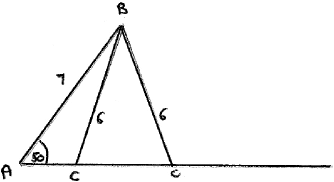
METHOD 1
\(\frac{6}{{\sin 50}} = \frac{7}{{\sin C}} \Rightarrow \sin C = \frac{{7\sin 50}}{6}\) (M1)
\(C = 63.344 \ldots \) (A1)
or\(\;\;\;C = 116.655 \ldots \) (A1)
\(B = 13.344 \ldots \;\;\;({\text{or }}B = 66.656 \ldots )\) (A1)
\({\text{area}} = \frac{1}{2} \times 6 \times 7 \times \sin 13.344 \ldots \;\;\;\left( {{\text{or }}\frac{1}{2} \times 6 \times 7 \times \sin 66.656 \ldots } \right)\) (M1)
\(4.846 \ldots \;\;\;({\text{or }} = 19.281 \ldots )\)
so answer is \(4.85{\text{ (c}}{{\text{m}}^2}{\text{)}}\) A1
METHOD 2
\({6^2} = {7^2} + {b^2} – 2 \times 7b\cos 50\) (M1)(A1)
\({b^2} – 14b\cos 50 + 13 = 0\;\;\;\)or equivalent method to solve the above equation (M1)
\(b = 7.1912821 \ldots \;\;\;{\text{or}}\;\;\;b = 1.807744 \ldots \) (A1)
\({\text{area}} = \frac{1}{2} \times 7 \times 1.8077 \ldots \sin 50 = 4.846 \ldots \) (M1)
\(\left( {{\text{or }}\frac{1}{2} \times 7 \times 7.1912821 \ldots \sin 50 = 19.281 \ldots } \right)\)
so answer is \(4.85{\text{ (c}}{{\text{m}}^2}{\text{)}}\) A1
METHOD 3
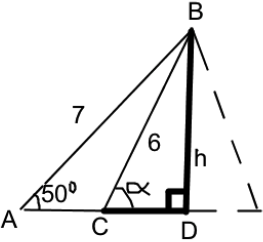
Diagram showing triangles \(ACB\) and \(ADB\) (M1)
\(h = 7\sin (50) = 5.3623 \ldots {\text{ (cm)}}\) (M1)
\(\alpha = \arcsin \frac{h}{6} = 63.3442 \ldots \) (M1)
\({\text{AC}} = {\text{AD}} – {\text{CD}} = 7\cos 50 – 6\cos \alpha = 1.8077 \ldots {\text{ (cm)}}\) (M1)
\({\text{area}} = \frac{1}{2} \times 1.8077 \ldots \times 5.3623 \ldots \) (M1)
\( = 4.85{\text{ (c}}{{\text{m}}^{\text{2}}}{\text{)}}\) A1
Total [6 marks]
Examiners report
Most candidates scored 4/6 showing that candidates do not have enough experience with the ambiguous case. Very few candidates drew a suitable diagram that would have illustrated this fact which could have helped them to understand the requirement that the answer should be less than 10. In fact many candidates ignored this requirement or used it incorrectly to solve an inequality.
Question
ABCD is a quadrilateral where \({\text{AB}} = 6.5,{\text{ BC}} = 9.1,{\text{ CD}} = 10.4,{\text{ DA}} = 7.8\) and \({\rm{C\hat DA}} = 90^\circ \). Find \({\rm{A\hat BC}}\), giving your answer correct to the nearest degree.
Answer/Explanation
Markscheme
\({\text{A}}{{\text{C}}^2} = {7.8^2} + {10.4^2}\) (M1)
\({\text{AC}} = 13\) (A1)
use of cosine rule eg, \(\cos ({\rm{A\hat BC}}) = \frac{{{{6.5}^2} + {{9.1}^2} – {{13}^2}}}{{2(6.5)(9.1)}}\) M1
\({\rm{A\hat BC}} = 111.804 \ldots ^\circ {\text{ }}( = 1.95134 \ldots )\) (A1)
\( = 112^\circ \) A1
[5 marks]
Examiners report
Well done by most candidates. A small number of candidates did not express the required angle correct to the nearest degree.
Question
In a triangle \({\text{ABC, AB}} = 4{\text{ cm, BC}} = 3{\text{ cm}}\) and \({\rm{B\hat AC}} = \frac{\pi }{9}\).
Use the cosine rule to find the two possible values for AC.
Find the difference between the areas of the two possible triangles ABC.
Answer/Explanation
Markscheme
METHOD 1
let \({\text{AC}} = x\)
\({3^2} = {x^2} + {4^2} – 8x\cos \frac{\pi }{9}\) M1A1
attempting to solve for \(x\) (M1)
\(x = 1.09,{\text{ }}6.43\) A1A1
METHOD 2
let \({\text{AC}} = x\)
using the sine rule to find a value of \(C\) M1
\({4^2} = {x^2} + {3^2} – 6x\cos (152.869 \ldots ^\circ ) \Rightarrow x = 1.09\) (M1)A1
\({4^2} = {x^2} + {3^2} – 6x\cos (27.131 \ldots ^\circ ) \Rightarrow x = 6.43\) (M1)A1
METHOD 3
let \({\text{AC}} = x\)
using the sine rule to find a value of \(B\) and a value of \(C\) M1
obtaining \(B = 132.869 \ldots ^\circ ,{\text{ }}7.131 \ldots ^\circ \) and \(C = 27.131 \ldots ^\circ ,{\text{ }}152.869 \ldots ^\circ \) A1
\((B = 2.319 \ldots ,{\text{ }}0.124 \ldots \) and \(C = 0.473 \ldots ,{\text{ }}2.668 \ldots )\)
attempting to find a value of \(x\) using the cosine rule (M1)
\(x = 1.09,{\text{ }}6.43\) A1A1
Note: Award M1A0(M1)A1A0 for one correct value of \(x\)
[5 marks]
\(\frac{1}{2} \times 4 \times 6.428 \ldots \times \sin \frac{\pi }{9}\) and \(\frac{1}{2} \times 4 \times 1.088 \ldots \times \sin \frac{\pi }{9}\) (A1)
(\(4.39747 \ldots \) and \(0.744833 \ldots \))
let \(D\) be the difference between the two areas
\(D = \frac{1}{2} \times 4 \times 6.428 \ldots \times \sin \frac{\pi }{9} – \frac{1}{2} \times 4 \times 1.088 \ldots \times \sin \frac{\pi }{9}\) (M1)
\((D = 4.39747 \ldots – 0.744833 \ldots )\)
\( = 3.65{\text{ (c}}{{\text{m}}^2})\) A1
[3 marks]
Examiners report
[N/A]
[N/A]
Question
In a triangle \({\text{ABC, AB}} = 4{\text{ cm, BC}} = 3{\text{ cm}}\) and \({\rm{B\hat AC}} = \frac{\pi }{9}\).
Use the cosine rule to find the two possible values for AC.
Find the difference between the areas of the two possible triangles ABC.
Answer/Explanation
Markscheme
METHOD 1
let \({\text{AC}} = x\)
\({3^2} = {x^2} + {4^2} – 8x\cos \frac{\pi }{9}\) M1A1
attempting to solve for \(x\) (M1)
\(x = 1.09,{\text{ }}6.43\) A1A1
METHOD 2
let \({\text{AC}} = x\)
using the sine rule to find a value of \(C\) M1
\({4^2} = {x^2} + {3^2} – 6x\cos (152.869 \ldots ^\circ ) \Rightarrow x = 1.09\) (M1)A1
\({4^2} = {x^2} + {3^2} – 6x\cos (27.131 \ldots ^\circ ) \Rightarrow x = 6.43\) (M1)A1
METHOD 3
let \({\text{AC}} = x\)
using the sine rule to find a value of \(B\) and a value of \(C\) M1
obtaining \(B = 132.869 \ldots ^\circ ,{\text{ }}7.131 \ldots ^\circ \) and \(C = 27.131 \ldots ^\circ ,{\text{ }}152.869 \ldots ^\circ \) A1
\((B = 2.319 \ldots ,{\text{ }}0.124 \ldots \) and \(C = 0.473 \ldots ,{\text{ }}2.668 \ldots )\)
attempting to find a value of \(x\) using the cosine rule (M1)
\(x = 1.09,{\text{ }}6.43\) A1A1
Note: Award M1A0(M1)A1A0 for one correct value of \(x\)
[5 marks]
\(\frac{1}{2} \times 4 \times 6.428 \ldots \times \sin \frac{\pi }{9}\) and \(\frac{1}{2} \times 4 \times 1.088 \ldots \times \sin \frac{\pi }{9}\) (A1)
(\(4.39747 \ldots \) and \(0.744833 \ldots \))
let \(D\) be the difference between the two areas
\(D = \frac{1}{2} \times 4 \times 6.428 \ldots \times \sin \frac{\pi }{9} – \frac{1}{2} \times 4 \times 1.088 \ldots \times \sin \frac{\pi }{9}\) (M1)
\((D = 4.39747 \ldots – 0.744833 \ldots )\)
\( = 3.65{\text{ (c}}{{\text{m}}^2})\) A1
[3 marks]
Examiners report
[N/A]
[N/A]
Question
Barry is at the top of a cliff, standing 80 m above sea level, and observes two yachts in the sea.
“Seaview” \((S)\) is at an angle of depression of 25°.
“Nauti Buoy” \((N)\) is at an angle of depression of 35°.
The following three dimensional diagram shows Barry and the two yachts at S and N.
X lies at the foot of the cliff and angle \({\text{SXN}} = \) 70°.
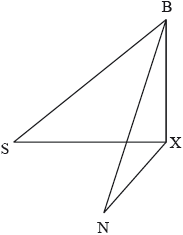
Find, to 3 significant figures, the distance between the two yachts.
Answer/Explanation
Markscheme
attempt to use tan, or sine rule, in triangle BXN or BXS (M1)
\({\text{NX}} = 80\tan 55{\rm{^\circ }}\left( { = \frac{{80}}{{\tan 35{\rm{^\circ }}}} = 114.25} \right)\) (A1)
\({\text{SX}} = 80\tan 65{\rm{^\circ }}\left( { = \frac{{80}}{{\tan 25{\rm{^\circ }}}} = 171.56} \right)\) (A1)
Attempt to use cosine rule M1
\({\text{S}}{{\text{N}}^2} = {171.56^2} + {114.25^2} – 2 \times 171.56 \times 114.25\cos 70\)° (A1)
\({\text{SN}} = 171{\text{ }}({\text{m}})\) A1
Note: Award final A1 only if the correct answer has been given to 3 significant figures.
[6 marks]
Examiners report
Question
A ship, S, is 10 km north of a motorboat, M, at 12.00pm. The ship is travelling northeast with a constant velocity of \(20{\text{ km}}\,{\text{h}}{{\text{r}}^{ – 1}}\). The motorboat wishes to intercept the ship and it moves with a constant velocity of \(30{\text{ km}}\,{\text{h}}{{\text{r}}^{ – 1}}\) in a direction \(\theta \) degrees east of north. In order for the interception to take place, determine
the value of \(\theta \).
the time at which the interception occurs, correct to the nearest minute.
Answer/Explanation
Markscheme
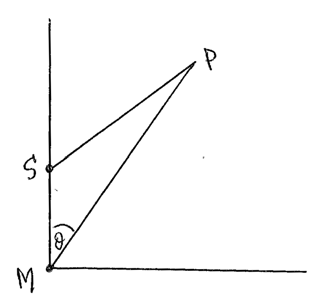
let the interception occur at the point P, t hrs after 12:00
then, SP = 20t and MP = 30t A1
using the sine rule,
\(\frac{{{\text{SP}}}}{{{\text{MP}}}} = \frac{2}{3} = \frac{{\sin \theta }}{{\sin 135}}\) M1A1
whence \(\theta = 28.1\) A1
[4 marks]
using the sine rule again,
\(\frac{{{\text{MP}}}}{{{\text{MS}}}} = \frac{{\sin 135}}{{\sin (45 – 28.1255 \ldots )}}\) M1A1
\(30t = 10 \times \frac{{\sin 135}}{{\sin 16.8745 \ldots }}\) M1
\(t = 0.81199 \ldots \) A1
the interception occurs at 12:49 A1
[5 marks]
Examiners report
[N/A]
[N/A]
Question
In triangle ABC, BC = a , AC = b , AB = c and [BD] is perpendicular to [AC].
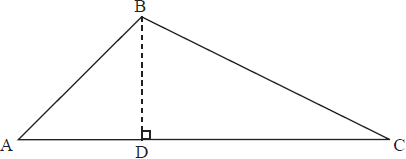
(a) Show that \({\text{CD}} = b – c\cos A\).
(b) Hence, by using Pythagoras’ Theorem in the triangle BCD, prove the cosine rule for the triangle ABC.
(c) If \({\rm{A\hat BC}} = 60^\circ \) , use the cosine rule to show that \(c = \frac{1}{2}a \pm \sqrt {{b^2} – \frac{3}{4}{a^2}} \) .
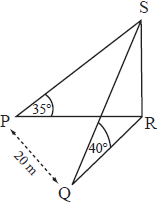
The above three dimensional diagram shows the points P and Q which are respectively west and south-west of the base R of a vertical flagpole RS on horizontal ground. The angles of elevation of the top S of the flagpole from P and Q are respectively 25° and 40° , and PQ = 20 m .
Determine the height of the flagpole.
Answer/Explanation
Markscheme
(a) \({\text{CD}} = {\text{AC}} – {\text{AD}} = b – c\cos A\) R1AG
[1 mark]
(b) METHOD 1
\({\text{B}}{{\text{C}}^2} = {\text{B}}{{\text{D}}^2} + {\text{C}}{{\text{D}}^2}\) (M1)
\({a^2} = {(c\sin A)^2} + {(b – c\cos A)^2}\) (A1)
\( = {c^2}{\sin ^2}A + {b^2} – 2bc\cos A + {c^2}{\cos ^2}A\) A1
\( = {b^2} + {c^2} – 2bc\cos A\) A1
[4 marks]
METHOD 2
\({\text{B}}{{\text{D}}^2} = {\text{A}}{{\text{B}}^2} – {\text{A}}{{\text{D}}^2} = {\text{B}}{{\text{C}}^2} – {\text{C}}{{\text{D}}^2}\) (M1)(A1)
\( \Rightarrow {c^2} – {c^2}{\cos ^2}A = {a^2} – {b^2} + 2bc\cos A – {c^2}{\cos ^2}A\) A1
\( \Rightarrow {a^2} = {b^2} + {c^2} – 2bc\cos A\) A1
[4 marks]
(c) METHOD 1
\({b^2} = {a^2} + {c^2} – 2ac\cos 60^\circ \Rightarrow {b^2} = {a^2} + {c^2} – ac\) (M1)A1
\( \Rightarrow {c^2} – ac + {a^2} – {b^2} = 0\) M1
\( \Rightarrow c = \frac{{a \pm \sqrt {{{( – a)}^2} – 4({a^2} – {b^2})} }}{2}\) (M1)A1
\( = \frac{{a \pm \sqrt {4{b^2} – 3{a^2}} }}{2} = \frac{a}{2} \pm \sqrt {\frac{{4{b^2} – 3{a^2}}}{4}} \) (M1)A1
\( = \frac{1}{2}a \pm \sqrt {{b^2} – \frac{3}{4}{a^2}} \) AG
Note: Candidates can only obtain a maximum of the first three marks if they verify that the answer given in the question satisfies the equation.
[7 marks]
METHOD 2
\({b^2} = {a^2} + {c^2} – 2ac\cos 60^\circ \Rightarrow {b^2} = {a^2} + {c^2} – ac\) (M1)A1
\({c^2} – ac = {b^2} – {a^2}\) (M1)
\({c^2} – ac + {\left( {\frac{a}{2}} \right)^2} = {b^2} – {a^2} + {\left( {\frac{a}{2}} \right)^2}\) M1A1
\({\left( {c – \frac{a}{2}} \right)^2} = {b^2} – \frac{3}{4}{a^2}\) (A1)
\(c – \frac{a}{2} = \pm \sqrt {{b^2} – \frac{3}{4}{a^2}} \) A1
\( \Rightarrow c = \frac{1}{2}a \pm \sqrt {{b^2} – \frac{3}{4}{a^2}} \) AG
[7 marks]
\({\text{PR}} = h\tan 55^\circ {\text{ , QR}} = h\tan 50^\circ {\text{ where RS}} = h\) M1A1A1
Use the cosine rule in triangle PQR. (M1)
\({20^2} = {h^2}{\tan ^2}55^\circ + {h^2}{\tan ^2}50^\circ – 2h\tan 55^\circ h\tan 50^\circ \cos 45^\circ \) A1
\({h^2} = \frac{{400}}{{{{\tan }^2}55^\circ + {{\tan }^2}50^\circ – 2\tan 55^\circ \tan 50^\circ \cos 45^\circ }}\) (A1)
\( = 379.9…\) (A1)
\(h = 19.5{\text{ (m)}}\) A1
[8 marks]
Examiners report
The majority of the candidates attempted part A of this question. Parts (a) and (b) were answered reasonably well. In part (c), many candidates scored the first two marks, but failed to recognize that the result was a quadratic equation, and hence did not progress further.
Correct answers to part B were rarely seen. Although many candidates expressed RS correctly in two different ways, they failed to go on to use the cosine rule.
Question
In the right circular cone below, O is the centre of the base which has radius 6 cm. The points B and C are on the circumference of the base of the cone. The height AO of the cone is 8 cm and the angle \({\rm{B\hat OC}}\) is 60°.
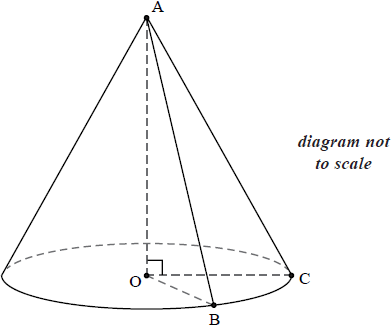
Calculate the size of the angle \({\rm{B\hat AC}}\).
Answer/Explanation
Markscheme
AC = AB = 10 (cm) A1
triangle OBC is equilateral (M1)
BC = 6 (cm) A1
EITHER
\({\rm{B\hat AC}} = 2\arcsin \frac{3}{{10}}\) M1A1
\({\rm{B\hat AC}} = 34.9^\circ \,\,\,\,\,\)(accept 0.609 radians) A1
OR
\(\cos {\rm{B\hat AC = }}\frac{{{{10}^2} + {{10}^2} – {6^2}}}{{2 \times 10 \times 10}} = \frac{{164}}{{200}}\) M1A1
\({\rm{B\hat AC}} = 34.9^\circ \,\,\,\,\,\)(accept 0.609 radians) A1
Note: Other valid methods may be seen.
[6 marks]
Examiners report
The question was generally well answered, but some students attempted to find the length of arc BC.
Question
Consider the triangle ABC where \({\rm{B\hat AC}} = 70^\circ \), AB = 8 cm and AC = 7 cm. The point D on the side BC is such that \(\frac{{{\text{BD}}}}{{{\text{DC}}}} = 2\).
Determine the length of AD.
Answer/Explanation
Markscheme
use of cosine rule: \({\text{BC}} = \sqrt {({8^2} + {7^2} – 2 \times 7 \times 8\cos 70)} = 8.6426 \ldots \) (M1)A1
Note: Accept an expression for \({\text{B}}{{\text{C}}^2}\).
\({\text{BD}} = 5.7617 \ldots \,\,\,\,\,{\text{(CD}} = 2.88085 \ldots )\) A1
use of sine rule: \(\hat B = \arcsin \left( {\frac{{7\sin 70}}{{{\text{BC}}}}} \right) = 49.561 \ldots ^\circ \,\,\,\,\,(\hat C = 60.4387 \ldots ^\circ )\) (M1)A1
use of cosine rule: \({\text{AD}} = \sqrt {{8^2} + {\text{B}}{{\text{D}}^2} – 2 \times {\text{BD}} \times 8\cos B} = 6.12{\text{ (cm)}}\) A1
Note: Scale drawing method not acceptable.
[6 marks]
Examiners report
Well done.
Question
Triangle ABC has AB = 5 cm, BC = 6 cm and area 10 \({\text{c}}{{\text{m}}^2}\).
(a) Find \(\sin \hat B\).
(b) Hence, find the two possible values of AC, giving your answers correct to two decimal places.
Answer/Explanation
Markscheme
(a) area \( = \frac{1}{2} \times {\text{BC}} \times {\text{AB}} \times \sin B\) (M1)
\(\left( {10 = \frac{1}{2} \times 5 \times 6 \times \sin B} \right)\)
\(\sin \hat B = \frac{2}{3}\) A1
(b) \(\cos B = \pm \frac{{\sqrt 5 }}{3}{\text{ }}( = \pm 0.7453 \ldots ){\text{ or }}B = 41.8 \ldots {\text{ and }}138.1 \ldots \) (A1)
\({\text{A}}{{\text{C}}^2} = {\text{B}}{{\text{C}}^2} + {\text{A}}{{\text{B}}^2} – 2 \times {\text{BC}} \times {\text{AB}} \times \cos B\) (M1)
\({\text{AC}} = \sqrt {{5^2} + {6^2} – 2 \times 5 \times 6 \times 0.7453 \ldots } {\text{ or }}\sqrt {{5^2} + {6^2} + 2 \times 5 \times 6 \times 0.7453 \ldots } \)
\({\text{AC}} = 4.03{\text{ or }}10.28\) A1A1
[6 marks]
Examiners report
Most candidates attempted this question and part (a) was answered correctly by most candidates but in (b), despite the wording of the question, the obtuse angle was often omitted leading to only one solution.
In many cases early rounding led to inaccuracy in the final answers and many candidates failed to round their answers to two decimal places as required.
Question
Given \(\Delta \)ABC, with lengths shown in the diagram below, find the length of the line segment [CD].
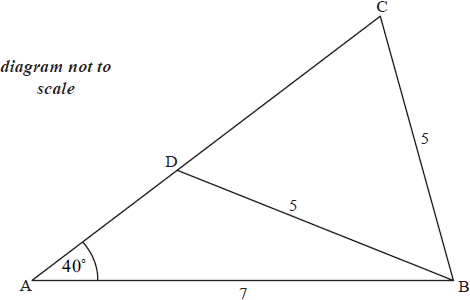
Answer/Explanation
Markscheme
METHOD 1
\(\frac{{\sin C}}{7} = \frac{{\sin 40}}{5}\) M1(A1)
\({\text{B}}\hat {\text{C}}{\text{D}} = 64.14…^\circ \) A1
\({\text{CD}} = 2 \times 5\cos 64.14…\) M1
Note: Also allow use of sine or cosine rule.
\({\text{CD}} = 4.36\) A1
[5 marks]
METHOD 2
let \({\text{AC}} = x\)
cosine rule
\({5^2} = {7^2} + {x^2} – 2 \times 7 \times x\cos 40\) M1A1
\({x^2} – 10.7 … x + 24 = 0\)
\(x = \frac{{10.7… \pm \sqrt {{{\left( {10.7…} \right)}^2} – 4 \times 24} }}{2}\) (M1)
\(x = 7.54\); \(3.18\) (A1)
CD is the difference in these two values \(= 4.36\) A1
Note: Other methods may be seen.
[5 marks]
Examiners report
This was an accessible question to most candidates although care was required when calculating the angles. Candidates who did not annotate the diagram or did not take care with the notation for the angles and sides often had difficulty recognizing when an angle was acute or obtuse. This prevented the candidate from obtaining a correct solution. There were many examples of candidates rounding answers prematurely and thus arriving at a final answer that was to the correct degree of accuracy but incorrect.
Question
The vertices of an equilateral triangle, with perimeter P and area A , lie on a circle with radius r . Find an expression for \(\frac{P}{A}\) in the form \(\frac{k}{r}\), where \(k \in {\mathbb{Z}^ + }\).
Answer/Explanation
Markscheme
let the length of one side of the triangle be x
consider the triangle consisting of a side of the triangle and two radii
EITHER
\({x^2} = {r^2} + {r^2} – 2{r^2}\cos 120^\circ \) M1
\( = 3{r^2}\)
OR
\(x = 2r\cos 30^\circ \) M1
THEN
\(x = r\sqrt 3 \) A1
so perimeter \( = 3\sqrt 3 r\) A1
now consider the area of the triangle
area \( = 3 \times \frac{1}{2}{r^2}\sin 120^\circ \) M1
\( = 3 \times \frac{{\sqrt 3 }}{4}{r^2}\) A1
\(\frac{P}{A} = \frac{{3\sqrt 3 r}}{{\frac{{3\sqrt 3 }}{4}{r^2}}}\)
\( = \frac{4}{r}\) A1
Note: Accept alternative methods
[6 marks]
Examiners report
It was pleasing to see some very slick solutions to this question. There were various reasons for the less successful attempts: not drawing a diagram; drawing a diagram, but putting one vertex of the triangle at the centre of the circle; drawing the circle inside the triangle; the side of the triangle being denoted by r the symbol used in the question for the radius of the circle.
Question
An electricity station is on the edge of a straight coastline. A lighthouse is located in the sea 200 m from the electricity station. The angle between the coastline and the line joining the lighthouse with the electricity station is 60°. A cable needs to be laid connecting the lighthouse to the electricity station. It is decided to lay the cable in a straight line to the coast and then along the coast to the electricity station. The length of cable laid along the coastline is x metres. This information is illustrated in the diagram below.
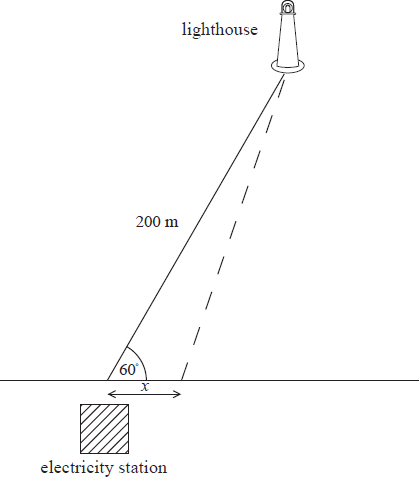
The cost of laying the cable along the sea bed is US$80 per metre, and the cost of laying it on land is US$20 per metre.
Find, in terms of x, an expression for the cost of laying the cable.
Find the value of x, to the nearest metre, such that this cost is minimized.
Answer/Explanation
Markscheme
let the distance the cable is laid along the seabed be y
\({y^2} = {x^2} + {200^2} – 2 \times x \times 200\cos 60^\circ \) (M1)
(or equivalent method)
\({y^2} = {x^2} – 200x + 40000\) (A1)
cost = C = 80y + 20x (M1)
\(C = 80{({x^2} – 200x + 40000)^{\frac{1}{2}}} + 20x\) A1
[4 marks]
\(x = 55.2786 \ldots = 55\) (m to the nearest metre) (A1)A1
\(\left( {x = 100 – \sqrt {2000} } \right)\)
[2 marks]
Examiners report
Some surprising misconceptions were evident here, using right angled trigonometry in non right angled triangles etc. Those that used the cosine rule, usually managed to obtain the correct answer to part (a).
Some surprising misconceptions were evident here, using right angled trigonometry in non right angled triangles etc. Many students attempted to find the value of the minimum algebraically instead of the simple calculator solution.
Question
A triangle \(ABC\) has \(\hat A = 50^\circ \), \({\text{AB}} = 7{\text{ cm}}\) and \({\text{BC}} = 6{\text{ cm}}\). Find the area of the triangle given that it is smaller than \(10{\text{ c}}{{\text{m}}^2}\).
Answer/Explanation
Markscheme
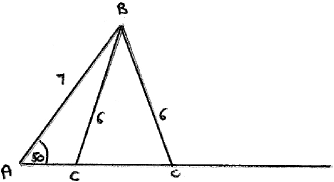
METHOD 1
\(\frac{6}{{\sin 50}} = \frac{7}{{\sin C}} \Rightarrow \sin C = \frac{{7\sin 50}}{6}\) (M1)
\(C = 63.344 \ldots \) (A1)
or\(\;\;\;C = 116.655 \ldots \) (A1)
\(B = 13.344 \ldots \;\;\;({\text{or }}B = 66.656 \ldots )\) (A1)
\({\text{area}} = \frac{1}{2} \times 6 \times 7 \times \sin 13.344 \ldots \;\;\;\left( {{\text{or }}\frac{1}{2} \times 6 \times 7 \times \sin 66.656 \ldots } \right)\) (M1)
\(4.846 \ldots \;\;\;({\text{or }} = 19.281 \ldots )\)
so answer is \(4.85{\text{ (c}}{{\text{m}}^2}{\text{)}}\) A1
METHOD 2
\({6^2} = {7^2} + {b^2} – 2 \times 7b\cos 50\) (M1)(A1)
\({b^2} – 14b\cos 50 + 13 = 0\;\;\;\)or equivalent method to solve the above equation (M1)
\(b = 7.1912821 \ldots \;\;\;{\text{or}}\;\;\;b = 1.807744 \ldots \) (A1)
\({\text{area}} = \frac{1}{2} \times 7 \times 1.8077 \ldots \sin 50 = 4.846 \ldots \) (M1)
\(\left( {{\text{or }}\frac{1}{2} \times 7 \times 7.1912821 \ldots \sin 50 = 19.281 \ldots } \right)\)
so answer is \(4.85{\text{ (c}}{{\text{m}}^2}{\text{)}}\) A1
METHOD 3
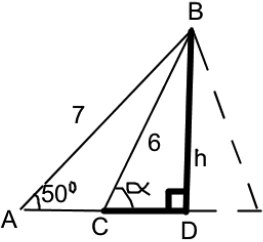
Diagram showing triangles \(ACB\) and \(ADB\) (M1)
\(h = 7\sin (50) = 5.3623 \ldots {\text{ (cm)}}\) (M1)
\(\alpha = \arcsin \frac{h}{6} = 63.3442 \ldots \) (M1)
\({\text{AC}} = {\text{AD}} – {\text{CD}} = 7\cos 50 – 6\cos \alpha = 1.8077 \ldots {\text{ (cm)}}\) (M1)
\({\text{area}} = \frac{1}{2} \times 1.8077 \ldots \times 5.3623 \ldots \) (M1)
\( = 4.85{\text{ (c}}{{\text{m}}^{\text{2}}}{\text{)}}\) A1
Total [6 marks]
Examiners report
Most candidates scored 4/6 showing that candidates do not have enough experience with the ambiguous case. Very few candidates drew a suitable diagram that would have illustrated this fact which could have helped them to understand the requirement that the answer should be less than 10. In fact many candidates ignored this requirement or used it incorrectly to solve an inequality.
Question
In triangle \({\text{ABC}}\), \({\text{AB}} = 5{\text{ cm}}\), \({\text{BC}} = 12{\text{ cm}}\) and \({\rm{A\hat BC}} = 100^\circ \).
Find the area of the triangle.
Find \(AC\).
Answer/Explanation
Markscheme
\(A = \frac{1}{2} \times 5 \times 12 \times \sin 100^\circ \) (M1)
\( = 29.5{\text{ (c}}{{\text{m}}^2}{\text{)}}\) A1
[2 marks]
\({\text{A}}{{\text{C}}^2} = {5^2} + {12^2} – 2 \times 5 \times 12 \times \cos 100^\circ \) (M1)
therefore \({\text{AC}} = 13.8{\text{ (cm)}}\) A1
[2 marks]
Total [4 marks]
Examiners report
[N/A]
[N/A]
Question
Triangle \(ABC\) has area \({\text{21 c}}{{\text{m}}^{\text{2}}}\). The sides \(AB\) and \(AC\) have lengths \(6\) cm and \(11\) cm respectively. Find the two possible lengths of the side \(BC\).
Answer/Explanation
Markscheme
\(21 = \frac{1}{2} \bullet 6 \bullet 11 \bullet \sin A\) (M1)
\(\sin A = \frac{7}{{11}}\) (A1)
EITHER
\(\hat A = 0.6897 \ldots ,{\text{ }}2.452 \ldots \left( {\hat A = \arcsin \frac{7}{{11}},{\text{ }}\pi – \arcsin \frac{7}{{11}} = 39.521 \ldots ^\circ ,{\text{ }}140.478 \ldots ^\circ } \right)\) (A1)
OR
\(\cos A = \pm \frac{{6\sqrt 2 }}{{11}}\;\;\;( = \pm 0.771 \ldots )\) (A1)
THEN
\({\text{B}}{{\text{C}}^2} = {6^2} + {11^2} – 2 \bullet 6 \bullet 11\cos A\) (M1)
\({\text{BC}} = 16.1\) or \(7.43\) A1A1
Note: Award M1A1A0M1A1A0 if only one correct solution is given.
[6 marks]
Examiners report
Question
ABCD is a quadrilateral where \({\text{AB}} = 6.5,{\text{ BC}} = 9.1,{\text{ CD}} = 10.4,{\text{ DA}} = 7.8\) and \({\rm{C\hat DA}} = 90^\circ \). Find \({\rm{A\hat BC}}\), giving your answer correct to the nearest degree.
Answer/Explanation
Markscheme
\({\text{A}}{{\text{C}}^2} = {7.8^2} + {10.4^2}\) (M1)
\({\text{AC}} = 13\) (A1)
use of cosine rule eg, \(\cos ({\rm{A\hat BC}}) = \frac{{{{6.5}^2} + {{9.1}^2} – {{13}^2}}}{{2(6.5)(9.1)}}\) M1
\({\rm{A\hat BC}} = 111.804 \ldots ^\circ {\text{ }}( = 1.95134 \ldots )\) (A1)
\( = 112^\circ \) A1
[5 marks]
Examiners report
Well done by most candidates. A small number of candidates did not express the required angle correct to the nearest degree.
Question
In a triangle \({\text{ABC, AB}} = 4{\text{ cm, BC}} = 3{\text{ cm}}\) and \({\rm{B\hat AC}} = \frac{\pi }{9}\).
Use the cosine rule to find the two possible values for AC.
Find the difference between the areas of the two possible triangles ABC.
Answer/Explanation
Markscheme
METHOD 1
let \({\text{AC}} = x\)
\({3^2} = {x^2} + {4^2} – 8x\cos \frac{\pi }{9}\) M1A1
attempting to solve for \(x\) (M1)
\(x = 1.09,{\text{ }}6.43\) A1A1
METHOD 2
let \({\text{AC}} = x\)
using the sine rule to find a value of \(C\) M1
\({4^2} = {x^2} + {3^2} – 6x\cos (152.869 \ldots ^\circ ) \Rightarrow x = 1.09\) (M1)A1
\({4^2} = {x^2} + {3^2} – 6x\cos (27.131 \ldots ^\circ ) \Rightarrow x = 6.43\) (M1)A1
METHOD 3
let \({\text{AC}} = x\)
using the sine rule to find a value of \(B\) and a value of \(C\) M1
obtaining \(B = 132.869 \ldots ^\circ ,{\text{ }}7.131 \ldots ^\circ \) and \(C = 27.131 \ldots ^\circ ,{\text{ }}152.869 \ldots ^\circ \) A1
\((B = 2.319 \ldots ,{\text{ }}0.124 \ldots \) and \(C = 0.473 \ldots ,{\text{ }}2.668 \ldots )\)
attempting to find a value of \(x\) using the cosine rule (M1)
\(x = 1.09,{\text{ }}6.43\) A1A1
Note: Award M1A0(M1)A1A0 for one correct value of \(x\)
[5 marks]
\(\frac{1}{2} \times 4 \times 6.428 \ldots \times \sin \frac{\pi }{9}\) and \(\frac{1}{2} \times 4 \times 1.088 \ldots \times \sin \frac{\pi }{9}\) (A1)
(\(4.39747 \ldots \) and \(0.744833 \ldots \))
let \(D\) be the difference between the two areas
\(D = \frac{1}{2} \times 4 \times 6.428 \ldots \times \sin \frac{\pi }{9} – \frac{1}{2} \times 4 \times 1.088 \ldots \times \sin \frac{\pi }{9}\) (M1)
\((D = 4.39747 \ldots – 0.744833 \ldots )\)
\( = 3.65{\text{ (c}}{{\text{m}}^2})\) A1
[3 marks]
Examiners report
[N/A]
[N/A]
Question
In a triangle \({\text{ABC, AB}} = 4{\text{ cm, BC}} = 3{\text{ cm}}\) and \({\rm{B\hat AC}} = \frac{\pi }{9}\).
Use the cosine rule to find the two possible values for AC.
Find the difference between the areas of the two possible triangles ABC.
Answer/Explanation
Markscheme
METHOD 1
let \({\text{AC}} = x\)
\({3^2} = {x^2} + {4^2} – 8x\cos \frac{\pi }{9}\) M1A1
attempting to solve for \(x\) (M1)
\(x = 1.09,{\text{ }}6.43\) A1A1
METHOD 2
let \({\text{AC}} = x\)
using the sine rule to find a value of \(C\) M1
\({4^2} = {x^2} + {3^2} – 6x\cos (152.869 \ldots ^\circ ) \Rightarrow x = 1.09\) (M1)A1
\({4^2} = {x^2} + {3^2} – 6x\cos (27.131 \ldots ^\circ ) \Rightarrow x = 6.43\) (M1)A1
METHOD 3
let \({\text{AC}} = x\)
using the sine rule to find a value of \(B\) and a value of \(C\) M1
obtaining \(B = 132.869 \ldots ^\circ ,{\text{ }}7.131 \ldots ^\circ \) and \(C = 27.131 \ldots ^\circ ,{\text{ }}152.869 \ldots ^\circ \) A1
\((B = 2.319 \ldots ,{\text{ }}0.124 \ldots \) and \(C = 0.473 \ldots ,{\text{ }}2.668 \ldots )\)
attempting to find a value of \(x\) using the cosine rule (M1)
\(x = 1.09,{\text{ }}6.43\) A1A1
Note: Award M1A0(M1)A1A0 for one correct value of \(x\)
[5 marks]
\(\frac{1}{2} \times 4 \times 6.428 \ldots \times \sin \frac{\pi }{9}\) and \(\frac{1}{2} \times 4 \times 1.088 \ldots \times \sin \frac{\pi }{9}\) (A1)
(\(4.39747 \ldots \) and \(0.744833 \ldots \))
let \(D\) be the difference between the two areas
\(D = \frac{1}{2} \times 4 \times 6.428 \ldots \times \sin \frac{\pi }{9} – \frac{1}{2} \times 4 \times 1.088 \ldots \times \sin \frac{\pi }{9}\) (M1)
\((D = 4.39747 \ldots – 0.744833 \ldots )\)
\( = 3.65{\text{ (c}}{{\text{m}}^2})\) A1
[3 marks]
Examiners report
[N/A]
[N/A]
Question
Barry is at the top of a cliff, standing 80 m above sea level, and observes two yachts in the sea.
“Seaview” \((S)\) is at an angle of depression of 25°.
“Nauti Buoy” \((N)\) is at an angle of depression of 35°.
The following three dimensional diagram shows Barry and the two yachts at S and N.
X lies at the foot of the cliff and angle \({\text{SXN}} = \) 70°.
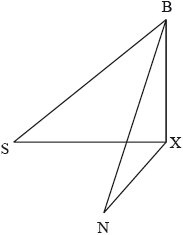
Find, to 3 significant figures, the distance between the two yachts.
Answer/Explanation
Markscheme
attempt to use tan, or sine rule, in triangle BXN or BXS (M1)
\({\text{NX}} = 80\tan 55{\rm{^\circ }}\left( { = \frac{{80}}{{\tan 35{\rm{^\circ }}}} = 114.25} \right)\) (A1)
\({\text{SX}} = 80\tan 65{\rm{^\circ }}\left( { = \frac{{80}}{{\tan 25{\rm{^\circ }}}} = 171.56} \right)\) (A1)
Attempt to use cosine rule M1
\({\text{S}}{{\text{N}}^2} = {171.56^2} + {114.25^2} – 2 \times 171.56 \times 114.25\cos 70\)° (A1)
\({\text{SN}} = 171{\text{ }}({\text{m}})\) A1
Note: Award final A1 only if the correct answer has been given to 3 significant figures.
[6 marks]
Examiners report
Question
Points A, B and C are on the circumference of a circle, centre O and radius \(r\) . A trapezium OABC is formed such that AB is parallel to OC, and the angle \({\rm{A}}\hat {\text{O}}{\text{C}}\) is \(\theta\) , \(\frac{\pi }{2} \leqslant \theta \leqslant \pi \) .
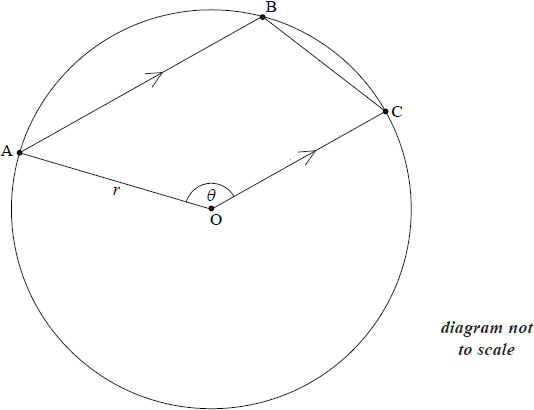
(a) Show that angle \({\rm{B\hat OC}}\) is \(\pi – \theta \).
(b) Show that the area, T, of the trapezium can be expressed as
\[T = \frac{1}{2}{r^2}\sin \theta – \frac{1}{2}{r^2}\sin 2\theta .\]
(c) (i) Show that when the area is maximum, the value of \(\theta \) satisfies
\[\cos \theta = 2\cos 2\theta .\]
(ii) Hence determine the maximum area of the trapezium when r = 1.
(Note: It is not required to prove that it is a maximum.)
Answer/Explanation
Markscheme
(a) \({\rm{O\hat AB}} = \pi – \theta \,\,\,\,\,\)(allied) A1
recognizing OAB as an isosceles triangle M1
so \({\rm{A\hat BO}} = \pi – \theta \)
\({\rm{B\hat OC}} = \pi – \theta \,\,\,\,\,\)(alternate) AG
Note: This can be done in many ways, including a clear diagram.
[3 marks]
(b) area of trapezium is \(T = {\text{are}}{{\text{a}}_{\Delta {\text{BOC}}}} + {\text{are}}{{\text{a}}_{\Delta {\text{AOB}}}}\) (M1)
\( = \frac{1}{2}{r^2}\sin (\pi – \theta ) + \frac{1}{2}{r^2}\sin (2\theta – \pi )\) M1A1
\( = \frac{1}{2}{r^2}\sin \theta – \frac{1}{2}{r^2}\sin 2\theta \) AG
[3 marks]
(c) (i) \(\frac{{{\text{d}}T}}{{{\text{d}}\theta }} = \frac{1}{2}{r^2}\cos \theta – {r^2}\cos 2\theta \) M1A1
for maximum area \(\frac{1}{2}{r^2}\cos \theta – {r^2}\cos 2\theta = 0\) M1
\(\cos \theta = 2\cos 2\theta \) AG
(ii) \({\theta _{\max }} = 2.205 \ldots \) (A1)
\(\frac{1}{2}\sin {\theta _{\max }} – \frac{1}{2}\sin 2{\theta _{\max }} = 0.880\) A1
[5 marks]
Total [11 marks]
Examiners report
In part (a) students had difficulties supporting their statements and were consequently unable to gain all the marks here. There were some good attempts at parts (b) and (c) although many students failed to recognise r as a constant and hence differentiated it, often incorrectly.
Question
Consider the planes \({\pi _1}:x – 2y – 3z = 2{\text{ and }}{\pi _2}:2x – y – z = k\) .
Find the angle between the planes \({\pi _1}\)and \({\pi _2}\) .
The planes \({\pi _1}\) and \({\pi _2}\) intersect in the line \({L_1}\) . Show that the vector equation of
\({L_1}\) is \(r = \left( {\begin{array}{*{20}{c}}
0\\
{2 – 3k}\\
{2k – 2}
\end{array}} \right) + t\left( {\begin{array}{*{20}{c}}
1\\
5\\
{ – 3}
\end{array}} \right)\)
The line \({L_2}\) has Cartesian equation \(5 – x = y + 3 = 2 – 2z\) . The lines \({L_1}\) and \({L_2}\) intersect at a point X. Find the coordinates of X.
Determine a Cartesian equation of the plane \({\pi _3}\) containing both lines \({L_1}\) and \({L_2}\) .
Let Y be a point on \({L_1}\) and Z be a point on \({L_2}\) such that XY is perpendicular to YZ and the area of the triangle XYZ is 3. Find the perimeter of the triangle XYZ.
Answer/Explanation
Markscheme
Note: Accept alternative notation for vectors (eg \(\langle a{\text{, }}b{\text{, }}c\rangle {\text{ or }}\left( {a{\text{, }}b{\text{, }}c} \right)\)).
\(\boldsymbol{n} = \left( {\begin{array}{*{20}{c}}
1 \\
{ – 2} \\
{ – 3}
\end{array}} \right)\) and \(\boldsymbol{m} = \left( {\begin{array}{*{20}{c}}
2 \\
{ – 1} \\
{ – 1}
\end{array}} \right)\) (A1)
\(\cos \theta = \frac{{\boldsymbol{n} \cdot \boldsymbol{m}}}{{\left| \boldsymbol{n} \right|\left| \boldsymbol{m} \right|}}\) (M1)
\(\cos \theta = \frac{{2 + 2 + 3}}{{\sqrt {1 + 4 + 9} \sqrt {4 + 1 + 1} }} = \frac{7}{{\sqrt {14} \sqrt 6 }}\) A1
\(\theta = 40.2^\circ \,\,\,\,\,(0.702{\text{ rad}})\) A1
[4 marks]
Note: Accept alternative notation for vectors (eg \(\langle a{\text{, }}b{\text{, }}c\rangle {\text{ or }}\left( {a{\text{, }}b{\text{, }}c} \right)\)).
METHOD 1
eliminate z from x – 2y – 3z = 2 and 2x – y – z = k
\(5x – y = 3k – 2 \Rightarrow x = \frac{{y – (2 – 3k)}}{5}\) M1A1
eliminate y from x – 2y – 3z = 2 and 2x – y – z = k
\(3x + z = 2k – 2 \Rightarrow x = \frac{{z – (2k – 2)}}{{ – 3}}\) A1
x = t, y = (2 − 3k) + 5t and z = (2k − 2) − 3t A1A1
\(r = \left( {\begin{array}{*{20}{c}}
0\\
{2 – 3k}\\
{2k – 2}
\end{array}} \right) + t\left( {\begin{array}{*{20}{c}}
1\\
5\\
{ – 3}
\end{array}} \right)\) AG
[5 marks]
METHOD 2
\(\left( {\begin{array}{*{20}{c}}
1\\
{ – 2}\\
{ – 3}
\end{array}} \right) \times \left( {\begin{array}{*{20}{c}}
2\\
{ – 1}\\
{ – 1}
\end{array}} \right) = \left( {\begin{array}{*{20}{c}}
{ – 1}\\
{ – 5}\\
3
\end{array}} \right) \Rightarrow {\text{direction is }}\left( {\begin{array}{*{20}{c}}
1\\
5\\
{ – 3}
\end{array}} \right)\) M1A1
Let x = 0
\(0 – 2y – 3z = 2{\text{ and }}2 \times 0 – y – z = k\) (M1)
solve simultaneously (M1)
\(y = 2 – 3k{\text{ and }}z = 2k – 2\) A1
therefore r \( = \left( {\begin{array}{*{20}{c}}
0\\
{2 – 3k}\\
{2k – 2}
\end{array}} \right) + t\left( {\begin{array}{*{20}{c}}
1\\
5\\
{ – 3}
\end{array}} \right)\) AG
[5 marks]
METHOD 3
substitute \(x = t,{\text{ }}y = (2 – 3k) + 5t{\text{ and }}z = (2k – 2) – 3t{\text{ into }}{\pi _1}{\text{ and }}{\pi _2}\) M1
for \({\pi _1}:t – 2(2 – 3k + 5t) – 3(2k – 2 – 3t) = 2\) A1
for \({\pi _2}:2t – (2 – 3k + 5t) – (2k – 2 – 3t) = k\) A1
the planes have a unique line of intersection R2
therefore the line is \(r = \left( {\begin{array}{*{20}{c}}
0\\
{2 – 3k}\\
{2k – 2}
\end{array}} \right) + t\left( {\begin{array}{*{20}{c}}
1\\
5\\
{ – 3}
\end{array}} \right)\) AG
[5 marks]
Note: Accept alternative notation for vectors (eg \(\langle a{\text{, }}b{\text{, }}c\rangle {\text{ or }}\left( {a{\text{, }}b{\text{, }}c} \right)\)).
\(5 – t = (2 – 3k + 5t) + 3 = 2 – 2(2k – 2 – 3t)\) M1A1
Note: Award M1A1 if candidates use vector or parametric equations of \({L_2}\)
eg \(\left( {\begin{array}{*{20}{c}}
0\\
{2 – 3k}\\
{2k – 2}
\end{array}} \right) + t\left( {\begin{array}{*{20}{c}}
1\\
5\\
{ – 3}
\end{array}} \right) = \left( {\begin{array}{*{20}{c}}
5\\
{ – 3}\\
1
\end{array}} \right) + s\left( {\begin{array}{*{20}{c}}
{ – 2}\\
2\\
{ – 1}
\end{array}} \right)\) or \( \Rightarrow \left\{ {\begin{array}{*{20}{l}}
{t = 5 – 2s}\\
{2 – 3k + 5t = – 3 + 2s}\\
{2k – 2 – 3t = 1 + s}
\end{array}} \right.\)
solve simultaneously M1
\(k = 2,{\text{ }}t = 1{\text{ }}(s = 2)\) A1
intersection point (\(1\), \(1\), \( – 1\)) A1
[5 marks]
Note: Accept alternative notation for vectors (eg \(\langle a{\text{, }}b{\text{, }}c\rangle {\text{ or }}\left( {a{\text{, }}b{\text{, }}c} \right)\)).
\({\overrightarrow l _2} = \left( {\begin{array}{*{20}{c}}
2\\
{ – 2}\\
1
\end{array}} \right)\) A1
\({\overrightarrow l _1} \times {\overrightarrow l _2} = \left| {\begin{array}{*{20}{c}}
\boldsymbol{i}&\boldsymbol{j}&\boldsymbol{k}\\
1&5&{ – 3}\\
2&{ – 2}&1
\end{array}} \right| = \left( {\begin{array}{*{20}{c}}
{ – 1}\\
{ – 7}\\
{ – 12}
\end{array}} \right)\) (M1)A1
\(\boldsymbol{r} \cdot \left( {\begin{array}{*{20}{c}}
1\\
7\\
{12}
\end{array}} \right) = \left( {\begin{array}{*{20}{c}}
1\\
1\\
{ – 1}
\end{array}} \right) \cdot \left( {\begin{array}{*{20}{c}}
1\\
7\\
{12}
\end{array}} \right)\) (M1)
\(x + 7y + 12z = – 4\) A1
[5 marks]
Note: Accept alternative notation for vectors (eg \(\langle a{\text{, }}b{\text{, }}c\rangle {\text{ or }}\left( {a{\text{, }}b{\text{, }}c} \right)\)).
Let \(\theta \) be the angle between the lines \({\overrightarrow l _1} = \left( {\begin{array}{*{20}{c}}
1\\
5\\
{ – 3}
\end{array}} \right)\) and \({\overrightarrow l _2} = \left( {\begin{array}{*{20}{c}}
2\\
{ – 2}\\
1
\end{array}} \right)\)
\(\cos \theta = \frac{{\left| {2 – 10 – 3} \right|}}{{\sqrt {35} \sqrt 9 }} \Rightarrow \theta = 0.902334…{\text{ }}51.699…^\circ )\) (M1)
as the triangle XYZ has a right angle at Y,
\({\text{XZ}} = a \Rightarrow {\text{YZ}} = a\sin \theta {\text{ and XY}} = a\cos \theta \) (M1)
\({\text{area = 3}} \Rightarrow \frac{{{a^2}\sin \theta \cos \theta }}{2} = 3\) (M1)
\(a = 3.5122…\) (A1)
perimeter \( = a + a\sin \theta + a\cos \theta = 8.44537… = 8.45\) A1
Note: If candidates attempt to find coordinates of Y and Z award M1 for expression of vector YZ in terms of two parameters, M1 for attempt to use perpendicular condition to determine relation between parameters, M1 for attempt to use the area to find the parameters and A2 for final answer.
[5 marks]
Examiners report
Although this was the last question in part B, it was answered surprisingly well by many candidates, except for part (e). Even those who had not done so well elsewhere often gained a number of marks in some parts of the question. Nevertheless the presence of parameters seemed to have blocked the abilities of weaker candidates to solve situations in which vectors were involved. Mathematical skills for this particular question were sometimes remarkable, however, calculations proved incomplete due to the way that planes were presented. Most candidates found a correct angle in part (a). Occasional arithmetic errors in calculating the magnitude of a vector and dot product occurred. In part (b) the vector product approach was popular. In some case candidates simply verified the result by substitution. There was a lot of simultaneous equation solving, much of which was not very pretty. In part (c), a number of candidates made errors when attempting to solve a system of equations involving parameters. Many of the results for the point were found in terms of k. It was notorious that candidates did not use their GDC to try to find the coordinates of the intersection point between lines. In part (d), a number of candidates used an incorrect point but this part was often done well.
Very few excellent answers to part (e) were seen using an efficient method. Most candidates attempted methods involving heavy algebraic manipulation and had little success in this part of the question.
Although this was the last question in part B, it was answered surprisingly well by many candidates, except for part (e). Even those who had not done so well elsewhere often gained a number of marks in some parts of the question. Nevertheless the presence of parameters seemed to have blocked the abilities of weaker candidates to solve situations in which vectors were involved. Mathematical skills for this particular question were sometimes remarkable, however, calculations proved incomplete due to the way that planes were presented. Most candidates found a correct angle in part (a). Occasional arithmetic errors in calculating the magnitude of a vector and dot product occurred. In part (b) the vector product approach was popular. In some case candidates simply verified the result by substitution. There was a lot of simultaneous equation solving, much of which was not very pretty. In part (c), a number of candidates made errors when attempting to solve a system of equations involving parameters. Many of the results for the point were found in terms of k. It was notorious that candidates did not use their GDC to try to find the coordinates of the intersection point between lines. In part (d), a number of candidates used an incorrect point but this part was often done well.
Very few excellent answers to part (e) were seen using an efficient method. Most candidates attempted methods involving heavy algebraic manipulation and had little success in this part of the question.
Although this was the last question in part B, it was answered surprisingly well by many candidates, except for part (e). Even those who had not done so well elsewhere often gained a number of marks in some parts of the question. Nevertheless the presence of parameters seemed to have blocked the abilities of weaker candidates to solve situations in which vectors were involved. Mathematical skills for this particular question were sometimes remarkable, however, calculations proved incomplete due to the way that planes were presented. Most candidates found a correct angle in part (a). Occasional arithmetic errors in calculating the magnitude of a vector and dot product occurred. In part (b) the vector product approach was popular. In some case candidates simply verified the result by substitution. There was a lot of simultaneous equation solving, much of which was not very pretty. In part (c), a number of candidates made errors when attempting to solve a system of equations involving parameters. Many of the results for the point were found in terms of k. It was notorious that candidates did not use their GDC to try to find the coordinates of the intersection point between lines. In part (d), a number of candidates used an incorrect point but this part was often done well.
Very few excellent answers to part (e) were seen using an efficient method. Most candidates attempted methods involving heavy algebraic manipulation and had little success in this part of the question.
Although this was the last question in part B, it was answered surprisingly well by many candidates, except for part (e). Even those who had not done so well elsewhere often gained a number of marks in some parts of the question. Nevertheless the presence of parameters seemed to have blocked the abilities of weaker candidates to solve situations in which vectors were involved. Mathematical skills for this particular question were sometimes remarkable, however, calculations proved incomplete due to the way that planes were presented. Most candidates found a correct angle in part (a). Occasional arithmetic errors in calculating the magnitude of a vector and dot product occurred. In part (b) the vector product approach was popular. In some case candidates simply verified the result by substitution. There was a lot of simultaneous equation solving, much of which was not very pretty. In part (c), a number of candidates made errors when attempting to solve a system of equations involving parameters. Many of the results for the point were found in terms of k. It was notorious that candidates did not use their GDC to try to find the coordinates of the intersection point between lines. In part (d), a number of candidates used an incorrect point but this part was often done well.
Very few excellent answers to part (e) were seen using an efficient method. Most candidates attempted methods involving heavy algebraic manipulation and had little success in this part of the question.
Although this was the last question in part B, it was answered surprisingly well by many candidates, except for part (e). Even those who had not done so well elsewhere often gained a number of marks in some parts of the question. Nevertheless the presence of parameters seemed to have blocked the abilities of weaker candidates to solve situations in which vectors were involved. Mathematical skills for this particular question were sometimes remarkable, however, calculations proved incomplete due to the way that planes were presented. Most candidates found a correct angle in part (a). Occasional arithmetic errors in calculating the magnitude of a vector and dot product occurred. In part (b) the vector product approach was popular. In some case candidates simply verified the result by substitution. There was a lot of simultaneous equation solving, much of which was not very pretty. In part (c), a number of candidates made errors when attempting to solve a system of equations involving parameters. Many of the results for the point were found in terms of k. It was notorious that candidates did not use their GDC to try to find the coordinates of the intersection point between lines. In part (d), a number of candidates used an incorrect point but this part was often done well.
Very few excellent answers to part (e) were seen using an efficient method. Most candidates attempted methods involving heavy algebraic manipulation and had little success in this part of the question.
Question
Compactness is a measure of how compact an enclosed region is.
The compactness, \(C\) , of an enclosed region can be defined by \(C = \frac{{4A}}{{\pi {d^2}}}\), where \(A\) is the area of the region and \(d\) is the maximum distance between any two points in the region.
For a circular region, \(C = 1\).
Consider a regular polygon of \(n\) sides constructed such that its vertices lie on the circumference of a circle of diameter \(x\) units.
If \(n > 2\) and even, show that \(C = \frac{n}{{2\pi }}\sin \frac{{2\pi }}{n}\).
If \(n > 1\) and odd, it can be shown that \(C = \frac{{n\sin \frac{{2\pi }}{n}}}{{\pi \left( {1 + \cos \frac{\pi }{n}} \right)}}\).
Find the regular polygon with the least number of sides for which the compactness is more than \(0.99\).
If \(n > 1\) and odd, it can be shown that \(C = \frac{{n\sin \frac{{2\pi }}{n}}}{{\pi \left( {1 + \cos \frac{\pi }{n}} \right)}}\).
Comment briefly on whether C is a good measure of compactness.
Answer/Explanation
Markscheme
each triangle has area \(\frac{1}{8}{x^2}\sin \frac{{2\pi }}{n}\;\;\;({\text{use of }}\frac{1}{2}ab\sin C)\) (M1)
there are \(n\) triangles so \(A = \frac{1}{8}n{x^2}\sin \frac{{2\pi }}{n}\) A1
\(C = \frac{{4\left( {\frac{1}{8}n{x^2}\sin \frac{{2\pi }}{n}} \right)}}{{\pi {n^2}}}\) A1
so \(C = \frac{n}{{2\pi }}\sin \frac{{2\pi }}{n}\) AG
[3 marks]
attempting to find the least value of \(n\) such that \(\frac{n}{{2\pi }}\sin \frac{{2\pi }}{n} > 0.99\) (M1)
\(n = 26\) A1
attempting to find the least value of \(n\) such that \(\frac{{n\sin \frac{{2\pi }}{n}}}{{\pi \left( {1 + \cos \frac{\pi }{n}} \right)}} > 0.99\) (M1)
\(n = 21\) (and so a regular polygon with 21 sides) A1
Note: Award (M0)A0(M1)A1 if \(\frac{n}{{2\pi }}\sin \frac{{2\pi }}{n} > 0.99\) is not considered and \(\frac{{n\sin \frac{{2\pi }}{n}}}{{\pi \left( {1 + \cos \frac{\pi }{n}} \right)}} > 0.99\) is correctly considered.
Award (M1)A1(M0)A0 for \(n = 26\).
[4 marks]
EITHER
for even and odd values of n, the value of C seems to increase towards the limiting value of the circle \((C = 1)\) ie as n increases, the polygonal regions get closer and closer to the enclosing circular region R1
OR
the differences between the odd and even values of n illustrate that this measure of compactness is not a good one. R1
Examiners report
Most candidates found this a difficult question with a large number of candidates either not attempting it or making little to no progress. In part (a), a number of candidates attempted to show the desired result using specific regular polygons. Some candidates attempted to fudge the result.
In part (b), the overwhelming majority of candidates that obtained either \(n = 21\) or \(n = 26\) or both used either a GDC numerical solve feature or a graphical approach rather than a tabular approach which is more appropriate for a discrete variable such as the number of sides of a regular polygon. Some candidates wasted valuable time by showing that \(C = \frac{{n\sin \frac{{2\pi }}{n}}}{{\pi \left( {1 + \cos \frac{\pi }{n}} \right)}}\) (a given result).
In part (c), the occasional candidate correctly commented that \(C \) was a good measure of compactness either because the value of \(C \) seemed to approach the limiting value of the circle as \(n \) increased or commented that \(C \) was not a good measure because of the disparity in \(C \)-values between even and odd values of \(n \).
Question
Consider the triangle \({\text{PQR}}\) where \({\rm{Q\hat PR = 30^\circ }}\), \({\text{PQ}} = (x + 2){\text{ cm}}\) and \({\text{PR}} = {(5 – x)^2}{\text{ cm}}\), where \( – 2 < x < 5\).
Show that the area, \(A\;{\text{c}}{{\text{m}}^2}\), of the triangle is given by \(A = \frac{1}{4}({x^3} – 8{x^2} + 5x + 50)\).
(i) State \(\frac{{{\text{d}}A}}{{{\text{d}}x}}\).
(ii) Verify that \(\frac{{{\text{d}}A}}{{{\text{d}}x}} = 0\) when \(x = \frac{1}{3}\).
(i) Find \(\frac{{{{\text{d}}^2}A}}{{{\text{d}}{x^2}}}\) and hence justify that \(x = \frac{1}{3}\) gives the maximum area of triangle \(PQR\).
(ii) State the maximum area of triangle \(PQR\).
(iii) Find \(QR\) when the area of triangle \(PQR\) is a maximum.
Answer/Explanation
Markscheme
use of \(A = \frac{1}{2}qr\sin \theta \) to obtain \(A = \frac{1}{2}(x + 2){(5 – x)^2}\sin 30^\circ \) M1
\( = \frac{1}{4}(x + 2)(25 – 10x + {x^2})\) A1
\(A = \frac{1}{4}({x^3} – 8{x^2} + 5x + 50)\) AG
[2 marks]
(i) \(\frac{{{\text{d}}A}}{{{\text{d}}x}} = \frac{1}{4}(3{x^2} – 16x + 5) = \frac{1}{4}(3x – 1)(x – 5)\) A1
(ii) METHOD 1
EITHER
\(\frac{{{\text{d}}A}}{{{\text{d}}x}} = \frac{1}{4}\left( {3{{\left( {\frac{1}{3}} \right)}^2} – 16\left( {\frac{1}{3}} \right) + 5} \right) = 0\) M1A1
OR
\(\frac{{{\text{d}}A}}{{{\text{d}}x}} = \frac{1}{4}\left( {3\left( {\frac{1}{3}} \right) – 1} \right)\left( {\left( {\frac{1}{3}} \right) – 5} \right) = 0\) M1A1
THEN
so \(\frac{{{\text{d}}A}}{{{\text{d}}x}} = 0\) when \(x = \frac{1}{3}\) AG
METHOD 2
solving \(\frac{{{\text{d}}A}}{{{\text{d}}x}} = 0\) for \(x\) M1
\( – 2 < x < 5 \Rightarrow x = \frac{1}{3}\) A1
so \(\frac{{{\text{d}}A}}{{{\text{d}}x}} = 0\) when \(x = \frac{1}{3}\) AG
METHOD 3
a correct graph of \(\frac{{{\text{d}}A}}{{{\text{d}}x}}\) versus \(x\) M1
the graph clearly showing that \(\frac{{{\text{d}}A}}{{{\text{d}}x}} = 0\) when \(x = \frac{1}{3}\) A1
so \(\frac{{{\text{d}}A}}{{{\text{d}}x}} = 0\) when \(x = \frac{1}{3}\) AG
[3 marks]
(i) \(\frac{{{{\text{d}}^2}A}}{{{\text{d}}{x^2}}} = \frac{1}{2}(3x – 8)\) A1
for \(x = \frac{1}{3},{\text{ }}\frac{{{{\text{d}}^2}A}}{{{\text{d}}{x^2}}} = – 3.5{\text{ }}( < 0)\) R1
so \(x = \frac{1}{3}\) gives the maximum area of triangle \(PQR\) AG
(ii) \({A_{\max }} = \frac{{343}}{{27}}{\text{ }}( = 12.7){\text{ (c}}{{\text{m}}^2}{\text{)}}\) A1
(iii) \({\text{PQ}} = \frac{7}{3}{\text{ (cm)}}\) and \({\text{PR}} = {\left( {\frac{{14}}{3}} \right)^2}{\text{ (cm)}}\) (A1)
\({\text{Q}}{{\text{R}}^2} = {\left( {\frac{7}{3}} \right)^2} + {\left( {\frac{{14}}{3}} \right)^4} – 2\left( {\frac{7}{3}} \right){\left( {\frac{{14}}{3}} \right)^2}\cos 30^\circ \) (M1)(A1)
\( = 391.702 \ldots \)
\({\text{QR = 19.8 (cm)}}\) A1
[7 marks]
Total [12 marks]
Examiners report
This question was generally well done. Parts (a) and (b) were straightforward and well answered.
This question was generally well done. Parts (c) (i) and (ii) were also well answered with most candidates correctly applying the second derivative test and displaying sound reasoning skills.
Part (c) (iii) required the use of the cosine rule and was reasonably well done. The most common error committed by candidates in attempting to find the value of \(QR\) was to use \({\text{PR}} = \frac{{14}}{3}{\text{ (cm)}}\) rather than \({\text{PR}} = {\left( {\frac{{14}}{3}} \right)^2}{\text{ (cm)}}\). The occasional candidate used \(\cos 30^\circ = \frac{1}{2}\).
Question
A triangle \(ABC\) has \(\hat A = 50^\circ \), \({\text{AB}} = 7{\text{ cm}}\) and \({\text{BC}} = 6{\text{ cm}}\). Find the area of the triangle given that it is smaller than \(10{\text{ c}}{{\text{m}}^2}\).
Answer/Explanation
Markscheme
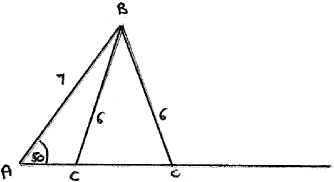
METHOD 1
\(\frac{6}{{\sin 50}} = \frac{7}{{\sin C}} \Rightarrow \sin C = \frac{{7\sin 50}}{6}\) (M1)
\(C = 63.344 \ldots \) (A1)
or\(\;\;\;C = 116.655 \ldots \) (A1)
\(B = 13.344 \ldots \;\;\;({\text{or }}B = 66.656 \ldots )\) (A1)
\({\text{area}} = \frac{1}{2} \times 6 \times 7 \times \sin 13.344 \ldots \;\;\;\left( {{\text{or }}\frac{1}{2} \times 6 \times 7 \times \sin 66.656 \ldots } \right)\) (M1)
\(4.846 \ldots \;\;\;({\text{or }} = 19.281 \ldots )\)
so answer is \(4.85{\text{ (c}}{{\text{m}}^2}{\text{)}}\) A1
METHOD 2
\({6^2} = {7^2} + {b^2} – 2 \times 7b\cos 50\) (M1)(A1)
\({b^2} – 14b\cos 50 + 13 = 0\;\;\;\)or equivalent method to solve the above equation (M1)
\(b = 7.1912821 \ldots \;\;\;{\text{or}}\;\;\;b = 1.807744 \ldots \) (A1)
\({\text{area}} = \frac{1}{2} \times 7 \times 1.8077 \ldots \sin 50 = 4.846 \ldots \) (M1)
\(\left( {{\text{or }}\frac{1}{2} \times 7 \times 7.1912821 \ldots \sin 50 = 19.281 \ldots } \right)\)
so answer is \(4.85{\text{ (c}}{{\text{m}}^2}{\text{)}}\) A1
METHOD 3

Diagram showing triangles \(ACB\) and \(ADB\) (M1)
\(h = 7\sin (50) = 5.3623 \ldots {\text{ (cm)}}\) (M1)
\(\alpha = \arcsin \frac{h}{6} = 63.3442 \ldots \) (M1)
\({\text{AC}} = {\text{AD}} – {\text{CD}} = 7\cos 50 – 6\cos \alpha = 1.8077 \ldots {\text{ (cm)}}\) (M1)
\({\text{area}} = \frac{1}{2} \times 1.8077 \ldots \times 5.3623 \ldots \) (M1)
\( = 4.85{\text{ (c}}{{\text{m}}^{\text{2}}}{\text{)}}\) A1
Total [6 marks]
Examiners report
Most candidates scored 4/6 showing that candidates do not have enough experience with the ambiguous case. Very few candidates drew a suitable diagram that would have illustrated this fact which could have helped them to understand the requirement that the answer should be less than 10. In fact many candidates ignored this requirement or used it incorrectly to solve an inequality.
Question
In triangle \({\text{ABC}}\), \({\text{AB}} = 5{\text{ cm}}\), \({\text{BC}} = 12{\text{ cm}}\) and \({\rm{A\hat BC}} = 100^\circ \).
Find the area of the triangle.
Find \(AC\).
Answer/Explanation
Markscheme
\(A = \frac{1}{2} \times 5 \times 12 \times \sin 100^\circ \) (M1)
\( = 29.5{\text{ (c}}{{\text{m}}^2}{\text{)}}\) A1
[2 marks]
\({\text{A}}{{\text{C}}^2} = {5^2} + {12^2} – 2 \times 5 \times 12 \times \cos 100^\circ \) (M1)
therefore \({\text{AC}} = 13.8{\text{ (cm)}}\) A1
[2 marks]
Total [4 marks]
Examiners report
[N/A]
[N/A]
Question
Triangle \(ABC\) has area \({\text{21 c}}{{\text{m}}^{\text{2}}}\). The sides \(AB\) and \(AC\) have lengths \(6\) cm and \(11\) cm respectively. Find the two possible lengths of the side \(BC\).
Answer/Explanation
Markscheme
\(21 = \frac{1}{2} \bullet 6 \bullet 11 \bullet \sin A\) (M1)
\(\sin A = \frac{7}{{11}}\) (A1)
EITHER
\(\hat A = 0.6897 \ldots ,{\text{ }}2.452 \ldots \left( {\hat A = \arcsin \frac{7}{{11}},{\text{ }}\pi – \arcsin \frac{7}{{11}} = 39.521 \ldots ^\circ ,{\text{ }}140.478 \ldots ^\circ } \right)\) (A1)
OR
\(\cos A = \pm \frac{{6\sqrt 2 }}{{11}}\;\;\;( = \pm 0.771 \ldots )\) (A1)
THEN
\({\text{B}}{{\text{C}}^2} = {6^2} + {11^2} – 2 \bullet 6 \bullet 11\cos A\) (M1)
\({\text{BC}} = 16.1\) or \(7.43\) A1A1
Note: Award M1A1A0M1A1A0 if only one correct solution is given.
[6 marks]
Examiners report
Question
ABCD is a quadrilateral where \({\text{AB}} = 6.5,{\text{ BC}} = 9.1,{\text{ CD}} = 10.4,{\text{ DA}} = 7.8\) and \({\rm{C\hat DA}} = 90^\circ \). Find \({\rm{A\hat BC}}\), giving your answer correct to the nearest degree.
Answer/Explanation
Markscheme
\({\text{A}}{{\text{C}}^2} = {7.8^2} + {10.4^2}\) (M1)
\({\text{AC}} = 13\) (A1)
use of cosine rule eg, \(\cos ({\rm{A\hat BC}}) = \frac{{{{6.5}^2} + {{9.1}^2} – {{13}^2}}}{{2(6.5)(9.1)}}\) M1
\({\rm{A\hat BC}} = 111.804 \ldots ^\circ {\text{ }}( = 1.95134 \ldots )\) (A1)
\( = 112^\circ \) A1
[5 marks]
Examiners report
Well done by most candidates. A small number of candidates did not express the required angle correct to the nearest degree.
Question
In a triangle \({\text{ABC, AB}} = 4{\text{ cm, BC}} = 3{\text{ cm}}\) and \({\rm{B\hat AC}} = \frac{\pi }{9}\).
Use the cosine rule to find the two possible values for AC.
Find the difference between the areas of the two possible triangles ABC.
Answer/Explanation
Markscheme
METHOD 1
let \({\text{AC}} = x\)
\({3^2} = {x^2} + {4^2} – 8x\cos \frac{\pi }{9}\) M1A1
attempting to solve for \(x\) (M1)
\(x = 1.09,{\text{ }}6.43\) A1A1
METHOD 2
let \({\text{AC}} = x\)
using the sine rule to find a value of \(C\) M1
\({4^2} = {x^2} + {3^2} – 6x\cos (152.869 \ldots ^\circ ) \Rightarrow x = 1.09\) (M1)A1
\({4^2} = {x^2} + {3^2} – 6x\cos (27.131 \ldots ^\circ ) \Rightarrow x = 6.43\) (M1)A1
METHOD 3
let \({\text{AC}} = x\)
using the sine rule to find a value of \(B\) and a value of \(C\) M1
obtaining \(B = 132.869 \ldots ^\circ ,{\text{ }}7.131 \ldots ^\circ \) and \(C = 27.131 \ldots ^\circ ,{\text{ }}152.869 \ldots ^\circ \) A1
\((B = 2.319 \ldots ,{\text{ }}0.124 \ldots \) and \(C = 0.473 \ldots ,{\text{ }}2.668 \ldots )\)
attempting to find a value of \(x\) using the cosine rule (M1)
\(x = 1.09,{\text{ }}6.43\) A1A1
Note: Award M1A0(M1)A1A0 for one correct value of \(x\)
[5 marks]
\(\frac{1}{2} \times 4 \times 6.428 \ldots \times \sin \frac{\pi }{9}\) and \(\frac{1}{2} \times 4 \times 1.088 \ldots \times \sin \frac{\pi }{9}\) (A1)
(\(4.39747 \ldots \) and \(0.744833 \ldots \))
let \(D\) be the difference between the two areas
\(D = \frac{1}{2} \times 4 \times 6.428 \ldots \times \sin \frac{\pi }{9} – \frac{1}{2} \times 4 \times 1.088 \ldots \times \sin \frac{\pi }{9}\) (M1)
\((D = 4.39747 \ldots – 0.744833 \ldots )\)
\( = 3.65{\text{ (c}}{{\text{m}}^2})\) A1
[3 marks]
Examiners report
[N/A]
[N/A]
Question
In a triangle \({\text{ABC, AB}} = 4{\text{ cm, BC}} = 3{\text{ cm}}\) and \({\rm{B\hat AC}} = \frac{\pi }{9}\).
Use the cosine rule to find the two possible values for AC.
Find the difference between the areas of the two possible triangles ABC.
Answer/Explanation
Markscheme
METHOD 1
let \({\text{AC}} = x\)
\({3^2} = {x^2} + {4^2} – 8x\cos \frac{\pi }{9}\) M1A1
attempting to solve for \(x\) (M1)
\(x = 1.09,{\text{ }}6.43\) A1A1
METHOD 2
let \({\text{AC}} = x\)
using the sine rule to find a value of \(C\) M1
\({4^2} = {x^2} + {3^2} – 6x\cos (152.869 \ldots ^\circ ) \Rightarrow x = 1.09\) (M1)A1
\({4^2} = {x^2} + {3^2} – 6x\cos (27.131 \ldots ^\circ ) \Rightarrow x = 6.43\) (M1)A1
METHOD 3
let \({\text{AC}} = x\)
using the sine rule to find a value of \(B\) and a value of \(C\) M1
obtaining \(B = 132.869 \ldots ^\circ ,{\text{ }}7.131 \ldots ^\circ \) and \(C = 27.131 \ldots ^\circ ,{\text{ }}152.869 \ldots ^\circ \) A1
\((B = 2.319 \ldots ,{\text{ }}0.124 \ldots \) and \(C = 0.473 \ldots ,{\text{ }}2.668 \ldots )\)
attempting to find a value of \(x\) using the cosine rule (M1)
\(x = 1.09,{\text{ }}6.43\) A1A1
Note: Award M1A0(M1)A1A0 for one correct value of \(x\)
[5 marks]
\(\frac{1}{2} \times 4 \times 6.428 \ldots \times \sin \frac{\pi }{9}\) and \(\frac{1}{2} \times 4 \times 1.088 \ldots \times \sin \frac{\pi }{9}\) (A1)
(\(4.39747 \ldots \) and \(0.744833 \ldots \))
let \(D\) be the difference between the two areas
\(D = \frac{1}{2} \times 4 \times 6.428 \ldots \times \sin \frac{\pi }{9} – \frac{1}{2} \times 4 \times 1.088 \ldots \times \sin \frac{\pi }{9}\) (M1)
\((D = 4.39747 \ldots – 0.744833 \ldots )\)
\( = 3.65{\text{ (c}}{{\text{m}}^2})\) A1
[3 marks]
Examiners report
[N/A]
[N/A]
Question
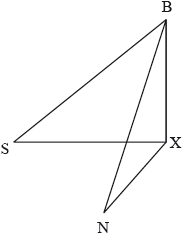
Barry is at the top of a cliff, standing 80 m above sea level, and observes two yachts in the sea.
“Seaview” \((S)\) is at an angle of depression of 25°.
“Nauti Buoy” \((N)\) is at an angle of depression of 35°.
The following three dimensional diagram shows Barry and the two yachts at S and N.
X lies at the foot of the cliff and angle \({\text{SXN}} = \) 70°.
Find, to 3 significant figures, the distance between the two yachts.
Answer/Explanation
Markscheme
attempt to use tan, or sine rule, in triangle BXN or BXS (M1)
\({\text{NX}} = 80\tan 55{\rm{^\circ }}\left( { = \frac{{80}}{{\tan 35{\rm{^\circ }}}} = 114.25} \right)\) (A1)
\({\text{SX}} = 80\tan 65{\rm{^\circ }}\left( { = \frac{{80}}{{\tan 25{\rm{^\circ }}}} = 171.56} \right)\) (A1)
Attempt to use cosine rule M1
\({\text{S}}{{\text{N}}^2} = {171.56^2} + {114.25^2} – 2 \times 171.56 \times 114.25\cos 70\)° (A1)
\({\text{SN}} = 171{\text{ }}({\text{m}})\) A1
Note: Award final A1 only if the correct answer has been given to 3 significant figures.
[6 marks]
